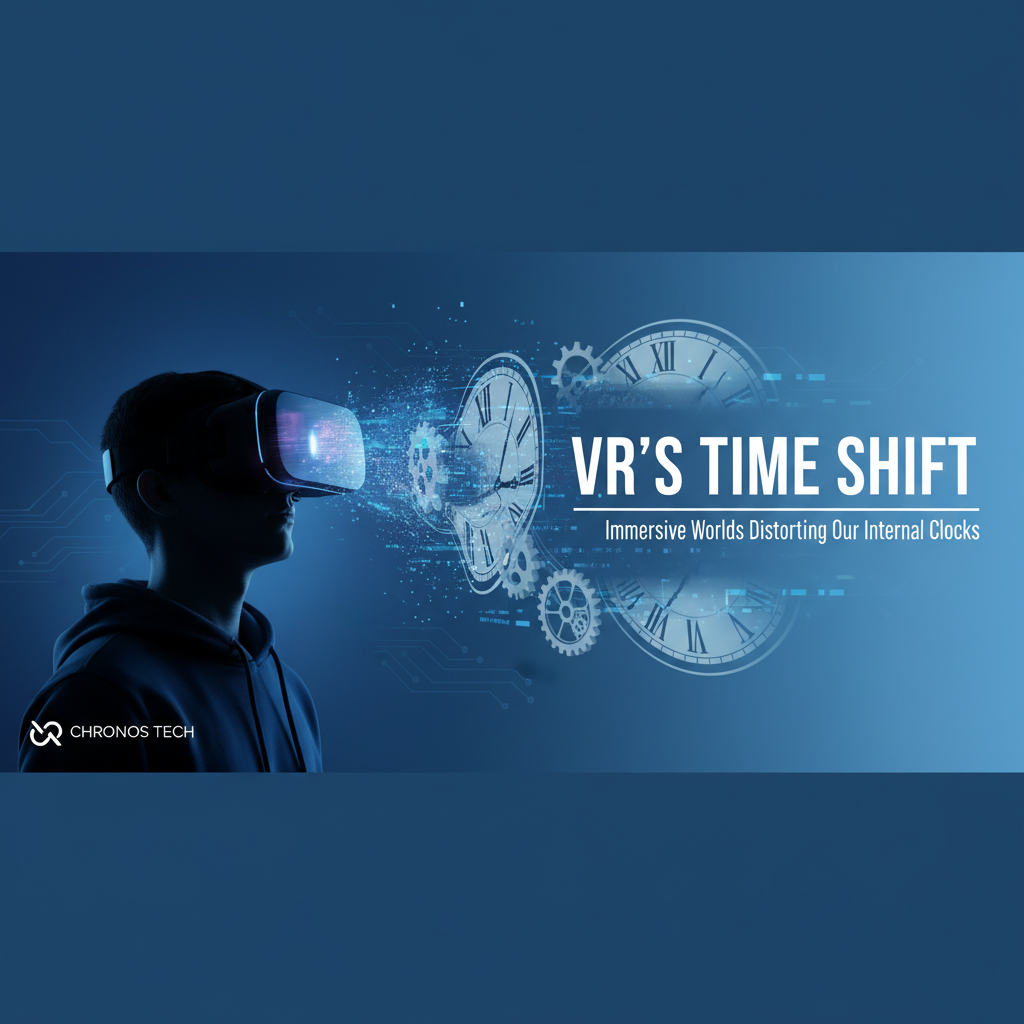
VR's Time Shift: Immersive Worlds Distorting Our Internal Clocks
 Dominic Mueller
VR's Time Shift: Immersive Worlds Distorting Our Internal Clocks
Step into a virtual reality (VR) headset, and you don't just enter a new environment; you might just enter a new time zone altogether. The flickering pixels and spatial audio of VR aren't merely visual and auditory stimuli; they are powerful architects reshaping our most fundamental perception: that of time itself. What feels like mere minutes inside a captivating VR experience can stretch into hours in the real world, leaving us disoriented and wondering where the day went. Conversely, a grueling task in VR might feel interminable, despite only a short duration in physical reality.
This phenomenon, often dubbed "VR's time shift," isn't just a quirky side effect of advanced technology; it's a fascinating area of interdisciplinary research, blending psychology, neuroscience, and computer science. As VR becomes increasingly sophisticated and integrated into our lives – from gaming and entertainment to training, therapy, and even work – understanding how these digital realms manipulate our internal clocks becomes not just academic but profoundly practical. This article delves into the intriguing ways VR distorts our perception of time, explores the underlying mechanisms, and ponders the implications for our digital futures.
The Elusive Nature of Time: A Quick Primer
Before we explore how VR messes with time, it's crucial to understand that our perception of time is inherently subjective and malleable. Unlike the objective, ticking hands of a clock, our internal clock – often referred to as the "chronometer of the mind" – is a complex interplay of various cognitive and physiological processes.
- No Single "Time Organ": There isn't one specific organ in our brain dedicated solely to time perception. Instead, a distributed network involving areas like the cerebellum, basal ganglia, prefrontal cortex, and hippocampus all contribute.
- Context is King: Our emotional state, level of attention, engagement, physiological arousal, and even our age significantly influence how quickly or slowly time seems to pass.
- The "Flow State": When we are deeply engrossed in an activity, time often seems to fly. This is known as the "flow state," a psychological concept where a person is fully immersed in a feeling of energized focus, full involvement, and enjoyment in the process of the activity. VR is a potent generator of flow.
- Retrospective vs. Prospective Time: We perceive time differently during an event (prospective) compared to after it (retrospective). An exciting event might feel brief while it's happening but seem long in retrospect because of the richness of memories created.
VR doesn't just mimic reality; it creates a new one, complete with its own set of rules for how our minds process the passage of moments.
How VR Bends the Arrow of Time: Key Mechanisms
So, what exactly is it about VR that so effectively warps our temporal experience? Several factors contribute to this phenomenon:
1. Immersion and Presence: The Ultimate Distractors
The defining characteristic of VR is its unparalleled ability to generate a sense of immersion and presence. Immersion refers to the objective quality of the technology (e.g., field of view, resolution, tracking accuracy), while presence is the subjective psychological state of feeling like you are "there" in the virtual environment.
- Sensory Overload (in a good way): VR typically isolates us from external sensory input (the real world) while bombarding our senses with a consistent, coherent virtual world. Our vision is filled, our hearing is dominated by spatial audio, and haptic feedback can even simulate touch. This comprehensive sensory input monopolizes our attentional resources.
- Loss of Real-World Cues: In VR, we often lose access to real-world time cues like the position of the sun, ambient sounds from outside (e.g., street noise, family members), or even glancing at a physical clock. Without these anchors, our internal clock becomes more susceptible to the virtual world's influence.
- Heightened Focus: The novelty and interactivity of VR experiences demand high levels of attention and cognitive resources. When our brains are fully occupied processing new stimuli, solving puzzles, or reacting to virtual threats, there's less cognitive bandwidth available to actively monitor the passage of time. This intense focus directly contributes to the "time flies when you're having fun" effect.
2. Novelty and Information Density
New experiences tend to make time feel longer in retrospect because our brains encode more novel information. While in a novel VR world, time might fly due to engagement, after the experience, we might remember it as a rich, extended period. This is because our memory for an event is often tied to the number of distinct memories or "chapters" we form. A VR experience, by its very nature, is often packed with novel sights, sounds, and interactions.
3. Emotional Arousal and Physiological State
VR is exceptionally good at eliciting strong emotional responses – joy, fear, excitement, wonder, or even anxiety.
- Adrenaline and Excitement: Fast-paced VR games or thrilling experiences can trigger an adrenaline rush. Physiological arousal (increased heart rate, heightened alertness) can accelerate our internal clock, making perceived time shorten during the experience. This aligns with research suggesting that during stressful or exciting events, time can appear to speed up.
- Anxiety and Boredom: Conversely, a frustrating VR experience, or one that induces motion sickness, can make time feel like it's dragging. When uncomfortable or bored, our attention is drawn to the passage of time itself, making every second feel longer.
4. Manipulation of Pace and Events within VR
Game developers and VR creators can intentionally or unintentionally manipulate time perception through the design of their virtual worlds:
- Event Density: A VR experience packed with rapid-fire events, quick transitions, and constant stimuli will make time feel faster. Conversely, a sparse, slow-paced environment with long periods of inaction can make time crawl.
- Sensory Rhythms: The rhythm of background music, the frequency of visual changes, or even the speed of movement through a virtual landscape can subconsciously influence our internal tempo.
- Narrative Flow: Engaging storylines and compelling narratives can create a "flow state" where we are so engrossed that we lose track of time. This is a common tactic in traditional media, amplified in VR.
5. Proprioception and Vestibular Mismatch (Motion Sickness)
Our bodies have an internal sense of position and movement (proprioception) and balance (vestibular system). In VR, these systems can get conflicting signals. We might see ourselves moving rapidly through a virtual environment, but our physical body remains stationary. This sensory mismatch is a primary cause of motion sickness (sim sickness).
- Distress and Time: When experiencing motion sickness, the brain is working overtime to resolve the sensory conflict, often leading to feelings of discomfort and unease. This state of distress can draw attention to the unpleasant passage of time, making minutes feel like hours. For individuals suffering from VR sickness, time drags miserably.
Research Insights: Peeking Behind the Temporal Curtain
Scientists are actively investigating the "VR time shift" phenomenon. Here are some interesting findings:
- Studies by Mel Slater and Colleagues: Pioneering work in VR research has consistently demonstrated the strong relationship between presence in VR and distorted time perception. Participants who reported higher levels of "being there" in a virtual environment often underestimated the actual duration they spent in VR.
- Increased Time Dilation for Negative Experiences: Some research suggests that negative or stressful VR experiences might lead to even greater time dilation (i.e., time feeling longer) than neutral or positive ones, supporting the idea that discomfort makes us more aware of time's passage.
- Cognitive Load: Studies have shown that when a VR task demands high cognitive load (e.g., complex problem-solving, rapid decision-making), users tend to underestimate the actual time spent, as their attention is fully consumed by the task itself.
- Future Applications in Therapy: Understanding VR's impact on time perception could have therapeutic benefits. For instance, in pain management, making time feel shorter during painful procedures could reduce suffering. Conversely, in rehabilitation, extending the perceived duration of a task could motivate patients to continue.
Interesting Fact: A study published in Frontiers in Virtual Reality explored how varying the apparent speed of objects in VR could influence time perception. Participants generally perceived the duration of an event to be shorter when objects in the virtual scene moved faster, suggesting our brain's internal clock is indeed sensitive to the pace of the virtual world.
Practical Takeaways and Insights
Understanding VR's time-bending capabilities isn't just an academic exercise. It has tangible implications for users, developers, and even our daily routines.
For VR Users: Mindful Immersion
- Set Alarms: If you have real-world commitments, set a timer or alarm before entering VR. Don't rely on your internal clock.
- Take Regular Breaks: Prolonged VR sessions can lead to eye strain, fatigue, and disorientation. Regularly step out of VR, even if for just a few minutes, to re-calibrate your senses and internal clock.
- Stay Hydrated and Aware of Your Body: VR can be physically demanding. Pay attention to thirst, hunger, and physical discomfort, as these cues might be suppressed by your deep immersion.
- Manage Expectations: Be aware that "losing track of time" is a common VR experience. Don't feel guilty about it; rather, plan for it.
For VR Developers: Designing for Temporal Awareness
- Integrate Subtle Time Cues: Consider adding unobtrusive visual or auditory cues that indicate the passage of time. This could be a gradually changing skybox, subtle ambient sound variations, or even a discreet, optional virtual clock.
- Vary Pacing Strategically: For longer experiences, vary the pace to prevent either extreme boredom or overwhelming sensory input, which can both distort time negatively.
- Provide Save Points/Breaks: Design experiences with natural stopping points or opportunities for players to easily pause and take a break without feeling like they are interrupting the flow too much.
- Minimize Motion Sickness: A top priority. As discussed, motion sickness can severely impact perceived time, making an experience feel much longer and more unpleasant. Smooth locomotion, comfort options, and clear spatial anchors are key.
- Consider Therapeutic Applications: For VR applications in therapy or training, intentionally manipulating time perception could be a powerful tool. Shortening perceived time for painful procedures or lengthening it for cognitive tasks could be beneficial.
Broader Societal Implications
- Productivity and Work: As VR enters the workplace (e.g., virtual meetings, collaborative design), understanding how it impacts task duration and perceived efficiency will be critical. Could a 30-minute VR meeting feel like an hour, leading to fatigue? Or could an hour of complex design feel like minutes, boosting productivity?
- Education: Could VR be used to make learning feel faster and more engaging, or to allow students to "experience" history for what feels like hours in a shorter real-world time?
- Ethics of Manipulation: As we gain more control over manipulating time perception in VR, ethical questions will arise. How much is too much? When does clever design cross into manipulative territory?
The Future: Will VR Redefine Our Relationship with Time?
The ability of VR to distort our perception of time is more than a novelty; it's a profound demonstration of how deeply intertwined our subjective experience is with the environments we inhabit. As VR technology continues to advance – becoming lighter, more realistic, and offering even broader sensory feedback (e.g., haptics, olfactory stimulation) – its influence on our internal clocks will only intensify.
Imagine a future where you can step into a virtual training simulation that compresses weeks of real-world learning into what feels like a few intense days. Or where you can relax in a tranquil virtual landscape, experiencing hours of calm in just 30 minutes of real time. These possibilities, while exciting, also raise important questions about our psychological well-being and our relationship with objective reality.
The lines between the real and the virtual are already blurring. Our internal clocks, once reliably tied to the rhythms of the physical world, are now increasingly susceptible to the artificial cadences of digital realms. Understanding this "VR time shift" is not just about comprehending a technological quirk; it's about preparing for a future where our most fundamental perceptions, including that of time itself, are continually being re-engineered by the immersive worlds we create. The clock in VR doesn't just tick; it dances to a different beat, inviting us to lose ourselves, quite literally, in another dimension of time.
Make Every Second Count
Inspired by this article? Take action now! Create a custom timer to help you manage your time better and reach your goals.
Create Your TimerAbout Dominic Mueller
Dominic Mueller is a German director for television and film with a deep fascination for time and time measurement. When he's not behind the camera crafting compelling visual stories, he explores the intricate world of temporal perception and timekeeping. Based in the beautiful city of Cologne, Germany, Dominic shares his life with his girlfriend and their beloved dog, Nala, finding inspiration in both the precise mechanics of time and the fleeting moments that make life meaningful.