Haptic Time: Feeling the Future's Precision Clock Signals
 Dominic Mueller
Haptic Time: Feeling the Future's Precision Clock Signals
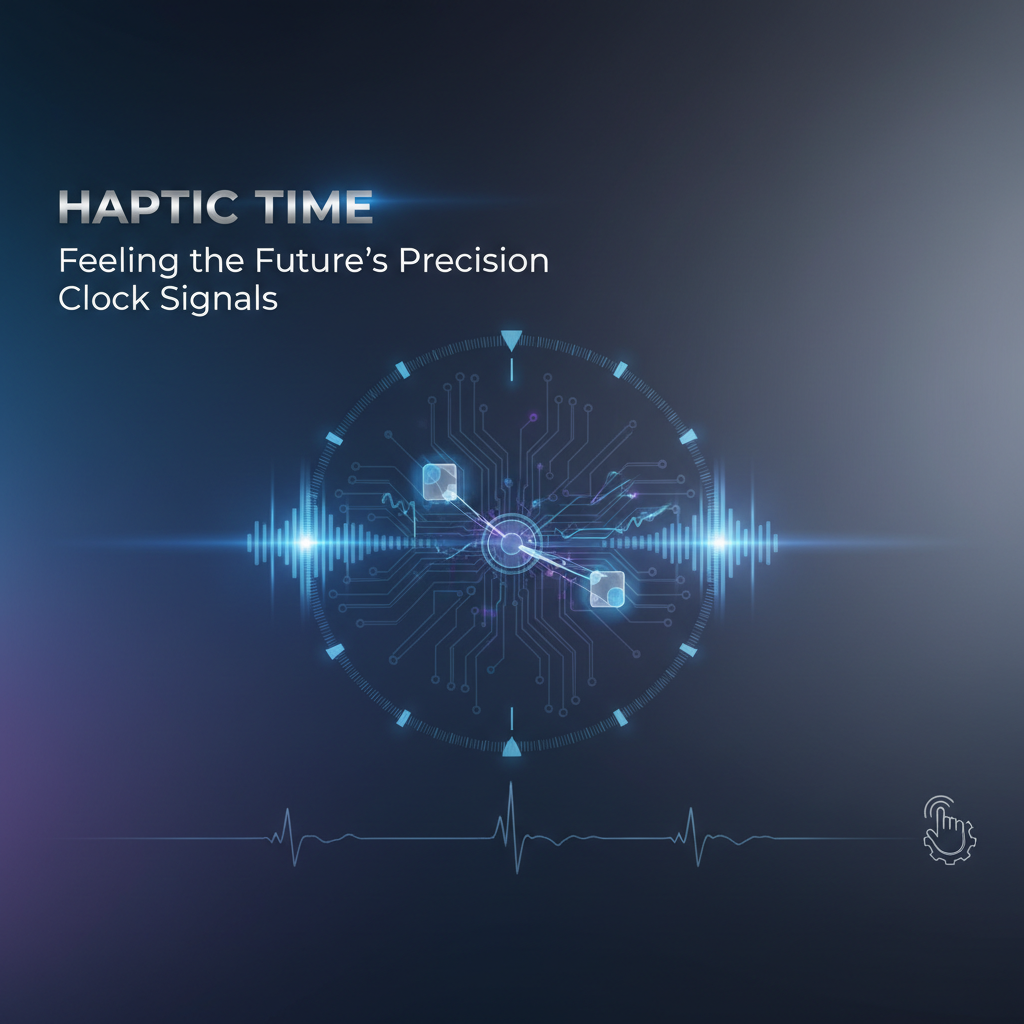
Imagine a world where you don't just see or hear time, but feel it. A world where the subtle vibrations on your wrist or the delicate pressure on your fingertip communicate the precise tick of a global clock, synchronizing your every action with an invisible yet omnipresent rhythm. This isn't science fiction; it's the nascent, exciting field of Haptic Time.
In an increasingly connected and automated world, precision timing is paramount. From the synchronization of global financial markets to the coordinated movements of autonomous vehicles, from the deep-space navigation of probes to the delicate operations within our own bodies, time is the invisible conductor orchestrating every event. But as we push the boundaries of accuracy, how do humans, often the weakest link in the timing chain, interact with these ultra-precise signals? Haptic Time offers a revolutionary answer, transforming abstract numerical data into tangible, perceivable sensations.
This article will delve into the concept of Haptic Time, exploring its underlying principles, current applications, future potential, and the profound implications it holds for human-technology interaction and our very perception of time.
The Foundation: Why Precision Time Matters
Before we can appreciate "feeling" time, we must understand why time precision has become such a critical technological frontier.
- Global Navigation Satellite Systems (GNSS) like GPS: Your smartphone's location accuracy relies on atomic clocks aboard satellites. Even a nanosecond error can translate to a foot of positional error.
- 5G and Future Communications: Ultra-reliable low-latency communication (URLLC), a hallmark of 5G, demands extremely tight synchronization between base stations and devices, often in the order of nanoseconds.
- Financial Trading: High-frequency trading platforms use timestamps accurate to microseconds to execute millions of transactions daily. A lack of synchronization can lead to market inefficiencies or even unfair advantages.
- Power Grids: Synchronizing power generation and distribution across vast networks prevents outages and optimizes efficiency.
- Scientific Research: From particle accelerators to radio astronomy, experiments often require time synchronization across immense distances and with incredible precision to capture fleeting phenomena.
- Autonomous Systems: Self-driving cars, drones, and robots need to perfectly synchronize their sensor data and actions to navigate complex environments safely and effectively.
For decades, we've relied on visual displays, auditory alerts, and network protocols to convey time. But as precision requirements escalate, these methods often fall short, particularly when direct human interpretation is needed, or when conditions (like low light, high noise, or cognitive overload) make traditional interfaces impractical. This is where haptics enters the fray, offering a direct, intuitive, and often subconscious channel for time information.
What is Haptic Time? Bridging the Digital-Sensory Divide
At its core, Haptic Time refers to the use of touch-based feedback (haptics) to convey timing information or to synchronize human actions with external, often highly precise, clock signals. Instead of seeing a clock or hearing a metronome, you feel the rhythm, the pulse, or the precise moment.
This isn't just about a simple vibration. Modern haptics leverage sophisticated actuators and algorithms to create a rich tapestry of tactile sensations:
- Varying Frequencies: Different vibration frequencies can denote different units of time (e.g., a low rumble for an hour, a sharp buzz for a minute).
- Amplitude Modulation: The intensity of a vibration can indicate the proximity to a timed event or the "strength" of a synchronization signal.
- Spatial Haptics: Arrays of haptic actuators can direct pulses to specific parts of the body, creating a sense of direction or sequence in time.
- Texture Playback: Advanced haptics can simulate textures, potentially conveying the "smoothness" of a continuous time flow or the "roughness" of a misaligned signal.
- Kinesthetic Feedback: Force feedback, though less common for pure "time" signals, can guide movements in time-critical tasks.
The goal is to move beyond simple alerts and towards a more nuanced, intuitive, and even subconscious perception of time, allowing humans to integrate high-precision timing into their natural movements and cognitive processes.
Current Applications and Emerging Research
While the term "Haptic Time" might be new, the underlying principles are already at play in several fascinating areas:
- Wearable Metronomes for Musicians: Professional musicians often use wearable metronomes that provide silent, haptic cues, allowing them to maintain perfect tempo without auditory distractions. This is a rudimentary form of haptic time synchronization.
- Surgical Precision: In minimally invasive surgery, haptic feedback can guide a surgeon's hand, ensuring instruments are moved with precise timing and force, especially in complex, time-sensitive maneuvers. Research explores using haptic pulses to indicate the ideal moment for a cut or a stitch.
- Sports Training: Athletes, particularly in disciplines requiring highly synchronized movements (e.g., rowing, synchronized swimming, golf swings), can benefit from haptic devices that provide real-time timing cues to optimize their performance. Imagine a rower feeling a precise pulse to coordinate their stroke with teammates.
- Assisted Navigation: Haptic cues in smart watches or rings can direct users with vibrations, indicating turns or points of interest. While not precision clock signals directly, they utilize haptic timing for spatial guidance.
- Human-Robot Collaboration: In advanced manufacturing or exploration, humans and robots work side-by-side. Haptic feedback could be used to synchronize human actions with robotic movements, ensuring safe and efficient collaboration, especially in time-critical assembly tasks.
- Accessibility for the Visually and Hearing Impaired: Haptic devices can translate visual or auditory time cues into tactile sensations, offering new ways for individuals with sensory impairments to perceive and interact with time. Imagine a vibrating pattern on a smartwatch signaling the exact start of a timed event or a unique pulse sequence communicating time of day.
- Cognitive Load Reduction: In high-stress environments like cockpits or control rooms, visual and auditory channels are often overloaded. Haptic time signals can provide critical information without adding to this cognitive burden, allowing personnel to feel time deviations or upcoming deadlines without conscious effort.
Research Highlight: Recent studies explore the concept of "haptic chronesthesia," where specific haptic patterns are designed to evoke an intuitive understanding of time intervals, past events, or future predictions. This moves beyond simple alerts to a more complex, embodied perception of temporal information.
The Future Potential: Beyond the Tick
The true power of Haptic Time lies in its untapped potential, especially as our precision timing infrastructure becomes even more ubiquitous.
- Enhanced Human-Machine Interfaces (HMIs): Imagine operating complex machinery where haptic feedback on a control stick guides your timing for intricate operations, ensuring optimal performance down to the millisecond.
- Ubiquitous Synchronization: Your smart home devices could use subtle haptic cues to signal their synchronized status. Your smart doorbell could vibrate differently if its internal clock is out of sync with the global standard.
- Advanced Wearables for Health: Beyond simple step counting, future wearables could use haptic pulses to gently guide breathing patterns for relaxation, synchronize medication intake, or even provide real-time biofeedback based on precise physiological timing (e.g., heart rate variability).
- Immersive Virtual and Augmented Reality: Haptic gloves and suits are already enhancing immersion. Imagine these devices providing perfectly synchronized haptic feedback that matches the precise timing of virtual events, making the simulated world feel even more real and responsive.
- Space Exploration: Astronauts performing time-critical tasks in microgravity could benefit immensely from haptic guidance, helping them maintain synchronization with ground control or automated systems without relying solely on visual or auditory cues that might be distorted or unavailable.
- The "Silent Alarm" for Critical Alerts: Instead of jarring sounds, haptic patterns could be tailored to subtly alert individuals to critical time-sensitive events (e.g., a unique vibration on a pilot's wrist signifying a critical navigation update that must be acted upon within seconds).
- "Time Weaving" for Collective Action: In disaster response or military operations, small teams could be silently synchronized through haptic feedback, allowing for complex, coordinated actions without vocal commands, critical in stealth or high-noise environments.
The Challenges and Considerations
While the promise is immense, developing effective Haptic Time systems presents several challenges:
- Perceptual Sensitivity: Human perception of haptic signals varies. Designing universally understandable and distinct tactile cues is crucial. How do we differentiate between a "too early" vibration and a "too late" one without cognitive overload?
- Technological Limitations: Haptic actuators still have limitations in terms of resolution, power consumption, and the range of sensations they can produce. Miniaturization and increased fidelity are ongoing goals.
- Cognitive Load and Learning Curve: While intended to reduce cognitive load, poorly designed haptic interfaces can introduce confusion. Users will need to learn and adapt to these new "time languages."
- Personalization: What feels intuitive to one person might be irritating to another. Haptic Time systems will likely require significant personalization.
- Privacy and Security: If haptic signals are conveying sensitive timing data, their security becomes paramount, especially in critical infrastructure applications.
- Standardization: For widespread adoption, common haptic "time metaphors" and technical standards will be necessary to ensure interoperability and consistent interpretation.
Practical Takeaways and Insights
For developers, designers, and enthusiasts, several key insights emerge:
- Think Beyond the Beep: When designing any system that requires timing, consider if a haptic cue could be more effective, less intrusive, or provide a richer information channel than traditional visual or auditory methods.
- Context is King: The effectiveness of a haptic time signal is heavily dependent on its context. A subtle pulse on a smartwatch is different from a strong vibration on industrial equipment. Design with the user's environment and task in mind.
- Iterative Design and User Testing: Haptic feedback is notoriously difficult to design without extensive user testing. What feels good in a lab might not in the field.
- Start Simple: While complex haptic "languages" are intriguing, beginning with clear, simple haptic cues for basic timing information (e.g., "now," "almost," "sync") can lay the groundwork.
- Embrace the Subconscious: One of the greatest strengths of haptics is its ability to communicate subconsciously. Design cues that can be understood without requiring full cognitive attention.
- Consider the "Why": Before implementing haptic time, ask: What specific problem will this solve that other modalities cannot? Is it for precision, accessibility, cognitive load reduction, or immersion?
Conclusion: The Embodied Tick of Time
Haptic Time represents a paradigm shift in how humans interact with the relentless march of moments. It's about moving beyond abstract numbers and towards an embodied, intuitive understanding of time's most precise movements. As our world becomes ever more reliant on perfect synchronization, the ability to feel the future's precision clock signals will not just be a novelty but a necessity.
From enhancing human performance in critical tasks to making time more accessible and intuitive for all, Haptic Time promises a future where the silent, invisible conductor of our universe can finally be felt, bringing a new dimension to our perception and interaction with the very fabric of existence. We are on the cusp of truly feeling time, making the most abstract of concepts tangible, and weaving ourselves more deeply into the precise rhythm of the technological age. The future doesn't just tick; it vibrates, pulses, and presses, inviting us to synchronize with its profound, subtle beat.
Make Every Second Count
Inspired by this article? Take action now! Create a custom timer to help you manage your time better and reach your goals.
Create Your TimerAbout Dominic Mueller
Dominic Mueller is a German director for television and film with a deep fascination for time and time measurement. When he's not behind the camera crafting compelling visual stories, he explores the intricate world of temporal perception and timekeeping. Based in the beautiful city of Cologne, Germany, Dominic shares his life with his girlfriend and their beloved dog, Nala, finding inspiration in both the precise mechanics of time and the fleeting moments that make life meaningful.