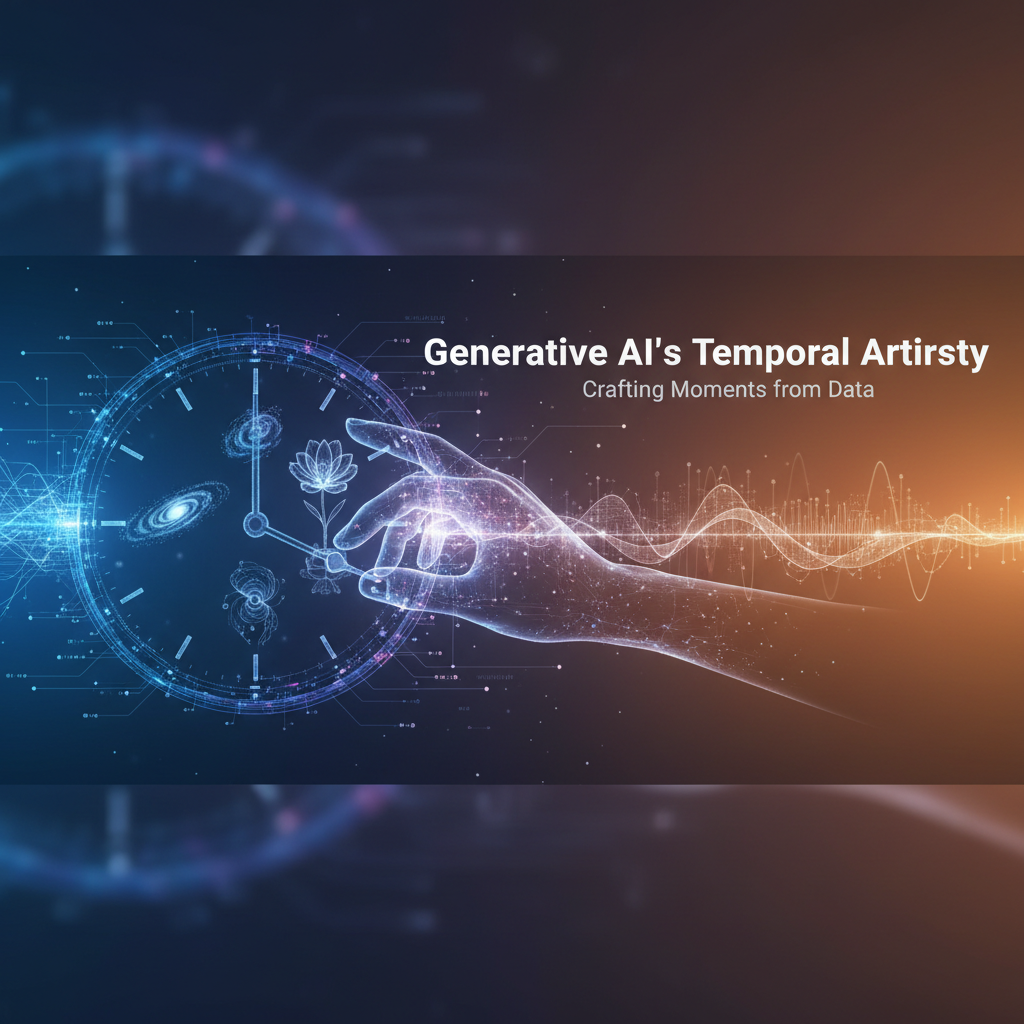
Generative AI's Temporal Artistry: Crafting Moments from Data
 Dominic Mueller
Generative AI's Temporal Artistry: Crafting Moments from Data
The Unfolding Canvas of Time: How AI Reimagines Our Past, Present, and Future
Time, that elusive fourth dimension, has always been a muse for artists, scientists, and philosophers alike. It governs our experiences, shapes our memories, and dictates the rhythm of our lives. But what if time itself could be crafted? What if algorithms could learn the subtle nuances of temporal progression, the delicate dance of cause and effect, the organic flow of moments, and then generate entirely new ones? This isn't the realm of science fiction anymore; it's the profound and rapidly evolving landscape of Generative AI's temporal artistry.
We stand at the cusp of a revolution where artificial intelligence isn't just analyzing data points; it's weaving narratives, animating histories, and even predicting futures by understanding the fundamental fabric of time embedded within vast datasets. From reconstructing ancient civilizations to simulating future climate scenarios, generative AI is becoming a master storyteller of temporal dynamics, offering us unprecedented ways to interact with the continuum of existence.
Understanding Temporal Data: The AI's Chronological Toolkit
Before AI can craft moments, it must first understand them. This understanding stems from what is broadly known as temporal data. Unlike static images or isolated text fragments, temporal data inherently possesses a sequence, an order, and often a duration.
What constitutes temporal data?
- Time Series Data: This is perhaps the most common form, where measurements or events are recorded at successive points in time. Examples include stock prices over a year, sensor readings from a machine every second, or climate measurements collected daily.
- Sequential Data: Similar to time series but often more abstract. This includes natural language (words in a sentence follow an order), music (notes in a melody), video (frames in a clip), or even human actions (steps in a dance).
- Event Data: Records discrete events that occur at specific points in time, like user clicks on a website, disease outbreaks, or astronomical observations.
- Spatio-Temporal Data: Integrates both location and time, such as tracking a hurricane's path over several days or monitoring traffic flow across a city.
The sheer volume and complexity of temporal data present significant challenges but also incredible opportunities for AI. Traditional algorithms often struggled to capture the long-range dependencies and intricate patterns embedded within these sequences. However, with the advent of deep learning, particularly architectures like Recurrent Neural Networks (RNNs), Long Short-Term Memory (LSTMs), Gated Recurrent Units (GRUs), and more recently, Transformer networks, AI has developed a sophisticated "temporal toolkit."
- RNNs/LSTMs/GRUs: These networks are designed with internal memory, allowing them to process sequences by maintaining a state that evolves over time. They can "remember" information from earlier steps in a sequence to influence later predictions or generations. Imagine an AI generating music; an LSTM can remember the key signature and rhythmic patterns established at the beginning of a piece to ensure coherence throughout.
- Transformers: Revolutionizing sequence modeling, Transformers leverage self-attention mechanisms, allowing them to weigh the importance of different parts of a sequence irrespective of their distance. This makes them exceptionally good at capturing very long-range dependencies, crucial for understanding complex narratives or long video sequences.
The Temporal Spectrum of Generative AI: From Past to Future
Generative AI's prowess in handling temporal data manifests across a fascinating spectrum, enabling it to operate as a digital historian, a dynamic artist, and even a predictive oracle.
1. Reconstructing the Past: Digital Archaeology and Historical Reanimation
One of the most awe-inspiring applications of temporal generative AI is its ability to reconstruct what has been lost or to visualize past events with unprecedented detail.
- Fact/Research: Researchers at the University of Cambridge, in collaboration with the British Museum, have used generative AI to reconstruct damaged ancient texts and artifacts. By training models on vast corpora of historical documents, these AIs can infer missing characters, words, or even entire passages, effectively "filling in the blanks" based on learned historical linguistic patterns and context. This goes beyond simple pattern matching; it involves understanding the temporal evolution of language and script.
- Digital Heritage: Imagine visiting a virtual ancient Rome where generative AI animates bustling marketplaces, recreates the attire and mannerisms of its citizens, and even generates plausible conversations in Latin, all based on historical records, archaeological data, and linguistic models. Projects like Google Arts & Culture's "Ancient Worlds, New Perspectives" leverage similar AI techniques to bring static historical data to life.
- Crime Scene Reconstruction: In forensics, generative AI is being explored to recreate crime scenes from disparate pieces of evidence – witness testimonies (sequential narrative), CCTV footage (video sequence), and forensic data (event data). By understanding the temporal relationships between these elements, AI can generate plausible sequences of events, offering new insights into investigations.
Insight: This capability transforms history from a static collection of facts into a dynamic, experiential narrative, making it accessible and engaging in new ways. It democratizes historical understanding by allowing individuals to "witness" the past.
2. Crafting the Present: Dynamic Media and Interactive Experiences
Generative AI is not just looking backward; it's actively shaping our present-day media and interactive experiences by creating dynamic, evolving content.
- Video Generation and Manipulation: Tools like Google's Imagen Video or RunwayML's Gen-1/Gen-2 can generate realistic video clips from text prompts or manipulate existing footage by altering styles, objects, or even actions. This involves understanding the temporal coherence of motion, lighting, and object interaction across frames. For instance, if you ask an AI to generate "a dog running through a field," it must ensure the dog's movement is physically plausible and consistent over time, and that the field's appearance changes naturally as the dog moves.
- Music Composition: AI like OpenAI's Jukebox or Amper Music can generate entire musical pieces in various styles. This requires a deep understanding of musical grammar, rhythm, harmony, and temporal progression – how melodies develop, how chords resolve, and how different sections of a song flow into one another. The AI learns the temporal structure of music, from micro-rhythms to macro-compositional forms.
- Interactive Storytelling and NPCs: In video games, generative AI is empowering more dynamic Non-Player Characters (NPCs) whose dialogue and actions adapt in real-time based on player interaction and the game's evolving state. This requires AI to maintain a temporal memory of events and player choices to generate contextually relevant responses and behaviors, making game worlds feel more alive and less scripted.
Takeaway: Generative AI is moving us towards a future of highly personalized and dynamic media, where content isn't just consumed but actively generated and adapted to individual preferences in real-time.
3. Simulating the Future: Prediction, Projection, and Pre-visualization
Perhaps the most potent and ethically complex aspect of generative AI's temporal artistry is its ability to peer into the future. While true "prediction" with 100% accuracy is often impossible due to chaotic systems, AI can generate plausible future scenarios based on learned temporal patterns.
- Climate Modeling and Environmental Science: Generative AI is being used to simulate complex climate systems, predict extreme weather events, and model the impact of environmental policies. By training on decades of spatio-temporal climate data, these models can generate future weather patterns, sea-level rises, or deforestation rates under various hypothetical conditions. This is not about predicting a single future, but generating a range of possible futures to inform decision-making.
- Financial Forecasting and Market Simulation: Beyond traditional econometric models, generative AI can simulate market dynamics, predict stock price movements, and even generate hypothetical financial crises by learning the complex temporal interdependencies of economic indicators, news sentiment, and trading behaviors.
- Urban Planning and Traffic Management: AI can simulate the future growth of cities, predict traffic congestion patterns based on urban development plans, and even generate optimal routes or public transport schedules, taking into account the temporal rhythms of human movement.
- Disease Outbreak Prediction: By analyzing temporal patterns of disease spread, travel data, and environmental factors, generative AI can model potential future outbreak scenarios, helping public health officials prepare and allocate resources.
Insight: This predictive capability offers powerful tools for proactive decision-making, risk assessment, and scenario planning across virtually every sector. However, it also highlights the critical need for transparency, bias mitigation, and ethical oversight in the development and application of such powerful systems. The temporal bias in training data – historical patterns reflecting past societal inequalities – can lead to generated futures that perpetuate these same issues.
The Temporal Challenges and Ethical Dimensions
While the capabilities are dazzling, the path of temporal generative AI is not without its intricate challenges and profound ethical considerations.
- Data Scarcity and Quality: Generating high-fidelity temporal data often requires massive, meticulously labeled datasets, which can be expensive and time-consuming to acquire. Gaps or biases in historical data can lead to skewed or inaccurate future generations.
- Long-Range Temporal Coherence: Maintaining consistency over very long generated sequences remains a significant challenge. An AI might create a beautiful 10-second video, but generating a coherent, engaging 2-hour movie with a complex plot is far more difficult, as the AI needs to remember and integrate elements from the very beginning to the very end.
- Plausibility vs. Reality: Generative AI excels at creating plausible moments, but plausibility doesn't always equate to factual accuracy or genuine insight, especially when extrapolating far into the future. Distinguishing between a genuinely insightful generation and a convincing hallucination is crucial.
- Temporal Bias and Fairness: If training data reflects historical biases (e.g., gender roles in old videos, racial disparities in crime data), the AI will learn and perpetuate these biases in its generated content and predictions. A generated historical reconstruction might omit or misrepresent marginalized groups, or a predictive model might disproportionately flag certain demographics.
- The Nature of Causality: AI can learn correlations and sequences, but does it truly understand causality? Generating a plausible future sequence of events doesn't necessarily mean the AI understands why those events happen. This limitation is critical when using AI for decision-making.
- Deepfakes and Misinformation: The ability to generate hyper-realistic video and audio sequences poses significant risks for creating convincing deepfakes and spreading misinformation, especially when manipulating historical footage or creating fabricated future events. The temporal fidelity of these fakes makes them particularly insidious.
Takeaway: As generative AI becomes more adept at crafting temporal realities, we must prioritize robust ethical frameworks, explainable AI (XAI) to understand its decisions, and critical digital literacy to discern between AI-generated content and genuine reality.
Practical Takeaways: Engaging with Temporal Generative AI
For individuals and organizations, understanding and engaging with generative AI's temporal artistry offers compelling opportunities:
- Innovate Content Creation: Leverage AI for dynamic storytelling, personalized marketing campaigns (generating adaptive ad content over time), or accelerating the production of animated media and interactive experiences.
- Enhance Historical Research and Education: Utilize AI tools to visualize historical data, reconstruct ancient sites, or create immersive educational content that brings the past to life for students.
- Bolster Predictive Analytics: Integrate generative AI into forecasting models for finance, logistics, climate science, and public health to explore multiple future scenarios and inform strategic planning.
- Develop Proactive Solutions: Use AI to simulate the temporal impact of proposed policies, urban designs, or environmental interventions before implementation, allowing for optimization and risk mitigation.
- Critically Evaluate AI-Generated Content: Cultivate a discerning eye for AI-generated media. Always question the source, look for inconsistencies, and understand the potential for bias or fabrication, especially when dealing with historical reconstructions or future predictions.
- Invest in Ethical AI Development: For developers and researchers, prioritize building temporal AI systems that are transparent, interpretable, and rigorously tested for biases. Contribute to the development of tools that can detect AI-generated manipulation.
Conclusion: Orchestrating the Symphony of Time
Generative AI's temporal artistry is more than just a technological marvel; it's a profound paradigm shift in how we perceive, interact with, and even create time-bound experiences. By learning the subtle rhythms, progressions, and interdependencies embedded in vast datasets, these intelligent systems are becoming master orchestrators of moments – enabling us to revisit forgotten pasts, animate our present, and envision countless potential futures.
From breathing life into ancient ruins to predicting the trajectory of climate change, AI is not merely reflecting the world; it is generating new temporal dimensions for us to explore. This power, however, comes with immense responsibility. As we move forward, our focus must be not just on what AI can generate, but how it generates it, the inherent biases it might carry, and the ethical implications of blurring the lines between reality and algorithmically crafted moments.
The canvas of time is unfolding, and generative AI is poised to paint its most intricate and captivating strokes yet. The question for humanity is not whether we will embrace this artistry, but how wisely we will wield its brushes to craft a future that is not only innovative but also equitable, insightful, and truly enriching. The symphony of time is being composed anew, and we are all now part of its audience and its creators.
Make Every Second Count
Inspired by this article? Take action now! Create a custom timer to help you manage your time better and reach your goals.
Create Your TimerAbout Dominic Mueller
Dominic Mueller is a German director for television and film with a deep fascination for time and time measurement. When he's not behind the camera crafting compelling visual stories, he explores the intricate world of temporal perception and timekeeping. Based in the beautiful city of Cologne, Germany, Dominic shares his life with his girlfriend and their beloved dog, Nala, finding inspiration in both the precise mechanics of time and the fleeting moments that make life meaningful.