Time in Quantum Physics
 Dominic Mueller
The Enigma of Time: A Quantum Perspective
From the rhythmic tick-tock of a clock to the inexorable march of history, time is an ever-present, fundamental aspect of our existence. We measure it, we feel it, we often wish we had more of it. Yet, for all its familiarity, time remains one of the universe's most profound mysteries, particularly when we delve into the bizarre and mind-bending realm of quantum physics. Here, the comfortable, linear progression of classical time begins to unravel, revealing a landscape where causality blurs, simultaneity is relative, and the very existence of a universal "now" is called into question.
This article embarks on a journey into the heart of quantum time, exploring how this foundational concept is reinterpreted, challenged, and even defied at the smallest scales of reality. We'll delve into the theoretical frameworks, experimental insights, and the profound implications of a quantum understanding of time, offering a glimpse into a universe far more intricate and dynamic than we often perceive.
The Classical View vs. The Quantum Realm: Where Time Diverges
Before we plunge into the quantum depths, it’s crucial to understand the classical conception of time that underpins our everyday experience. In Newtonian physics, time is an absolute, universal, and independent quantity, flowing uniformly and infinitely, unaffected by anything happening in space. Imagine a vast, invisible river, carrying all events along its current, with every observer experiencing the same flow. Einstein's special and general relativity revolutionized this view, showing that time is relative – its passage can slow down or speed up depending on an observer's motion and gravitational field. While a monumental shift, it still largely preserved time's continuous, flowing nature, a dimension within which events unfold.
However, the quantum realm, the domain of atoms, electrons, and photons, presents a radical departure. Here, the continuity we associate with time seems to fray. Quantum mechanics introduces concepts like superposition, entanglement, and wave-particle duality, all of which push the boundaries of our classical intuition, and time is no exception.
The Problem of Time in Quantum Gravity: A Grand Unification Challenge
One of the most profound challenges in theoretical physics is the reconciliation of quantum mechanics with general relativity, a quest known as "quantum gravity." At the heart of this problem lies the stark contrast in how these two theories treat time. General relativity treats space and time as a dynamic, interwoven fabric (spacetime) that can be warped and stretched by matter and energy. Quantum mechanics, on the other hand, typically assumes time to be an external parameter, a background against which quantum events unfold.
The Wheeler-DeWitt Equation, a foundational equation in canonical quantum gravity, famously encapsulates this "problem of time." In its original formulation, the equation effectively removes time from the universe. It describes a static, timeless universe, where change and evolution, as we understand them, cease to exist. This "timeless universe" scenario is deeply counter-intuitive, and physicists have been grappling with its implications for decades. Solutions range from proposing that time is an emergent phenomenon – something that arises from more fundamental, timeless interactions – to suggesting that our perception of time is merely a macroscopic illusion.
Quantum Clocks: When Time Gets Fuzzy
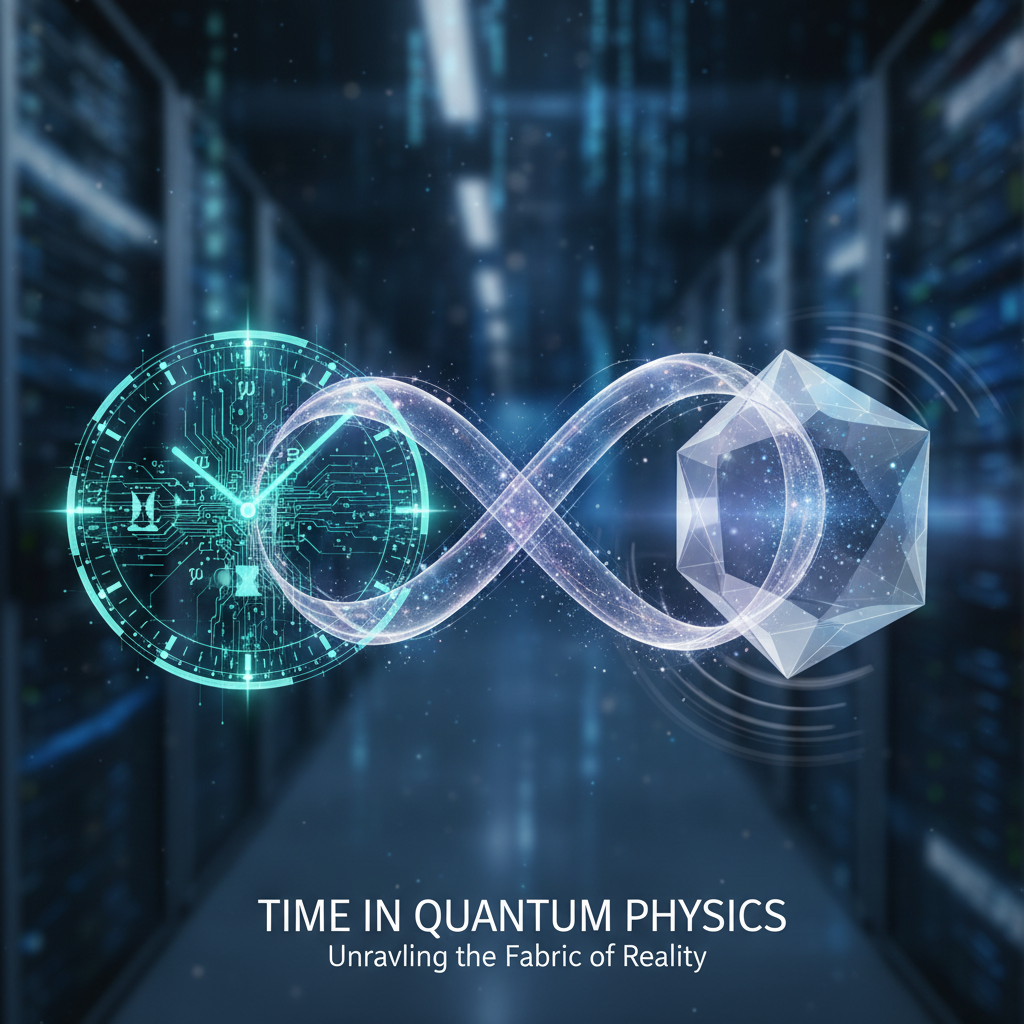
In the quantum world, even the most precise timekeeping devices can behave in peculiar ways. While we might imagine perfectly accurate quantum clocks, the Heisenberg Uncertainty Principle has a role to play. Just as we cannot simultaneously know a particle's exact position and momentum, there's a fascinating concept relating to energy and time. The "energy-time uncertainty" suggests that the more precisely you try to measure the energy of a quantum system, the less precisely you can define the time over which that energy measurement takes place, and vice-versa.
Think of it this way: to really pinpoint an event in time, you’d need an infinite amount of energy. In practice, this means there’s an inherent "fuzziness" to time measurements at the quantum scale. Quantum clocks, made from oscillating atoms, don't tick with perfect regularity; their "ticks" can be in a superposition of states, leading to an uncertain progression of time. Recent research has even explored the idea of "quantum batteries" and their relationship to time, where the energy stored within them is intimately linked to the coherence and uncertainty of their internal quantum states.
Indefinite Causal Order: Beyond Before and After
Perhaps one of the most mind-bending aspects of quantum time is the concept of indefinite causal order. In our everyday lives, causality is inviolable: cause precedes effect. If I push a domino, it falls after I push it. But in the quantum realm, this ironclad rule can be violated, at least on a fundamental level.
Scientists have demonstrated scenarios where two events, A and B, don't necessarily have a fixed causal order. It's not that A happens before B, or B happens before A; rather, they exist in a superposition of causal orders. This means that event A partially causes B, and event B partially causes A, simultaneously!
- Quantum Switch Experiment: A key experimental setup illustrating this is the "quantum switch." Imagine two operations, A and B, that a photon can undergo. In a classical setting, the photon would either go through A then B, or B then A. But in a quantum switch, the photon can be in a superposition of going through the sequence A then B, and the sequence B then A. This isn't just about the photon being in a superposition of locations; it's about the sequence of events being in a superposition. This opens up possibilities for quantum computing algorithms that could potentially outperform classical ones by exploiting these non-causal relationships.
This concept has profound implications, suggesting that causality itself might be an emergent property that solidifies only at macroscopic scales. At the quantum level, the universe might be more fluid and less rigidly ordered than we ever imagined.
Entanglement Across Time: Spooky Action into the Past?
Quantum entanglement, Einstein's "spooky action at a distance," describes how two or more particles can become linked in such a way that the quantum state of one instantaneously influences the other, regardless of the distance separating them. This phenomenon is typically discussed in terms of space. But what if entanglement could also extend across time?
While not yet definitively proven in the same way as spatial entanglement, the idea of "entanglement in time" is a fascinating frontier. Early theoretical work and some indirect experimental evidence suggest that past and future events might be entangled with the present. Imagine a scenario where the measurement of a particle now could influence its properties in the past, or "pre-determine" its properties in the future.
- Retrocausality: This concept is closely related to retrocausality, the idea that effects can precede their causes. While controversial and often bordering on science fiction, some interpretations of quantum mechanics, particularly those dealing with "block universe" models (where all of spacetime exists simultaneously, with no inherent flow), entertain the possibility that future measurements could somehow influence past events. This doesn't mean we can send messages to the past, but rather that the choices made in the future might already be woven into the fabric of past quantum states. This remains a highly speculative area, but it underscores how profoundly quantum mechanics challenges our linear understanding of time.
The Arrow of Time: Why Does Time Only Go Forwards?
One of the most persistent mysteries is the "arrow of time" – why time appears to flow only in one direction, from the past to the future. The fundamental laws of physics, both classical and quantum, are largely time-symmetric. This means that if you were to rewind a video of most physical processes (like two billiard balls colliding), the reversed sequence would still obey the laws of physics. Yet, our experience is unequivocally unidirectional.
The prevailing explanation for the arrow of time lies in thermodynamics, specifically the second law of thermodynamics, which states that the entropy (disorder) of a closed system can only increase or stay the same, never decrease. From a low-entropy state (like a perfectly organized deck of cards), the universe naturally evolves towards higher entropy (a scattered deck). This increase in disorder is what we perceive as the forward march of time.
However, in the quantum realm, the picture gets more nuanced:
- Quantum Entanglement and Entropy: The act of measurement in quantum mechanics, which collapses a superposition into a definite state, can be viewed as an irreversible process that increases universal entropy. Some theories propose that entanglement itself plays a role in the emergence of the arrow of time, linking increasing entanglement to increasing thermodynamic entropy.
- Decoherence: The process of decoherence, where a quantum system interacts with its environment and loses its quantum properties, effectively "solidifies" time's direction. As a quantum superposition interacts with countless particles in its surroundings, its delicate quantum correlations are destroyed, and it becomes irreversibly classical. This irreversible loss of information could be intrinsically linked to the unidirectional flow of time.
Practical Takeaways and Future Horizons
While the quantum nature of time might seem abstract, its implications are far-reaching, potentially influencing the next generation of technologies and deepening our understanding of reality.
- Redefining Measurement Precision: Understanding the quantum limits of time resolution is crucial for developing ultra-precise atomic clocks and new measurement technologies.
- Quantum Computing: The exploration of indefinite causal order could lead to novel quantum algorithms that exploit these non-classical temporal relationships for computational advantages, potentially solving problems currently intractable for classical computers.
- Fundamental Physics: Investigating quantum time is paramount for achieving a unified theory of quantum gravity, potentially revealing a more fundamental description of reality where time, as we know it, is an emergent property.
- Philosophical Implications: The quantum view of time challenges our deepest intuitions about causality, free will, and the nature of existence, sparking profound philosophical debates.
Research continues apace, with experiments pushing the boundaries of what's possible. Scientists are developing more sophisticated quantum clocks, exploring more complex states of indefinite causal order, and devising new ways to probe the entanglement between past, present, and future. The hope is that through these endeavors, we will unravel more layers of time's quantum enigma, bringing us closer to a complete picture of the universe.
Conclusion: Time, The Ultimate Quantum Puzzle
From the timeless universe of the Wheeler-DeWitt equation to the fuzzy measurements of quantum clocks and the baffling superposition of causal orders, quantum physics paints a picture of time that is profoundly different from our everyday experience. It suggests that time is not merely a fixed background tapestry against which events unfold, but rather an active, dynamic, and perhaps even emergent property of the universe itself.
The journey to fully understand time at its most fundamental level is far from over. It requires not only groundbreaking experiments and theoretical breakthroughs but also a willingness to challenge our most deeply held assumptions about reality. As we venture further into the quantum realm, the enigma of time continues to beckon, promising to reveal secrets that could fundamentally alter our understanding of existence, causality, and the very fabric of the cosmos. The clock may tick steadily in our macro world, but at the quantum heart of reality, time is performing a dance far stranger, and far more fascinating, than we ever imagined.
Make Every Second Count
Inspired by this article? Take action now! Create a custom timer to help you manage your time better and reach your goals.
Create Your TimerAbout Dominic Mueller
Dominic Mueller is a German director for television and film with a deep fascination for time and time measurement. When he's not behind the camera crafting compelling visual stories, he explores the intricate world of temporal perception and timekeeping. Based in the beautiful city of Cologne, Germany, Dominic shares his life with his girlfriend and their beloved dog, Nala, finding inspiration in both the precise mechanics of time and the fleeting moments that make life meaningful.