Quantum Entanglement: The Ultimate Sync Protocol
 Dominic Mueller
Quantum Entanglement: The Ultimate Sync Protocol
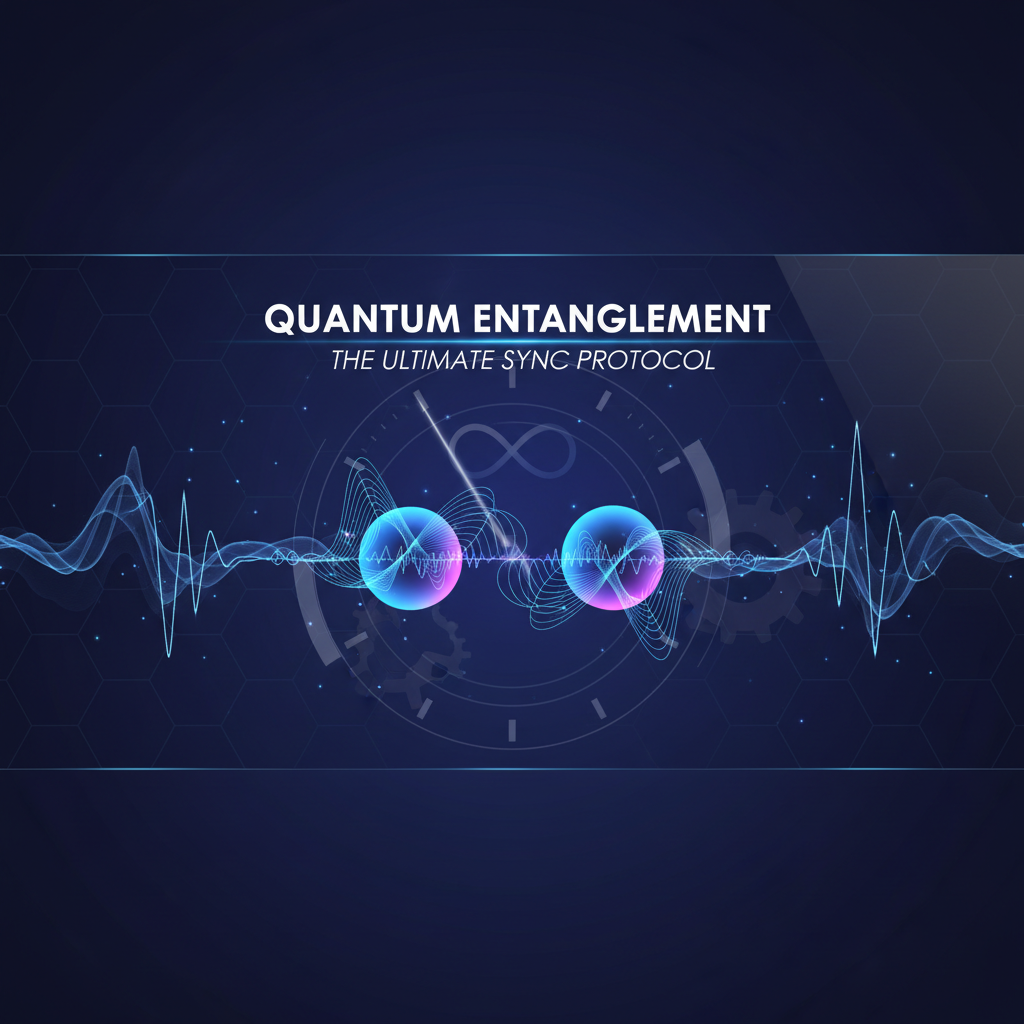
Imagine a universe where two particles, separated by light-years, instantly know what the other is doing. Change the spin of one, and its distant twin instantaneously mirrors that change. No time delay, no signal transmission, just an immediate, synchronized response. This isn't science fiction; it's the bizarre, beautiful, and profoundly challenging reality of quantum entanglement. Often dubbed "spooky action at a distance" by Albert Einstein, this phenomenon isn't just a quirky aspect of quantum mechanics – it holds the key to revolutionizing our understanding of information, communication, and even time itself.
In a world increasingly reliant on synchronized systems, from global financial markets to satellite navigation, understanding the ultimate sync protocol that nature itself offers is paramount. This article will delve into the mesmerizing world of quantum entanglement, exploring its fundamental principles, its potential to reshape technology, and its peculiar relationship with the fabric of time.
The Dance of Entangled Twins: What is Quantum Entanglement?
At its core, quantum entanglement describes a special connection between two or more quantum particles, typically photons or electrons. When particles become entangled, their fates become intertwined in such a way that they share the same quantum state, regardless of the distance separating them. It's as if they emerge from the same cosmic die roll, their outcomes forever linked.
To understand this, let's consider a simple analogy: Imagine you have two perfectly balanced coins. You toss one, and it lands heads. If it were a regular coin, the other coin could have landed heads or tails independently. But with entangled coins (if such a thing were possible in the classical world), if the first coin lands heads, you know with absolute certainty that the second coin, no matter where it is, must be tails. And if the first lands tails, the second must be heads. The act of measuring one instantly determines the state of the other.
In the quantum realm, this "knowing" happens not after a classical measurement, but as part of the quantum state itself. Before measurement, an entangled pair exists in a superposition of states – for example, both particles simultaneously "spin up" and "spin down" until one is observed. The moment one particle's spin is measured as "up," the other instantaneously collapses into the "down" state, no matter how far apart they are.
- Key Concept: This "instantaneous collapse" is the spooky part. It seems to imply information traveling faster than the speed of light, a notion that challenged Einstein's theory of relativity. However, while the correlation is instant, it's crucial to understand that no useful information can be transmitted faster than light using entanglement alone. You can't use it to send a Morse code message across the galaxy instantly because you don't control the outcome of the measurement; it's probabilistic.
Einstein's Discomfort and Bell's Triumph: Proving the Spookiness
Albert Einstein, along with Boris Podolsky and Nathan Rosen, proposed the famous EPR paradox in 1935. They argued that entanglement implied either non-local influences (information traveling faster than light) or that quantum mechanics was incomplete, and there were "hidden variables" determining the outcomes locally. Einstein, deeply committed to local realism, favored the latter explanation, believing that every physical property should have a definite value even when not measured.
Decades later, in the 1960s, physicist John Stewart Bell devised a theoretical test, now known as Bell's Theorem, to experimentally distinguish between hidden variables and the truly non-local nature of quantum entanglement. Bell showed that if hidden variables existed, the correlations between entangled particles would be limited in a specific way (Bell inequalities). If entanglement were truly non-local, these limits would be violated.
- Interesting Fact: Early experiments in the 1970s and 80s, notably by Alain Aspect, definitively demonstrated that Bell's inequalities are violated. This was a monumental moment, confirming that quantum mechanics is indeed non-local and that Einstein's "spooky action at a distance" is a fundamental feature of reality, not a flaw. These experiments often involved entangled photons sent through optical fibers or free space over ever-increasing distances, verifying their synchronized behavior.
Time's Arrow and Entanglement's Embrace: Why Synchronization Matters
The instantaneous nature of entanglement poses fascinating questions about time. If two events are truly instantaneous, does it mean they occur at the exact same moment in any reference frame, violating relativistic principles where simultaneity can be relative? The answer is nuanced: while the correlation is instantaneous, the act of measurement and observing that correlation still adheres to the speed of light. You must still classically communicate the result of your measurement to your distant colleague to confirm the correlation.
However, entanglement's potential for synchronization goes beyond simple correlation. It offers a new paradigm for securing and enhancing time-keeping and communication:
- Quantum Clocks and Distributed Synchronization: Imagine a network of highly precise atomic clocks, each entangled with others across vast distances. If one clock drifts slightly, its entangled partner could instantaneously "know" this, allowing for self-correcting, hyper-synchronized timing systems far more robust than current GPS-based methods. This could be crucial for future global satellite networks, deep-space communication, and even ultra-precise scientific instruments like radio telescopes operating as interferometers.
- Quantum Cryptography (QKD): This is perhaps the most mature application of entanglement. QKD exploits the fundamental principle that any attempt to eavesdrop on entangled particles inherently disturbs their state, instantly revealing the intrusion. This provides an absolutely secure method for key distribution, where the security is guaranteed by the laws of physics, not computational complexity. If a photon's polarization is measured by an eavesdropper, its entangled partner will "react," alerting the legitimate users that the key exchange has been compromised. The ability to detect eavesdropping instantaneously is key here, providing real-time security assurance.
- Quantum Teleportation: While not "Star Trek" style matter teleportation, quantum teleportation uses entanglement to transmit the quantum state of a particle from one location to another without physically moving the original particle. This involves three particles: the one whose state you want to transmit (A), and an entangled pair (B and C). You perform a measurement on A and B, which instantly influences C. With the classical measurement results sent to the receiver of C, they can then reconstruct the original state of A onto C. This is a crucial step towards quantum internet and distributed quantum computing, allowing for the transfer of quantum information across networks.
The Quantum Internet: A New Era of Global Connectivity
The vision of a quantum internet is predicated on the ability to distribute entangled particles across a global network. Such a network would enable:
- Unbreakable Communication: Every communication link would be secured by QKD, rendering traditional encryption attacks obsolete.
- Distributed Quantum Computing: Multiple quantum computers could be linked, forming a more powerful, distributed processing unit, allowing for computations beyond the scope of any single machine. For instance, simulating complex molecules for drug discovery or materials science.
- Hypersensitive Sensors: Entangled particles are inherently more sensitive to disturbances, leading to revolutionary sensors for everything from gravity waves to medical imaging, creating a new level of precision in measurement.
- Global Quantum Synchronization: As discussed, for incredibly precise time-stamping and clock networks, minimizing latency and maximizing accuracy. This could redefine how we measure and utilize time on a global scale, leading to new scientific discoveries and technological advancements.
Challenges and Roadblocks on the Path to Synchronization
Despite its immense promise, harnessing quantum entanglement for practical applications comes with significant challenges:
- Decoherence: Entangled states are extremely fragile. Interactions with the environment cause them to "decohere," losing their entanglement. Maintaining entanglement over long distances and for extended periods is a major hurdle.
- Entanglement Generation and Distribution: Creating entangled pairs reliably and then distributing them over vast geographical distances is technologically complex. Researchers are experimenting with fiber optics, free-space laser links, and even satellite-based entanglement distribution.
- Quantum Repeaters: Similar to classical signal repeaters, quantum repeaters are necessary to extend the range of entangled links by purifying and relaying quantum states without destroying them. This technology is still in its nascent stages.
- Scalability: Building quantum networks with many nodes and users requires significant breakthroughs in managing and controlling large numbers of entangled particles.
- Recent Research Highlight: In 2020, researchers successfully demonstrated entanglement distribution between two cities in China over 1,120 km using satellite links. This landmark achievement highlights the potential for future global quantum networks and represents a massive step towards overcoming the distance challenge.
The Ultimate Sync Protocol: Beyond Human Comprehension?
Quantum entanglement remains one of the most enigmatic phenomena in physics. Its instantaneous nature has forced us to reconsider our classical notions of locality, causality, and even time itself. While no information is truly sent faster than light, the correlation between entangled particles is inherently non-local, existing outside the constraints of space-time as we ordinarily perceive it.
As we continue to unravel the mysteries of entanglement, we are not just building new technologies; we are gaining a deeper understanding of the fundamental laws governing our universe. The implications extend beyond mere engineering – they touch upon philosophy, cosmology, and our very place in the cosmos.
Conclusion: A Future Woven with Entangled Threads
Quantum entanglement, Einstein's "spooky action at a distance," is transforming from a scientific curiosity into a cornerstone of future technologies. From unbreakable encryption to ultra-precise timing systems and a revolutionary quantum internet, its applications promise to redefine our world. The ability of two particles to instantly synchronize, regardless of their separation, offers the ultimate sync protocol – a natural phenomenon that promises levels of security, precision, and computational power previously confined to science fiction.
While the journey is fraught with challenges, the relentless pursuit of understanding and harnessing entanglement is a testament to human ingenuity. As we push the boundaries of quantum physics, we are not just building advanced machines; we are peering into the very fabric of reality, finding that the universe itself is connected in ways far more profound and synchronized than we ever imagined. The future of technology, communication, and even our understanding of time, lies woven into these intricate, entangled threads.
Make Every Second Count
Inspired by this article? Take action now! Create a custom timer to help you manage your time better and reach your goals.
Create Your TimerAbout Dominic Mueller
Dominic Mueller is a German director for television and film with a deep fascination for time and time measurement. When he's not behind the camera crafting compelling visual stories, he explores the intricate world of temporal perception and timekeeping. Based in the beautiful city of Cologne, Germany, Dominic shares his life with his girlfriend and their beloved dog, Nala, finding inspiration in both the precise mechanics of time and the fleeting moments that make life meaningful.