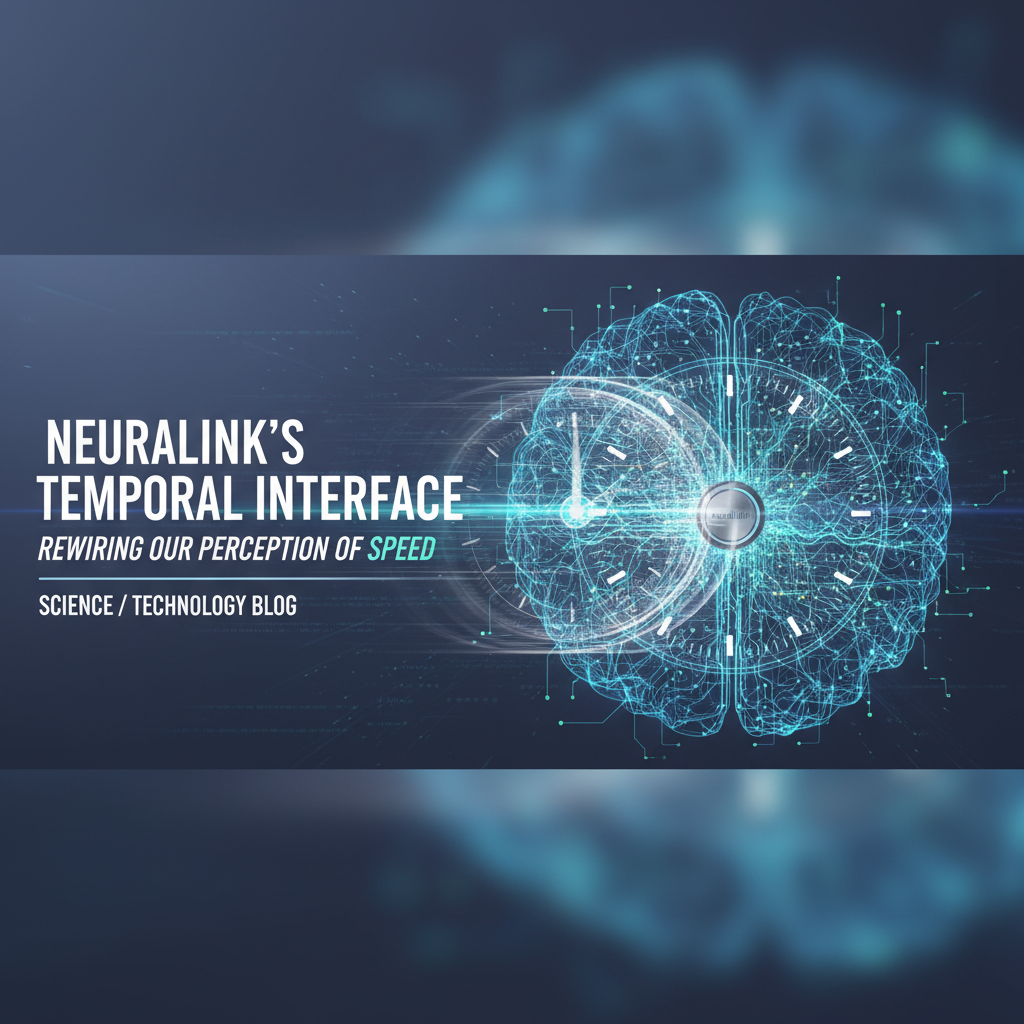
Neuralink's Temporal Interface: Rewiring Our Perception of Speed
 Dominic Mueller
Neuralink's Temporal Interface: Rewiring Our Perception of Speed
In the intricate dance of existence, time is our most fundamental, yet often elusive, partner. We chase it, lament its passing, and sometimes, in moments of intense focus, feel like we can bend it. But what if we could not just perceive time differently, but actively rewire our brain's temporal processing? This isn't the stuff of science fiction anymore; it's the audacious frontier Neuralink is exploring, pushing the boundaries of what it means to be human in relation to the universe's most unyielding constant.
For centuries, our perception of speed – of how quickly events unfold, of how rapidly we can react, and of the very pace of life itself – has been constrained by the biological limitations of our nervous system. But what if a direct neural interface could unlock new dimensions of temporal awareness, fundamentally altering our relationship with the concept of "fast"? This article will delve into how Neuralink's ambitious brain-computer interface (BCI) technology, while primarily focused on restoring motor function and communication, harbors the potential to profoundly impact our subjective experience of time and speed.
The Biological Clock: Our Innate Temporal Processor
Before we dive into the futuristic, let's ground ourselves in the present understanding of how our brains handle time. Our perception of time isn't a single, uniform experience. It's a complex, multi-faceted phenomenon influenced by a myriad of factors.
- Internal Clocks: Our bodies house numerous internal oscillators, from the circadian rhythm dictating sleep-wake cycles to the neural firing rates that govern our ability to estimate short durations. The suprachiasmatic nucleus in the hypothalamus acts as the master clock for our circadian rhythms, while regions like the cerebellum, basal ganglia, and prefrontal cortex are implicated in processing shorter time intervals.
- Attention and Emotion: When we're engaged and focused, time seems to fly. Conversely, in states of boredom or fear, minutes can stretch into eternity. This is because our attention allocates resources to processing sensory information, and when these resources are heavily taxed, our perception of elapsed time can become distorted. Dopamine, a neurotransmitter associated with reward and motivation, is also known to influence time perception, often accelerating our subjective experience.
- Sensory Processing Speed: The speed at which our senses register and relay information to the brain dictates our reaction times and our ability to discern rapidly occurring events. A tennis player, for instance, has a finely tuned visual-motor system that processes the ball's trajectory and speed with incredible efficiency.
The human brain, for all its marvels, has inherent latencies. It takes time for light to hit our retina, for electrical signals to travel along neurons, and for the brain to interpret these signals and formulate a response. These minuscule delays, accumulated across complex tasks, define the limits of our natural "speed."
Neuralink's Promise: Bypassing Biological Bottlenecks
Neuralink's core mission is to create a high-bandwidth BCI capable of transmitting information directly between the brain and external devices. While the immediate applications are geared towards medical benefits – restoring vision, hearing, and motor control for individuals with neurological disorders – the underlying technology holds profound implications for our temporal perception.
Imagine a world where your thoughts can instantaneously control a computer, bypassing the relatively slow mechanical movements of fingers on a keyboard or voice commands. This direct neural pathway eliminates several layers of biological processing, effectively reducing latency and speeding up interaction.
The "Noodle" and Neural Latency
Neuralink's "Noodle" (or link) device aims to record electrical signals from thousands of neurons simultaneously and, crucially, to stimulate them with high precision. By reading neural activity associated with intent and translating it into digital commands, Neuralink seeks to overcome the inherent "bottleneck" of our peripheral nervous system.
Consider the time it takes to:
- Think about typing a word.
- Send motor commands to your fingers.
- Execute those commands on a keyboard.
- Wait for the computer to process the input.
A Neuralink interface could potentially collapse steps 2 and 3, directly translating the thought into a digital output. This isn't just about faster typing; it's about a fundamental reduction in the latency of interaction with the digital world.
Rewiring Perception: Speeding Up Subjective Time
This reduction in latency isn't merely about faster execution; it could lead to a radical shift in our subjective perception of speed.
Enhanced Reaction Times
One of the most immediate impacts could be on reaction times. If a Neuralink user can directly perceive and respond to digital stimuli without the delays of sensory organs and motor neurons, their reaction time could theoretically approach the speed of neural processing itself.
- Gaming: Imagine a gamer whose neural interface allows them to react to in-game events milliseconds faster than their opponents. This isn't just an advantage; it's a completely different level of gameplay.
- Precision Control: For tasks requiring extreme precision and rapid feedback, like operating complex machinery or performing delicate surgery remotely, a Neuralink interface could provide a level of real-time control currently unimaginable.
Compressing Information: A Faster "Mental Clock"
Beyond reaction times, the ability to directly input and output information at high bandwidth could change how our brains process and integrate data. If the brain can receive more information per unit of time, it might adapt to process it faster, effectively "speeding up" its internal clock.
- "Bullet Time" for the Mind: Could a Neuralink interface allow us to perceive rapidly unfolding events with greater granularity, akin to the "bullet time" effect in movies? By providing more granular neural data about an event, the brain might "stretch out" the perceived duration, allowing for more detailed analysis in what would otherwise be a fleeting moment.
- Accelerated Learning: If information can be directly "fed" into the brain via neural stimulation, bypassing the slower processes of reading or listening, could learning accelerate dramatically? Imagine downloading a skill set or a complex knowledge domain directly into your neural pathways. This wouldn't just be about speed; it would be about transforming the very process of acquiring knowledge.
The Temporal Implications: Beyond the Human Baseline
The human brain has evolved to process information at a certain pace, attuned to the rhythms of the natural world. A Neuralink interface, by augmenting or even bypassing these natural constraints, could open doors to experiences currently beyond our biological capabilities.
Sensory Augmentation and Temporal Resolution
Consider the concept of "temporal resolution" – our ability to distinguish between two successive stimuli. Humans have a relatively limited temporal resolution compared to some animals. For example, a fly's nervous system processes visual information much faster, allowing it to perceive movements that appear as a blur to us as distinct events.
Could a Neuralink interface, by directly stimulating sensory cortices with high-frequency signals, enhance our temporal resolution?
- Seeing Faster: Imagine perceiving frame rates far beyond the current human limit of around 60-100 Hz, making everything appear in slow motion.
- Hearing More Clearly: Distinguishing individual notes in a rapid musical passage with unprecedented clarity.
- Enhanced Situational Awareness: In complex, fast-paced environments, an augmented temporal resolution could provide a distinct advantage, allowing for quicker analysis and response.
The "Time Dilation" Effect of Enhanced Cognition
If Neuralink can amplify our cognitive processing power, effectively allowing us to think and process information much faster, the subjective experience could be akin to time dilation. While external physical time remains constant, our internal experience of it could slow down. For someone with a highly augmented cognitive speed, a single external minute might feel like several minutes or even hours of internal thought and processing.
- Deeper Problem Solving: Tackling complex problems that currently require extended periods of focused effort could be compressed into shorter durations.
- Creative Acceleration: The rapid generation and evaluation of ideas, leading to accelerated artistic and scientific breakthroughs.
Practical Takeaways and Ethical Considerations
While the full realization of these temporal effects is still in the future, the implications are profound.
Practical Insights for the Present:
- Understanding Our Limitations: Recognizing the biological constraints on our perception of speed can help us appreciate our natural abilities and limitations.
- The Power of Focus: Even without a BCI, practices like mindfulness and focused attention can significantly alter our subjective experience of time, making it feel more expansive or compressed as needed.
- Optimizing Digital Interaction: The pursuit of lower latency in digital interfaces (e.g., faster internet, more responsive touchscreens) is already a small step towards the kind of direct, instantaneous interaction Neuralink promises.
Ethical Quandaries of Temporal Rewiring:
The ability to manipulate our perception of time and speed raises significant ethical questions:
- The "Haves" and "Have-Nots": Will temporal augmentation create an even greater divide between those with access to such technology and those without, leading to a new form of "cognitive elite"?
- Loss of Shared Reality: If individuals experience time and speed at vastly different rates, how will this impact shared social experiences, communication, and the very fabric of society?
- Mental Overload: Could subjecting the brain to accelerated information processing lead to unprecedented levels of stress, anxiety, or even neurological damage?
- The Nature of Being Human: If our fundamental temporal experience is altered, what does it mean for our sense of self, our relationship with memory, and our place in the flow of existence?
Neuralink's focus remains on restoring neurological function, a noble and vital pursuit. However, the inherent capabilities of such a high-bandwidth BCI inevitably extend beyond therapeutic applications, touching upon fundamental aspects of human experience, not least of which is our perception of time.
Conclusion: The Dawn of a New Temporal Reality
Neuralink's temporal interface, though not its stated primary goal, represents a radical frontier in human-computer interaction. By bypassing the biological bottlenecks of our nervous system, it promises to reduce latency, enhance reaction times, and potentially even rewire our subjective experience of speed and time.
From accelerating learning to amplifying our cognitive processing power, the potential for a "faster" human existence is both exhilarating and daunting. As we stand on the precipice of this technological revolution, it's crucial to engage in thoughtful discussion about the ethical implications. How do we ensure equitable access? How do we safeguard mental well-being in an accelerated world? And what truly defines "human" when our innate temporal perception can be augmented and manipulated?
The future promises not just faster computers, but potentially faster minds. Neuralink isn't just building a brain-computer interface; it's laying the groundwork for a new temporal reality, one where our perception of speed, the very rhythm of our existence, may be fundamentally rewritten. The clock is ticking, and the revolution, in more ways than one, is just beginning.
Make Every Second Count
Inspired by this article? Take action now! Create a custom timer to help you manage your time better and reach your goals.
Create Your TimerAbout Dominic Mueller
Dominic Mueller is a German director for television and film with a deep fascination for time and time measurement. When he's not behind the camera crafting compelling visual stories, he explores the intricate world of temporal perception and timekeeping. Based in the beautiful city of Cologne, Germany, Dominic shares his life with his girlfriend and their beloved dog, Nala, finding inspiration in both the precise mechanics of time and the fleeting moments that make life meaningful.