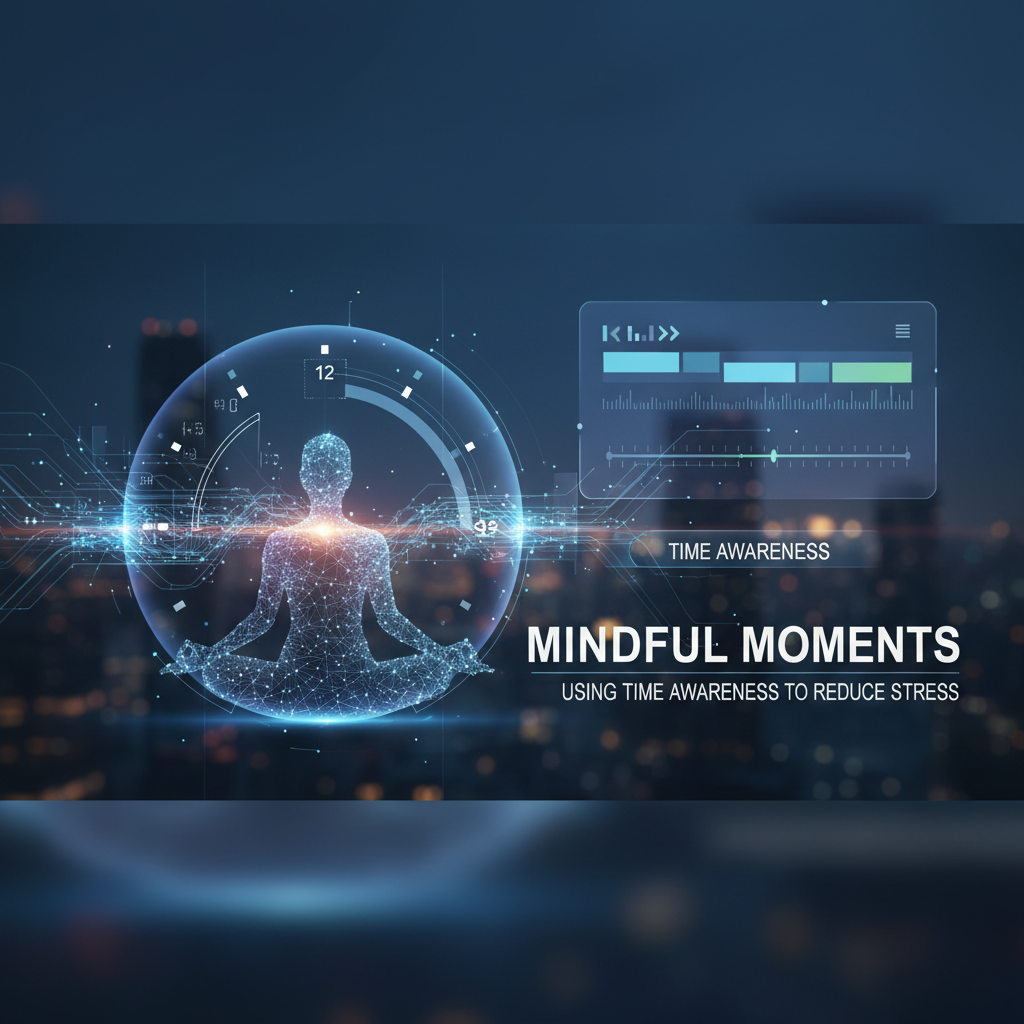
Mindful Moments: Using Time Awareness to Reduce Stress
 Dominic Mueller
Mindful Moments: Harnessing Time Awareness to Diffuse Stress
In our perpetually accelerating world, the relentless tick-tock of the clock often feels less like a measure of progress and more like a harbinger of stress. We’re constantly racing against deadlines, juggling commitments, and feeling the pervasive pressure of "not enough time." But what if our relationship with time could be reframed? What if, instead of being a source of anxiety, a deeper awareness of time could become a powerful tool for reducing stress and cultivating inner peace?
This isn't about finding more hours in the day, nor is it about mastering superhuman efficiency. It's about developing "time awareness" – a conscious, present-moment understanding of how we perceive, experience, and allocate our most finite resource. By paying closer attention to time, we unlock a profound ability to manage stress more effectively and live a more fulfilling life.
The Tyranny of the Clock: How Our Modern Perception of Time Fuels Stress
Before we delve into solutions, it's crucial to understand the problem. Our modern understanding of time, largely influenced by industrialization and the digital age, is deeply problematic for our mental well-being.
- Linear and Scarce: We perceive time as a strictly linear progression, an endless, finite resource that constantly depletes. This creates a sense of scarcity, triggering a fight-or-flight response when we feel it slipping away.
- External rather than Internal: Clocks, calendars, and digital notifications dictate our schedules, often overriding our internal rhythms and needs. We become slaves to external markers of time, rather than listening to our body's cues.
- The "Always On" Culture: The 24/7 nature of our connected world blurs the lines between work and rest. The expectation to be constantly responsive and productive means our minds are rarely given a true break, leading to chronic stress and burnout.
- Future-Oriented Anxiety: Much of our stress stems from dwelling on past regrets or anxieties about future events. We spend less time in the present moment, where true peace resides.
- The Planning Fallacy: This cognitive bias, identified in psychological research, describes our tendency to underestimate the time required to complete tasks. We consistently overcommit and then feel overwhelmed when reality inevitably falls short of our optimistic projections.
These factors combine to create a perfect storm of chronic stress, characterized by feelings of overwhelm, fatigue, and a constant sense of rushing.
Beyond the Clock: What is Time Awareness?
Time awareness isn't about being more efficient in the traditional sense. It's about cultivating a mindful relationship with time. It encompasses several key aspects:
- Present Moment Focus: Shifting attention from past regrets or future anxieties to the "now." This is the cornerstone of mindfulness itself.
- Subjective Time Perception: Recognizing that time is not always linear. Sometimes minutes crawl, sometimes hours fly. Understanding this helps us appreciate and leverage these shifts.
- Appreciation of Transience: Acknowledging the fleeting nature of all moments – both good and bad. This can foster gratitude and resilience.
- Intentional Allocation: Consciously choosing how to spend our time, aligning our actions with our values and priorities.
- Internal Rhythms: Tuning into our personal energy cycles and optimizing tasks accordingly, rather than blindly following external schedules.
Developing time awareness empowers us to reclaim agency over our lives, reducing the feeling of being dragged along by an unstoppable current.
The Science of Time and Stress: Intriguing Insights
Research increasingly illuminates the intricate connection between our perception of time and our stress levels.
- The "Chronos" vs. "Kairos" Distinction: Ancient Greeks had two words for time: Chronos, referring to chronological, sequential time (think clock time), and Kairos, meaning "the right, critical, or opportune moment." Our modern world largely emphasizes Chronos. Developing time awareness involves cultivating Kairos – recognizing and seizing meaningful moments. Stress often arises when we prioritize Chronos over Kairos.
- Mindfulness and Brain Activity: Neuroscientific studies consistently show that mindfulness practices, which inherently cultivate present-moment time awareness, reduce activity in the amygdala, the brain's "fear center." This leads to a reduction in stress response.
- Time Poverty and Well-being: Research often links "time poverty" – the subjective feeling of having too much to do and not enough time – to lower life satisfaction and higher stress, regardless of actual leisure time available. This highlights that perception is often more impactful than objective reality when it comes to time.
- Flow State and Time Distortion: When we are deeply engaged in an activity we enjoy, we enter a "flow state" (a concept popularized by Mihaly Csikszentmihalyi). In this state, our perception of time often distorts – hours can feel like minutes. This is a prime example of positive time awareness, where our focus on the present moment eliminates external stress.
- The Power of Anticipation: While future anxiety is stressful, positive anticipation can be a powerful mood booster. Planning for pleasurable events, even small ones, helps shift our time awareness from dread to excitement.
These insights underscore that our subjective experience of time is not merely a byproduct of our circumstances; it's a powerful lever we can pull to influence our emotional state.
Practical Strategies for Cultivating Time Awareness and Reducing Stress
Shifting our relationship with time requires intentional practice, but the rewards are profound. Here are several practical strategies you can implement today:
1. Embrace Single-Tasking (The Antidote to Multitasking Mania)
- The Myth of Multitasking: Studies show that true multitasking is largely a myth. Instead, we rapidly switch tasks, leading to reduced efficiency, increased errors, and heightened stress. Each switch carries a "cost" in terms of cognitive energy.
- Practice: Choose one task, even a small one, and dedicate your full attention to it for a set period. Turn off notifications. Fully immerse yourself. Notice how your focus improves and how this single-mindedness reduces the feeling of being pulled in multiple directions.
- Bonus Insight: Cal Newport, author of Deep Work, champions single-tasking for productivity and well-being, arguing that deep, focused work is becoming a rare and valuable skill.
2. Schedule "White Space" and Buffer Time
- The Over-Scheduled Life: We often cram our schedules to the brim, leaving no room for the unexpected or for our brains to simply decompress.
- Practice: Intentionally block out short periods (15-30 minutes) in your calendar that are unassigned. Use this "white space" for reflection, a short walk, or simply staring out the window. Similarly, add "buffer time" between meetings or tasks to allow for transitions and prevent the feeling of rushing.
- Practical Tip: When planning your day, overestimate the time needed for tasks by 10-20%. This creates a hidden buffer that can absorb minor delays without triggering stress.
3. Practice Mindful Pauses Throughout Your Day
- The Automatic Pilot: We often rush through our days on autopilot, reacting rather than consciously choosing.
- Practice: Set gentle reminders on your phone (non-intrusive sounds, not glaring alarms) to take a mindful pause several times a day. For just 60 seconds:
- Stop what you're doing.
- Take three deep, slow breaths.
- Notice your surroundings – sights, sounds, smells.
- Bring your awareness to the present moment, acknowledging the passage of this specific instant.
- Benefit: These micro-breaks reset your mind, break the stress cycle, and bring you back into the present.
4. Create Time Journals or Time Audits
- The Illusion of Time: We often think we know how we spend our time, but reality can be surprising.
- Practice: For a few days, meticulously track how you spend every 30 minutes. Don't judge, just observe.
- Insight: This "time audit" often reveals hidden time sinks (e.g., excessive social media scrolling, unnecessary meetings) and opportunities to realign your time with your values. It’s like a financial audit, but for your most valuable asset.
5. Cultivate "Kairos" Moments
- Beyond the Schedule: Don't just tick off tasks; seek out meaningful experiences within your day.
- Practice: Look for opportunities to fully engage with a moment.
- Really taste your food while eating lunch.
- Deeply listen to a loved one without formulating your reply.
- Allow yourself to be completely absorbed by a hobby for a short while.
- Notice the beauty of a sunset or the warmth of your coffee.
- Result: These deliberate engagements with the present enrich your life and reduce the feeling that time is merely passing by unappreciated.
6. Reframe Your Language Around Time
- Words Shape Reality: Our language profoundly impacts our perception.
- Practice: Be conscious of how you talk about time. Instead of "I don't have enough time," try "I'm choosing to prioritize X over Y right now." Instead of "I'm so busy," try "I have a full schedule," or "I'm engaged in many interesting activities."
- Impact: This subtle shift empowers you, moving from a victim of time to an active participant in its allocation.
7. Incorporate Time-Blocking (The Intentional Scheduler)
- Proactive vs. Reactive: Instead of letting your day react to incoming demands, proactively decide how to spend your time.
- Practice: At the start of each day or week, block out specific periods for specific activities – work tasks, exercise, creative pursuits, family time, and even "nothing time." Treat these blocks as non-negotiable appointments with yourself.
- Benefit: This creates structure, reduces decision fatigue, and ensures that important, non-urgent tasks (which often reduce stress in the long run) don't get sidelined.
The Long-Term Benefits: A Less Stressed, More Present Life
By consistently practicing these strategies, the long-term benefits extend far beyond simply managing daily stress. You'll likely experience:
- Increased Calm: A reduction in that perpetual "rushed" feeling.
- Greater Focus and Productivity: By single-tasking and respecting your attention span.
- Enhanced Well-being: A deeper appreciation for the present and a reduction in anxiety about the past or future.
- Improved Decision-Making: With more mental clarity and less pressure.
- Stronger Relationships: By being truly present with loved ones.
- A Sense of Control: Feeling less like a leaf swept away by the river of time and more like a conscious navigator.
Conclusion: Reclaiming Your Chronological Consciousness
Stress is an inherent part of modern life, but its intensity is often amplified by our unexamined relationship with time. By becoming more aware of time – not just the ticking hands of the clock, but our subjective experiences, our internal rhythms, and our choices in the present moment – we gain a powerful antidote to overwhelm.
Time awareness isn't about fitting more into your day; it's about getting more out of the time you have. It's about recognizing that every moment is a unique, irreplaceable gift, and that how you choose to perceive and utilize it profoundly shapes your mental, emotional, and physical health. So, take a breath. Tune into this very moment. Begin to reclaim your chronological consciousness, and watch as the relentless pressure of time transforms into a gentle rhythm of mindful living. The present moment is always calling – are you listening?
Make Every Second Count
Inspired by this article? Take action now! Create a custom timer to help you manage your time better and reach your goals.
Create Your TimerAbout Dominic Mueller
Dominic Mueller is a German director for television and film with a deep fascination for time and time measurement. When he's not behind the camera crafting compelling visual stories, he explores the intricate world of temporal perception and timekeeping. Based in the beautiful city of Cologne, Germany, Dominic shares his life with his girlfriend and their beloved dog, Nala, finding inspiration in both the precise mechanics of time and the fleeting moments that make life meaningful.