Microsecond Masterminds: How 5G Warps Latency Perception
 Dominic Mueller
Microsecond Masterminds: How 5G Warps Latency Perception
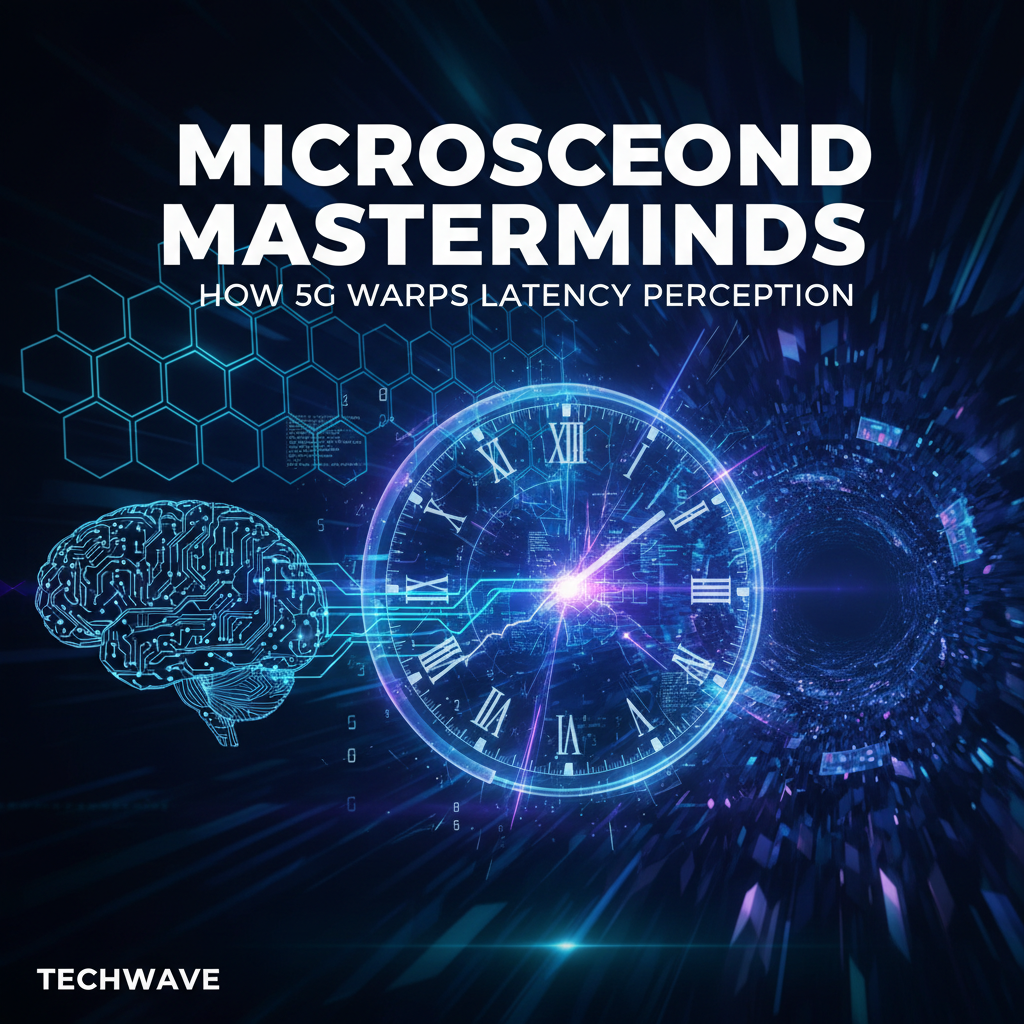
In a world increasingly defined by instant gratification, the concept of "waiting" is quickly becoming an archaic relic. From streaming high-definition video to communicating across continents, our digital experiences demand immediacy. But what if we told you that the very fabric of our digital interactions is being subtly yet profoundly altered? Enter 5G, the fifth generation of wireless technology, and its most revolutionary characteristic: its mastery over latency. This isn't just about faster downloads; it's about a fundamental shift in how we perceive and interact with time in the digital realm.
Latency, in its simplest terms, is the time delay between a cause and effect in a system. For mere mortals, a few hundred milliseconds might seem insignificant, but in the intricate dance of modern technology, these tiny temporal gaps are the invisible architects of our digital experience. 5G, with its promise of single-digit millisecond latency, isn't just reducing these delays; it's reshaping our cognitive perception of time itself, turning us into microsecond masterminds.
The Invisible Fabric of Time: Understanding Latency
Before we dive into 5G's temporal superpowers, let's unpack what latency truly means. Imagine sending a text message. It leaves your phone, travels through a cell tower, bounces to a central server, then to the recipient's cell tower, and finally arrives at their device. Each step involves a tiny delay – processing time, transmission time, and propagation time (how long it takes for a signal to travel across distance). The sum of these delays is the end-to-end latency.
For years, we've lived with inherent latencies that we largely accept or even ignore.
- 4G LTE: Typically boasts latencies of 40-60 milliseconds (ms). While a significant leap from 3G (100-300ms), it still introduces perceptible delays in real-time applications. Think about video calls where voices sometimes overlap or online games where a slight stutter can mean the difference between victory and defeat.
- Human Perception: Our brains are remarkably good at filtering out constant background noise, and that includes minor delays. However, as delays decrease, our sensitivity increases. Studies show that humans can generally perceive delays as low as 10-20ms, particularly in interactive contexts. Below this threshold, interactions begin to feel truly instantaneous.
Latency isn't just a technical metric; it's a temporal barrier that dictates the possibilities of digital interaction. High latency is like trying to have a conversation through a delay line, making natural back-and-forth impossible. Low latency, on the other hand, opens up a world of seamless, real-time collaboration and control.
5G's Temporal Leap: Engineering Near-Instantaneity
So, how does 5G achieve its remarkable feat of nearly eliminating perceptible latency? It's a combination of several ingenious architectural and technological advancements:
1. Millimeter Wave (mmWave) Technology
- Speed of Light, Redefined: While all radio waves travel at the speed of light, mmWave frequencies (24-100 GHz) offer significantly more bandwidth. This wider "pipe" allows more data to be transmitted simultaneously, reducing the time it takes for a data packet to travel, even if the absolute propagation speed remains constant. Think of it like a wider highway allowing more cars to pass at the same speed.
- Shorter Wavelengths, Smaller Antennas: The shorter wavelengths of mmWave signals mean that smaller antennas can be used, enabling technologies like Massive MIMO (Multiple-Input, Multiple-Output).
2. Massive MIMO
- Symphony of Signals: Massive MIMO involves using hundreds or even thousands of small antennas at base stations. These antennas can simultaneously send and receive multiple data streams to and from numerous users, effectively creating dedicated virtual connections for each device. This dramatically boosts capacity and efficiency, which in turn reduces congestion and, crucially, latency. Instead of waiting in a queue, your data gets its own express lane.
3. Beamforming
- Focused Energy: Instead of broadcasting signals indiscriminately in all directions, beamforming intelligently directs radio signals towards specific user devices. This targeted approach minimizes interference, maximizes signal strength, and ensures that data packets arrive efficiently and quickly, cutting down on retransmissions and errors that add to delay. It’s like a laser pointer for data, rather than a floodlight.
4. Edge Computing (Multi-access Edge Computing - MEC)
- Bringing the Cloud Closer: Traditionally, data from your device would travel to a centralized cloud server, often hundreds or thousands of miles away, adding significant propagation delay. Edge computing physically moves computational power and data storage closer to the source of data generation – to the "edge" of the network, such as cell towers or local data centers.
- Real-World Impact: An autonomous car processing sensor data for collision avoidance doesn't need to send that data to a distant cloud and wait for a response. With MEC, the processing can happen almost instantaneously at a local hub, bringing response times down to unperceivable levels. This dramatically shrinks the temporal distance data needs to travel.
5. Network Slicing
- Tailored Temporal Pathways: Network slicing allows telecom operators to create multiple virtual networks on a single physical 5G infrastructure. Each "slice" can be customized with specific performance characteristics, including latency requirements.
- Use Case Example: A surgeon performing remote robotic surgery might require an ultra-low latency slice (perhaps 1ms), while a smart city sensor monitoring traffic patterns might operate on a less demanding slice. This prioritizes critical applications, ensuring their temporal needs are met without compromise.
These innovations, working in concert, enable 5G to target an impressive latency of 1 millisecond (ms) – a figure that pushes the boundaries of human perception and opens up entirely new possibilities.
The Cognitive Shift: Warping Our Perception of Time
When latency drops to sub-10ms levels, something remarkable happens: our sense of time warps. Interactions that once felt like "remote control" become indistinguishable from direct interaction.
- From Delay to Instantaneity: Imagine interacting with a virtual object in augmented reality. With 4G, there might be a subtle lag between your hand movement and the object's response, reminding you it's not truly there. With 5G, the response is so immediate that your brain integrates the virtual object seamlessly into your physical environment. The temporal gap shrinks to nothingness, blurring the lines between physical and digital.
- The "Feel" of Control: For gamers, 5G can transform the competitive landscape. Inputs become razor-sharp, reducing the frustration of "input lag." This isn't just about faster reactions; it's about a deeper sense of control and immersion. The game feels less like a simulation and more like an extension of your own thoughts and actions.
- Erasing Geographic Distance: Remote collaboration enters a new era. Surgeons can guide robots in distant operating theaters with the precision of being in the same room. Engineers can co-design complex 3D models in virtual reality, manipulating objects as if they were physically present together. The perception of distance, temporally speaking, begins to erode.
This shift in perception is profound. We move from acknowledging a digital intermediary to experiencing a digital environment as a seamless extension of our physical world. The "waiting time" component of digital interaction effectively disappears from our cognitive radar.
Temporal Triumphs: Real-World Impacts and Applications
The sub-millisecond revolution ushered in by 5G is not just theoretical; it's already beginning to redefine entire industries and create unforeseen opportunities where time is of the essence.
1. Autonomous Vehicles: Seconds to Survival
- Split-Second Decisions: Self-driving cars rely on constant communication with each other (V2V - Vehicle-to-Vehicle) and with infrastructure (V2I - Vehicle-to-Infrastructure) to navigate safely. Even a 50ms delay in processing an emergency braking signal could mean the difference between preventing an accident and a catastrophic collision. 5G's ultra-low latency enables vehicles to react almost instantaneously to changes in their environment, exchanging data packets for obstacle detection, lane changes, and emergency maneuvers without perceptible delay.
- Coordinated Control: Imagine a fleet of autonomous vehicles moving in perfect synchronization, optimizing traffic flow and preventing congestion. This level of coordination requires constant, real-time data exchange, only achievable with 5G's temporal precision.
2. Remote Surgery and Telemedicine: Bridging the Distance
- Precision without Proximity: Robotic surgery demands absolute precision and real-time haptic feedback (the sensation of touch). With 5G, a surgeon can perform a delicate operation thousands of miles away, receiving real-time video and tactile feedback with such minimal delay that it feels as if they are standing next to the patient. This isn't just about convenience; it's about bringing specialized medical expertise to underserved areas, literally saving lives across temporal and spatial divides.
- Emergency Response: First responders can use advanced AR/VR tools with low latency to assess situations, guide victims, and receive remote assistance from specialists in real-time.
3. Industrial Automation and Robotics: The Factory of the Future
- Synchronized Production: Modern factories are increasingly automated, with robots working in precise coordination. 5G enables these robots to communicate and collaborate with near-zero latency, leading to more efficient production lines, fewer errors, and greater flexibility. The "temporal jitter" that plagued earlier wireless systems is virtually eliminated.
- Predictive Maintenance: Sensors continuously monitor machinery, and with 5G, data can be analyzed at the edge in real-time, predicting potential failures before they occur. This dramatically reduces downtime, optimizing the flow of time within a manufacturing process.
4. Immersive Entertainment: AR/VR and Cloud Gaming
- Beyond Immersion: True augmented and virtual reality experiences require seamless, lag-free interaction. Any perceptible delay between head movement and visual update can cause motion sickness and break the sense of presence. 5G's latency prowess makes truly immersive, responsive AR/VR possible, from navigating virtual worlds to overlaying digital information onto the real one.
- Cloud Gaming Unleashed: The dream of cloud gaming – playing graphically intensive games on any device, streamed from powerful servers – has been hampered by latency. 5G virtually removes this bottleneck, allowing for console-quality gaming experiences on smartphones or tablets, with inputs registered in milliseconds, indistinguishable from local play.
5. Smart Cities and Infrastructure: Orchestrating the Urban Pulse
- Responsive Systems: Smart traffic lights that adapt to real-time traffic flow, smart grids that dynamically balance energy distribution, and comprehensive public safety monitoring systems all rely on vast networks of sensors capable of communicating and reacting in mere milliseconds. 5G provides the temporal backbone for these highly responsive urban ecosystems.
These are just a few examples. The true power of 5G's low latency lies not only in improving existing applications but in enabling entirely new ones we can't yet imagine – applications where the temporal constraints of the past simply made them infeasible.
The Road Ahead: Challenges and Ethical Considerations
While 5G's temporal mastery is transformative, it doesn't come without its own set of challenges and considerations.
- Infrastructure Investment: Building out the dense network of small cells and edge computing nodes required for full 5G low-latency realization is a monumental, costly undertaking.
- Security at Speed: Ultra-low latency also means that malicious attacks can propagate and execute faster. Robust, real-time security protocols become even more critical when every microsecond counts.
- Digital Divide: As 5G-enabled applications become central to various aspects of life, ensuring equitable access to this technology is paramount to prevent exacerbating existing digital divides.
- Our Relationship with Time: As digital interactions become truly instantaneous, how will this impact our cognitive processing? Will our patience for even minor delays diminish further? Will the constant stream of real-time data create new forms of cognitive load or anxiety? These are fascinating psychological questions we will need to explore.
Conclusion: Embracing the Microsecond Future
5G is more than just a faster network; it's a profound re-engineering of time itself within the digital domain. By compressing delays to the point of imperceptibility, it shifts our cognitive experience from "remote interaction" to "direct control." We are no longer waiting for the digital world; we are seamlessly integrating with it.
The implications are vast, impacting everything from the safety of our roads to the precision of medical procedures, from the immersion of entertainment to the efficiency of industrial operations. As we continue to develop and deploy this technology, we are actively training ourselves, and our machines, to become microsecond masterminds. The future of interaction isn't just fast; it's temporally seamless, fundamentally altering our relationship with digital space and the passage of time within it. The era of the microsecond is truly upon us, and with it, a reality far more responsive and interconnected than ever before.
Make Every Second Count
Inspired by this article? Take action now! Create a custom timer to help you manage your time better and reach your goals.
Create Your TimerAbout Dominic Mueller
Dominic Mueller is a German director for television and film with a deep fascination for time and time measurement. When he's not behind the camera crafting compelling visual stories, he explores the intricate world of temporal perception and timekeeping. Based in the beautiful city of Cologne, Germany, Dominic shares his life with his girlfriend and their beloved dog, Nala, finding inspiration in both the precise mechanics of time and the fleeting moments that make life meaningful.