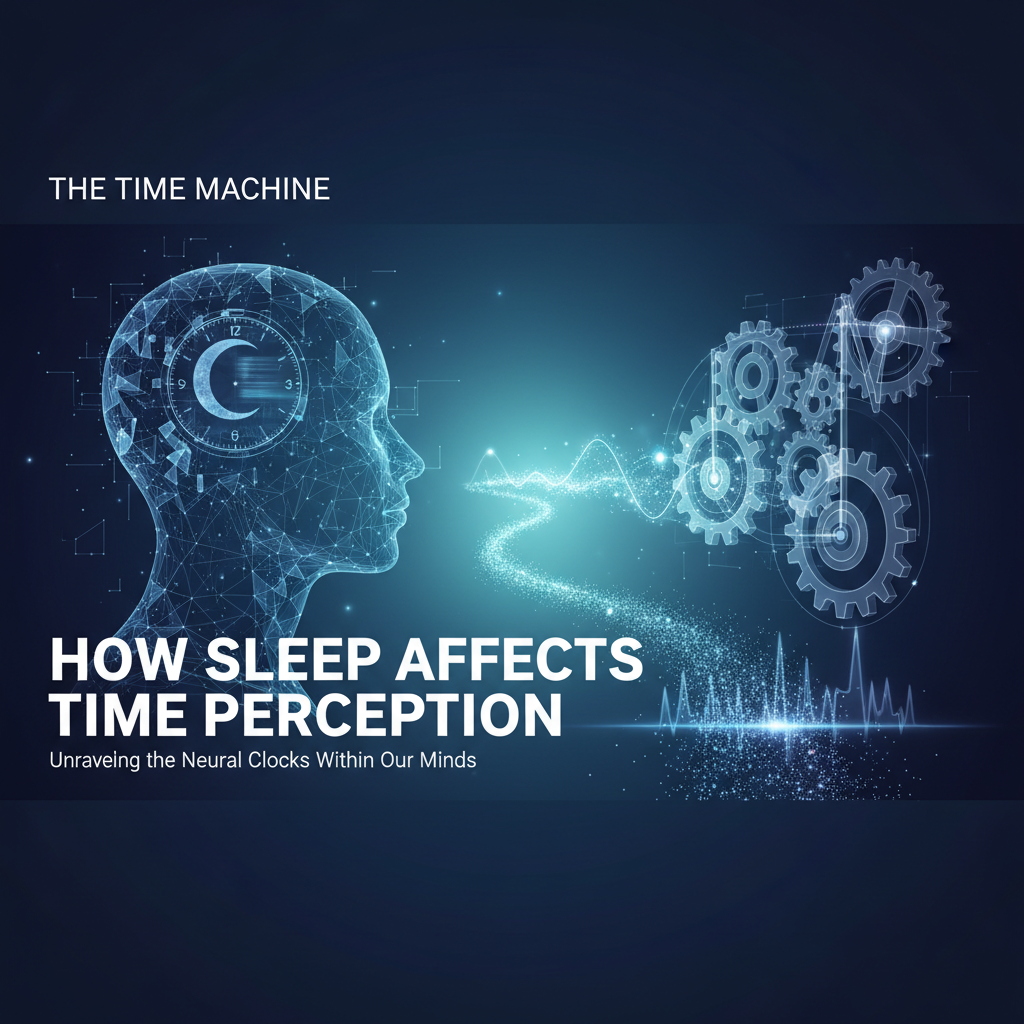
How Sleep Affects Time Perception
 Dominic Mueller
The Chronometer Within: How Sleep Shapes Our Perception of Time
Have you ever woken up feeling like the night flew by in an instant, or conversely, dragged on for an eternity? This common experience hints at a profound and often overlooked connection: the intricate dance between sleep and our perception of time. While we often view time as an external, objective force – a relentless ticking of seconds, minutes, and hours – our internal experience of it is anything but constant. It stretches and shrinks, accelerates and decelerates, often under the subtle yet powerful influence of one of life's most fundamental biological needs: sleep.
In our bustling, always-on world, sleep is often the first thing sacrificed at the altar of productivity and entertainment. Yet, this vital physiological process isn't just about resting our bodies; it's a complex, multi-stage journey through different brain states that profoundly recalibrates our cognitive functions, including our perception of duration. From the fleeting moments of a dream-filled REM cycle to the deep, restorative delta waves, sleep acts as an internal chronometer, subtly altering how we measure, recall, and anticipate the passage of time.
This article will delve into the fascinating science behind how sleep sculpts our temporal awareness. We'll explore the various ways insufficient, disrupted, or even optimal sleep impacts our internal clock, drawing on compelling research and offering practical insights into how we can leverage the power of sleep to better navigate our temporal world.
The Dual Nature of Time: Objective vs. Subjective
Before we dive into the intricacies of sleep, it's crucial to distinguish between two fundamental aspects of time. Objective time refers to the measurable, external progression of events, universally understood and quantified by clocks. Subjective time, on the other hand, is our internal, psychological experience of duration. This subjective experience is highly plastic, influenced by a myriad of factors, including our emotional state, attention, age, and crucially, our sleep patterns.
Think of waiting for a bus when you're late – those minutes crawl by. Now imagine a thrilling concert – hours vanish in what feels like moments. These examples neatly illustrate the power of subjective time. Sleep, in its different forms and qualities, acts as a powerful lever on this subjective temporal experience, sometimes compressing it, sometimes expanding it.
The Sleep Stages and Their Temporal Signatures
Sleep isn't a monolithic state; it's a complex cycle of distinct stages, each with its own unique brain wave patterns and physiological characteristics. These stages, broadly categorized into Non-Rapid Eye Movement (NREM) and Rapid Eye Movement (REM) sleep, each play a role in shaping our temporal perception.
NREM Sleep: The Deeper Dive
NREM sleep is divided into three stages (N1, N2, N3), with N3 being the deepest and most restorative. During N3, also known as slow-wave sleep, brain activity slows considerably, and delta waves dominate.
- Temporal Distortion: Research suggests that being awakened from deep NREM sleep can lead to significant temporal disorientation. Individuals often underestimate how long they've been asleep, or wake feeling as if no time has passed at all. This is likely due to the brain's reduced processing of external stimuli and the diminished cognitive functions during this profound state. When we're deprived of this deep sleep, our internal clock can become less accurate, affecting our ability to judge durations once we're awake.
- Memory Consolidation and Time: While not directly about time perception during sleep, NREM sleep is critical for memory consolidation. As memories are processed and moved from short-term to long-term storage, they are intrinsically linked to the temporal context in which they were formed. Disruptions to NREM sleep can impair this process, leading to a less cohesive and temporally accurate memory of past events, which indirectly influences our overall sense of time's flow.
REM Sleep: The Land of Dreams and Time Warps
REM sleep is arguably the most fascinating stage when it comes to time perception. Characterized by rapid eye movements, muscle paralysis, and vivid dreaming, REM sleep is a period of intense brain activity, often mirroring wakefulness.
- Dream Time vs. Real Time: Dreams are notoriously fluid with time. A dream sequence that feels like hours might have unfolded in mere minutes of real time. This disconnect highlights how our brain, freed from the constraints of sensory input and immediate external reality, can construct its own highly subjective temporal narratives. The brain's ability to compress and expand time during dreams suggests a deep plasticity in our temporal processing mechanisms during this state.
- Emotional Processing and Time Estimation: REM sleep is also crucial for emotional processing. Interestingly, strong emotions – whether joy, fear, or anxiety – are known to distort time perception in wakefulness. During REM sleep, the brain is actively processing and regulating emotions. Some researchers hypothesize that this emotional processing during REM sleep might contribute to the unique temporal distortions experienced in dreams and could, subsequently, influence our emotional-affective biases in time perception when awake.
The Impact of Sleep Deprivation: Time's Erosion
Perhaps the most palpable connection between sleep and temporal perception comes from the jarring experience of sleep deprivation. When we don't get enough quality sleep, our cognitive faculties, including our internal clock, begin to falter.
-
Slowing Down Time? Not Always in a Good Way: While a single sleepless night might make the next day feel incredibly long and arduous, this isn't necessarily a precise expansion of subjective time. Instead, it's often a feeling of sluggishness, impaired concentration, and increased effort needed for tasks. This effort expenditure can make time feel slower, but it's more a symptom of cognitive strain than an accurate recalibration of our internal timing mechanisms.
Research has shown that sleep-deprived individuals often make less accurate judgments of elapsed time, tending to over-estimate shorter durations and under-estimate longer ones. This is believed to be due to impaired attentional resources and reduced efficiency of dopamine-related neural circuits, which are integral to our internal clock mechanisms.
-
Impaired Prospective and Retrospective Timing: Sleep deprivation significantly affects both prospective timing (estimating how much time will pass) and retrospective timing (estimating how much time has passed).
- Prospective Timing: Imagine needing to wake up at a specific time without an alarm. A sleep-deprived individual is far less likely to accurately estimate the duration of their sleep and wake up precisely on time.
- Retrospective Timing: Recalling how long a meeting lasted or how long ago an event occurred also becomes more challenging with insufficient sleep. The "temporal tags" that help us anchor memories in time become smudged or lost.
-
Reduced Temporal Accuracy for Tasks: In experiments, sleep-deprived participants perform worse on tasks requiring precise timing, such as tapping a rhythm or estimating the duration of visual stimuli. This impairment extends to real-world scenarios, impacting professions requiring acute temporal judgment, from pilots to surgeons.
Circadian Rhythm and the Internal Clock
Central to understanding how sleep influences time perception is the circadian rhythm. This approximately 24-hour internal clock, primarily regulated by the suprachiasmatic nucleus (SCN) in the brain, governs our sleep-wake cycle, hormone release, body temperature, and many other physiological processes.
-
Synchronization is Key: Our internal clock is ideally synchronized with the external 24-hour light-dark cycle. When this synchronization is disrupted – due to jet lag, shift work, or inconsistent sleep patterns – the entire system goes awry.
A desynchronized circadian rhythm can directly impact our neural timing mechanisms. The neurotransmitters and brain regions involved in regulating our sleep-wake cycle are also intimately linked to how we perceive and process time. When these systems are out of sync, our subjective experience of time can become fragmented, leading to feelings of disorientation and a general unease with the passage of days and nights.
-
Timing of Sleep Affects Perception: It's not just the amount of sleep, but when we sleep, that matters. Sleeping at biologically inappropriate times (e.g., trying to sleep during the day if you're a night-shift worker) can lead to poorer sleep quality and greater cognitive impairment, which in turn distorts temporal perception.
Technology's Role: Disrupting the Chronometer
In our modern age, technology, while offering unprecedented convenience, has become a significant disruptor of natural sleep patterns, thereby indirectly impacting our temporal processing.
- Blue Light and Circadian Disruption: The ubiquity of screens emitting blue light – from smartphones, tablets, and computers – is a major culprit. Blue light suppresses melatonin production, delaying sleep onset and shifting our circadian rhythm. This constant disruption messes with our natural sleep cues, making it harder for our internal clock to stay synchronized and potentially leading to a more erratic sense of time's passage.
- "Revenge Bedtime Procrastination": A growing phenomenon, especially among young adults, where individuals sacrifice sleep to reclaim personal time lost during a busy day. While understandable, this deliberate sleep deprivation has the same detrimental effects on temporal perception and cognitive function as unintentional sleep disruption. The irony is that by "gaining" a few extra hours awake, we ultimately diminish our ability to effectively process and appreciate the time that follows.
Practical Takeaways: Reclaiming Our Internal Chronometer
Understanding the profound link between sleep and time perception offers valuable insights. By prioritizing and optimizing our sleep, we can not only improve our overall well-being but also enhance our connection to and understanding of time itself.
- Prioritize Consistent Sleep Schedules: Go to bed and wake up at roughly the same time every day, even on weekends. This strengthens your circadian rhythm and helps calibrate your internal clock.
- Create a Conducive Sleep Environment: Ensure your bedroom is dark, quiet, and cool. Eliminate blue light exposure from screens at least an hour before bedtime.
- Mind Your Melatonin: Consider dimming lights in the evening to naturally encourage melatonin production. If struggling, consult a doctor about melatonin supplements.
- Embrace Naps Wisely: Short power naps (20-30 minutes) can be restorative and boost cognitive function without inducing sleep inertia. Longer naps, especially in the late afternoon, can disrupt nighttime sleep.
- Manage Stress: Chronic stress can interfere with sleep and directly impact time perception. Incorporate relaxation techniques like meditation or deep breathing into your routine.
- Regular Exercise: Physical activity (but not too close to bedtime) promotes deeper sleep, which is critical for accurate temporal processing.
- Limit Caffeine and Alcohol: Both can disrupt sleep stages, particularly REM and deep NREM, thereby impacting memory consolidation and temporal awareness.
Conclusion: Mastering the Flow of Time Through Rest
Our perception of time is a marvel of biological engineering, a complex internal chronometer constantly being recalibrated by our mental and physical states. Among these influences, sleep stands as a fundamental architect, subtly shaping how we experience the duration of our lives. From the vivid time-warps of our dreams to the temporal distortions induced by sleep deprivation, it's clear that sleep is far more than mere unconsciousness; it's an active process of cognitive and physiological restoration that underpins our very sense of reality.
In a world obsessed with efficiency and the relentless pursuit of more hours in the day, the science tells us a different story. True mastery over our experience of time may not come from squeezing out extra hours, but from embracing the profound restorative power of sleep. By respecting our biological need for consistent, quality rest, we don't just rejuvenate our bodies; we synchronize our internal chronometer, allowing us to perceive time more accurately, appreciate its moments more deeply, and ultimately, navigate the temporal landscape of our lives with greater clarity and purpose. The ticking clock outside may be objective, but the clock within is a gift, finely tuned and cherished by the profound mystery of sleep.
Make Every Second Count
Inspired by this article? Take action now! Create a custom timer to help you manage your time better and reach your goals.
Create Your TimerAbout Dominic Mueller
Dominic Mueller is a German director for television and film with a deep fascination for time and time measurement. When he's not behind the camera crafting compelling visual stories, he explores the intricate world of temporal perception and timekeeping. Based in the beautiful city of Cologne, Germany, Dominic shares his life with his girlfriend and their beloved dog, Nala, finding inspiration in both the precise mechanics of time and the fleeting moments that make life meaningful.