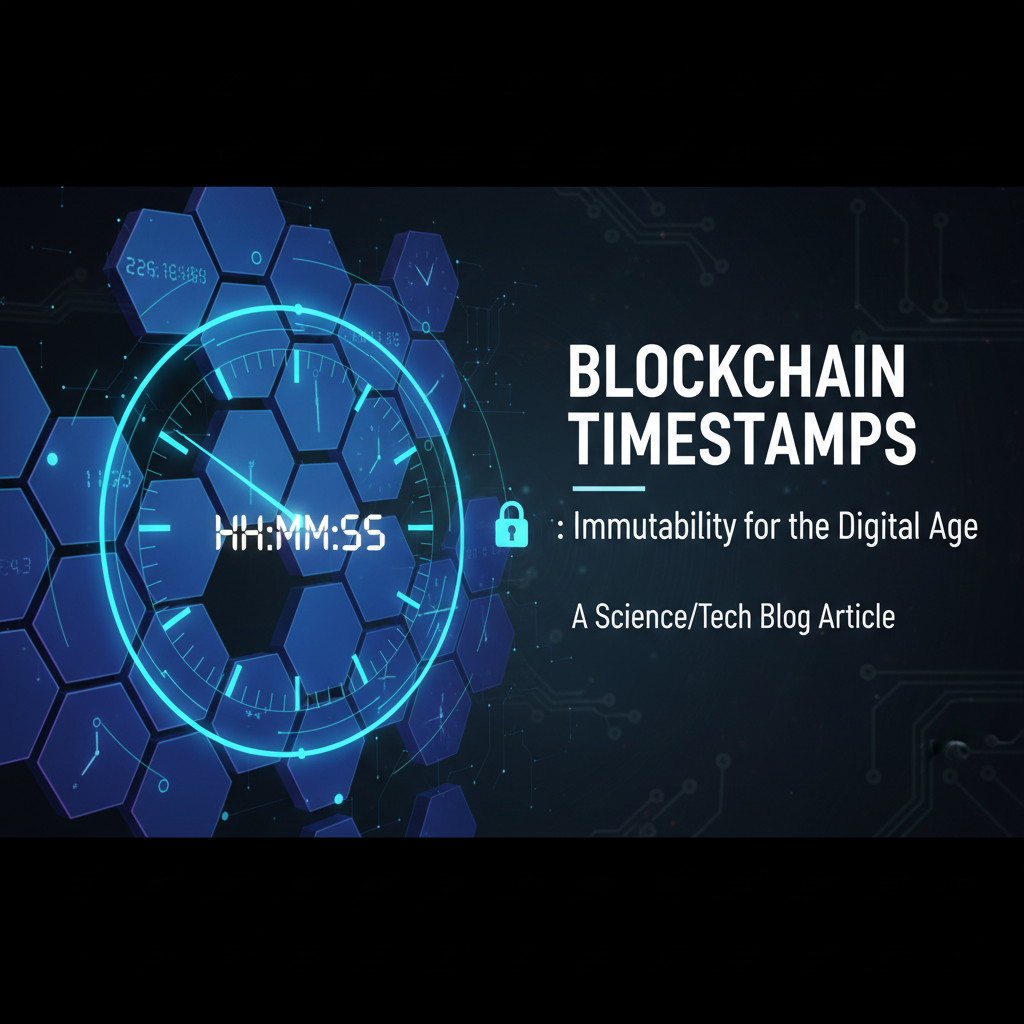
Blockchain Timestamps: Immutability for the Digital Age
 Dominic Mueller
Blockchain Timestamps: Immutability for the Digital Age
In a world drowning in digital data, where information is constantly being created, modified, and sometimes mysteriously altered, the concept of an unchangeable record feels like a digital utopia. Imagine a photograph, a medical record, or a legal document, stamped with a seal so robust that no one, not even the most sophisticated hacker, could tamper with its creation date or content without leaving an undeniable trace. This isn't science fiction; it's the power of blockchain timestamps, a revolutionary technology that is forging a new era of trust and integrity in the digital realm.
At its heart, a timestamp is a record of the time a specific event occurred. From ancient sundials to precise atomic clocks, humanity has always sought ways to chronicle time. But traditional timestamps are often centralized – relying on a single authority or system that can be compromised. Blockchain timestamps, however, disrupt this paradigm by leveraging the decentralized, cryptographic strength of blockchain technology, offering an unparalleled level of immutability and verifiable proof of existence. This article will delve into the fascinating world of blockchain timestamps, exploring their mechanics, applications, and profound implications for ensuring the integrity of our digital age.
The Problem with Traditional Timestamps: A Fragile History
Before we appreciate the innovation of blockchain timestamps, it’s crucial to understand the limitations of their predecessors. Think about the timestamp on a document in your computer, or the "last modified" date on a file. These are easily manipulated. A simple change to your system's clock can alter the timestamp of a file you create. Software engineers can backdate or forward-date events in logs. For critical information – legal contracts, intellectual property, medical records, or even digital currency transactions – this fragility is unacceptable.
- Centralized Authority: Traditional timestamps often rely on a central server or authority to provide the time. If this authority is compromised, the integrity of all timestamps issued by it is jeopardized.
- Lack of Verifiability: How do you definitively prove that a document existed at a specific point in time if the timestamp can be easily faked? This lack of independent verification is a major hurdle in disputes.
- Vulnerability to Tampering: Without strong cryptographic safeguards, anyone with access to a system can potentially alter timestamps, making it difficult to establish a true chronology of events.
These vulnerabilities undermine trust and open doors for fraud, intellectual property theft, and legal disputes. The need for a tamper-proof, verifiable timestamp is not merely a convenience, but a fundamental requirement for a secure and trustworthy digital future.
How Blockchain Timestamps Work: A Chronological Chain of Trust
The magic of blockchain timestamps lies in their inherent connection to the blockchain itself. A blockchain is a distributed, immutable ledger that records transactions in "blocks." Each block is cryptographically linked to the previous one, forming a "chain." This structure is what gives blockchain timestamps their power.
Here's a simplified breakdown of the process:
- Hashing the Data: When you want to timestamp a piece of digital information (a document, an image, a video, a piece of code), it's first put through a cryptographic hash function. This function takes the data and produces a fixed-size string of characters called a "hash" or "digital fingerprint." Even a tiny change to the original data will result in a completely different hash. This is a one-way process; you can't reconstruct the original data from its hash.
- Integrating into a Block: This unique hash is then bundled together with other transaction hashes and a timestamp of its own (the block creation time). This bundle forms a new block in the blockchain.
- Cryptographic Linking: Each new block contains a cryptographic hash of the previous block. This creates an unbreakable link. If anyone tries to alter a hash within an older block, the hash of that block would change. This would, in turn, change the hash of the next block, and so on, cascading through the entire chain. This immediate and verifiable alteration makes tampering virtually impossible to conceal.
- Distributed Consensus: The newly created block and its contents (including your timestamped hash) are then broadcast to the entire network of computers (nodes) participating in the blockchain. These nodes verify the block's authenticity and add it to their copy of the ledger. This decentralized consensus mechanism ensures that no single entity can control or alter the record.
Interesting Fact: The very first block in a blockchain is often called the "genesis block." Bitcoin's genesis block, mined on January 3, 2009, notably includes the headline "The Times 03/Jan/2009 Chancellor on brink of second bailout for banks" – a subtle, yet powerful, timestamp acknowledging the state of the world at its creation.
What makes this system so formidable is the combination of cryptographic hashing and decentralized immutability. Once a hash is embedded into a block and that block is added to the chain, it's practically set in stone. Attempting to alter it would require recalculating the hashes of all subsequent blocks, and then convincing the majority of the decentralized network to accept this fraudulent chain – a computationally Herculean and practically impossible task for a robust, well-distributed blockchain.
Practical Applications: Where Timestamps Shine
The implications of truly immutable timestamps are vast and extend across numerous industries, offering solutions to age-old problems of trust and verification.
1. Intellectual Property Protection
For artists, writers, inventors, and innovators, proving original creation and ownership is paramount.
- Copyrights: A musician can timestamp their new song, providing undeniable proof of its existence at a specific moment before public release. If a dispute arises later, the blockchain timestamp serves as powerful evidence of prior creation.
- Patents: Inventors can timestamp their research notes, designs, or prototypes, establishing a verifiable timeline for their innovation process.
- Digital Art & NFTs: Non-Fungible Tokens (NFTs) inherently leverage blockchain timestamps to establish unique ownership and provenance for digital assets. The timestamp marks the moment of creation or first minting, solidifying its place in the digital ledger.
2. Legal and Regulatory Compliance
The legal world, heavily reliant on verifiable records and strict adherence to timelines, is a prime beneficiary.
- Contractual Agreements: Timestamping digital contracts provides irrefutable proof of their signing date and content at that precise moment. This eliminates disputes over retroactively altered terms.
- Evidence Tamper-Proofing: Digital evidence, from surveillance footage to intercepted communications, can be timestamped to prove its integrity and prevent accusations of doctoring or manipulation in court.
- Regulatory Filings: Businesses can timestamp regulatory submissions, ensuring compliance officers can verify the exact time and content of crucial filings.
3. Supply Chain Management and Logistics
Tracking goods from origin to consumer can be complex and prone to fraud.
- Provenance Verification: Timestamping key events in a supply chain – manufacturing, shipping, customs clearance, delivery – creates an immutable timeline. Consumers can then verify the authenticity and journey of a product, combating counterfeiting.
- Temperature Monitoring: For perishable goods, sensors can record temperature data, which can then be timestamped and anchored to a blockchain. This provides undeniable proof of proper storage conditions throughout transit.
4. Data Integrity and Audit Trails
Ensuring the accuracy and unalterability of data is critical for numerous sectors.
- Medical Records: Timestamping patient data, diagnoses, and treatment plans provides an unalterable audit trail, enhancing patient safety and reducing medical fraud.
- Financial Transactions: While primarily known for currency, blockchain technology's timestamping capabilities are crucial for tracking the precise moment financial transactions occur, invaluable for auditing and reconciliation.
- Academic Research: Researchers can timestamp their experimental data or research papers, ensuring academic integrity and preventing disputes over prior publication.
5. Cybersecurity and Auditing
- Log Files: Server logs, security events, and audit trails can be timestamped on a blockchain, creating a tamper-proof record of system activity. If a breach occurs, investigators can rely on these immutable logs to reconstruct events accurately.
- Software Release Dates: Developers can timestamp code releases, ensuring that specific versions of software are traceable and verifiable at different stages of development.
The Power of the "Proof of Existence"
The core takeaway from blockchain timestamps is their ability to provide "proof of existence." It doesn't necessarily prove ownership (though it often aids in it), nor does it guarantee the accuracy of the content itself, but it irrefutably confirms that a specific piece of digital data existed in an exact state at a precise moment in time. This distinction is important. While you can timestamp a document, the blockchain doesn't magically verify if the information within that document is true; it only confirms its integrity and creation time.
This seemingly simple concept has profound implications. In a digital world where information is fluid, fragile, and often manipulated, cryptographic timestamps provide a stable anchors – immutable markers in the relentless flow of data.
Challenges and Considerations: Not a Panacea
While immensely powerful, blockchain timestamps are not without their considerations:
- Scalability: High volumes of timestamping requests can sometimes strain the capacity of public blockchains, leading to slower confirmation times or higher transaction fees. Dedicated timestamping services or layer-2 solutions are emerging to address this.
- Cost: While often inexpensive per individual timestamp, large-scale enterprise adoption can incur costs.
- Energy Consumption: Public blockchains, especially those using Proof-of-Work (like Bitcoin), have an environmental footprint due to their energy consumption. More energy-efficient consensus mechanisms are being developed and adopted.
- User Experience: For widespread adoption, the process of generating hashes and anchoring them to a blockchain needs to become more user-friendly and integrated into existing workflows.
- Long-Term Archiving: While the record on the blockchain is immutable, what about the original data itself? The hash ensures integrity, but the data still needs to be stored reliably somewhere offline or in decentralized storage solutions for future retrieval.
Despite these challenges, the trajectory of blockchain timestamps is clear: they are becoming an indispensable tool for securing digital assets and establishing incontrovertible timelines.
The Future is Time-Anchored
The digital age, characterized by its ephemeral nature, is paradoxically finding its anchor in the immutable, time-stamped records of blockchain technology. We are moving towards a future where every significant digital event, from the creation of a piece of art to the signing of a multi-million-dollar contract, can be indelibly marked with an unchangeable proof of time.
This isn't just about security; it's about building a digital infrastructure grounded in trust. When every record can be verified, when every timestamp is beyond dispute, we unlock new possibilities for transparency, accountability, and justice. Blockchain timestamps are more than just a technological innovation; they are a fundamental shift in how we perceive and prove the chronology of our digital existence, offering a beacon of immutability in an increasingly fluid world. As the digital landscape continues to evolve, the demand for verifiable and tamper-proof timelines will only grow, making blockchain timestamps an essential cornerstone for the integrity of our interconnected future.
Make Every Second Count
Inspired by this article? Take action now! Create a custom timer to help you manage your time better and reach your goals.
Create Your TimerAbout Dominic Mueller
Dominic Mueller is a German director for television and film with a deep fascination for time and time measurement. When he's not behind the camera crafting compelling visual stories, he explores the intricate world of temporal perception and timekeeping. Based in the beautiful city of Cologne, Germany, Dominic shares his life with his girlfriend and their beloved dog, Nala, finding inspiration in both the precise mechanics of time and the fleeting moments that make life meaningful.