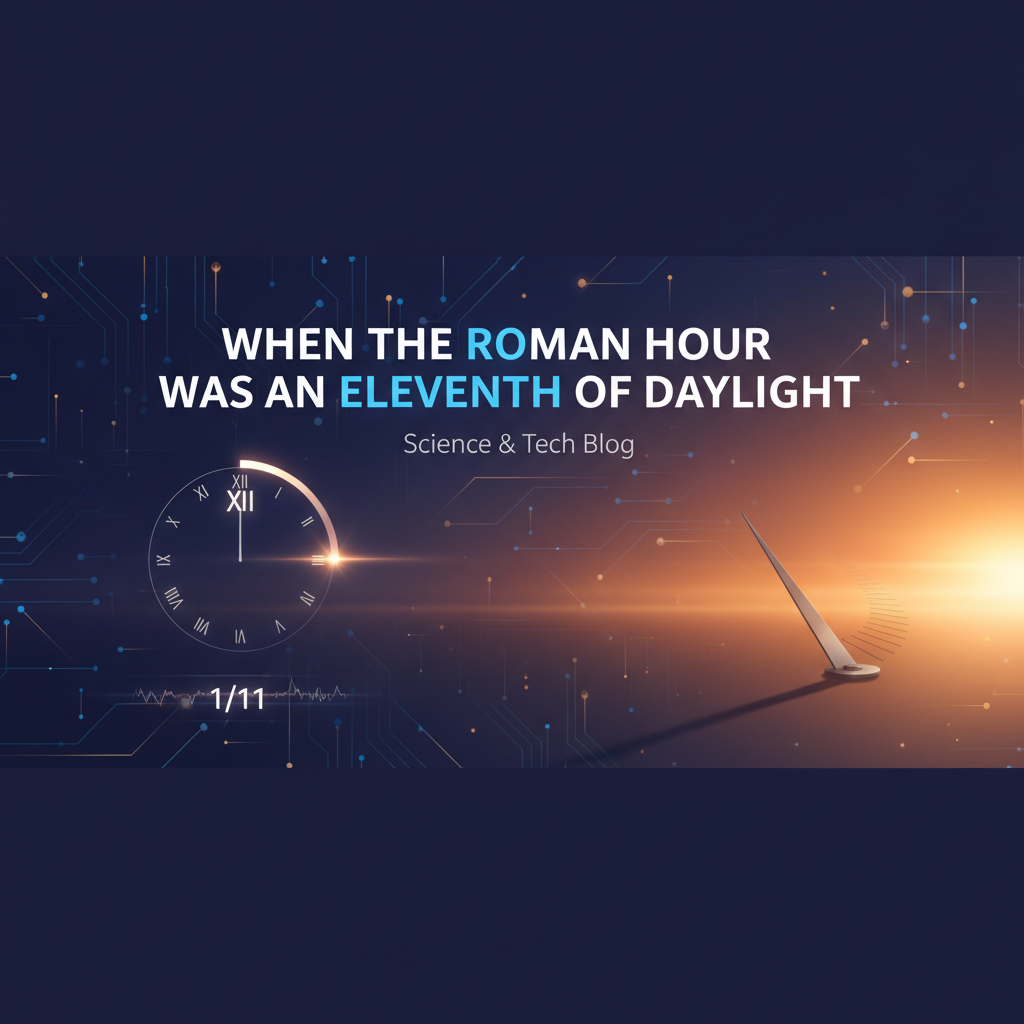
When the Roman Hour Was an Eleventh of Daylight
 Dominic Mueller
When the Roman Hour Was an Eleventh of Daylight: Unpacking an Ancient Time-Keeping System
Imagine a world where the length of an hour wasn't fixed. Where midday could be 12:00 PM one day, and an hour later the next. Where the rhythm of daily life danced to the sun's whims, and your morning commute might take 2 "hours" in winter, but only 1.5 "hours" in summer. This wasn't some abstract philosophical concept; it was the lived reality for vast swathes of humanity for millennia, encapsulated perfectly by the Roman hour.
Before the tick-tock of mechanical clocks standardized our perception of time, societies often divided the day and night into flexible segments. Among these, the Roman system of "temporal hours" stands out as a fascinating testament to a different relationship with time – one deeply intertwined with the natural world. Far from being a rigid sixty minutes, a Roman hour was, for much of its existence, simply an eleventh of daylight. This seemingly simple definition unlocks a profound historical narrative about precision, daily life, and the very concept of measuring the passage of moments.
In this comprehensive exploration, we'll journey back to ancient Rome and beyond, delving into the intricacies of temporal hours, their origins, how they shaped daily life, and why their legacy continues to echo in our modern, hyper-precise world.
The Flexible Fabric of Ancient Time
To truly grasp the Roman hour, we must first shed our modern chronocentric biases. Our 24-hour day, divided into sixty-minute hours and sixty-second minutes, is a relatively recent invention, solidified by the advent of reliable mechanical clocks in the late Middle Ages and early Renaissance. Before this technological leap, time-keeping was largely solar-dependent and contextual.
Early civilizations, observing the constant cycle of the sun and stars, naturally sought to divide the day and night into manageable segments. Their primary motivations weren't about tracking atomic precision but about coordinating human activities: when to wake, when to work, when to eat, and when to sleep.
Origins of the Temporal Hour: A Sumerian Legacy?
The concept of dividing the day and night into twelve parts each isn't uniquely Roman. It likely has roots in earlier civilizations, particularly the Babylonians and Egyptians. The Babylonians, with their advanced astronomical observations and sexagesimal (base-60) number system, were pivotal. They divided the celestial circle into 360 degrees and applied this division to time, influencing later cultures.
The Egyptians, too, divided the daylight into ten hours, with an hour for dawn and an hour for dusk, totaling twelve daytime hours. They also divided the night into twelve hours using decan stars. This dual division of daylight and night into twelve parts, regardless of their actual duration, became a widespread practice. The Romans, inheriting much from Greek and ultimately earlier Near Eastern traditions, adopted and adapted this system.
Unpacking the Roman Daytime Hour: A Shifting Metric
For the Romans, the period from sunrise to sunset constituted the dies artificialis (artificial day), and this was divided into twelve equal "hours". Similarly, the period from sunset to sunrise, the nox (night), was also divided into twelve "hours."
Here's the crucial point: since the length of daylight and night varies significantly with the seasons and latitude, the length of these "hours" also varied.
- Summer Solstice (longest day): In Rome, around June 21st, daylight could last approximately 15 hours. Each daytime Roman hour would therefore be around 75 modern minutes long (15 hours * 60 minutes / 12 hours = 75 minutes). Conversely, the night would be shorter (approx. 9 hours), making each nocturnal Roman hour around 45 modern minutes (9 hours * 60 minutes / 12 hours = 45 minutes).
- Winter Solstice (shortest day): Around December 21st, daylight might last only about 9 hours. Each daytime Roman hour would shrink to approximately 45 modern minutes (9 hours * 60 minutes / 12 hours = 45 minutes). The night, being longer (approx. 15 hours), would have nocturnal hours stretching to 75 modern minutes (15 hours * 60 minutes / 12 hours = 75 minutes).
- Equinoxes (equal day and night): Around March 20th and September 22nd, daylight and night are roughly equal (12 hours each). On these days, a Roman hour would align perfectly with a modern hour of 60 minutes (12 hours * 60 minutes / 12 hours = 60 minutes).
This means that a "first hour of the day" (or prima hora) in summer was significantly longer than a "first hour of the day" in winter. Similarly, the "ninth hour" (nona hora) – a significant time in Roman culture, often associated with the main meal – shifted its actual modern clock time throughout the year.
How Were These Hours Measured?
Measuring these fluctuating hours required ingenuity:
- Sundials (Solaria): The most common public timekeeping device, sundials indicated the temporal hours by the length and direction of a gnomon's shadow. Roman sundials were often elaborate and precisely calibrated for their specific latitude, featuring curved lines to account for the changing trajectory of the sun throughout the year. However, they were useless on cloudy days or at night.
- Water Clocks (Clepsydrae): For indoor use, cloudy days, and especially for night, water clocks were indispensable. These devices measured time by the regulated flow of water from one vessel to another. For temporal hours, water clocks had to be adjusted seasonally. This could involve:
- Changing the water flow rate: By adjusting an orifice.
- Changing the scale on the receiving vessel: The most common method, where the markings for each hour would be different depending on the month. Some advanced clepsydrae had revolving drums or interchangeable scales to account for the seasonal variations.
- Astronomy: While not for daily use by the general public, astronomers and priests used stellar observations and star charts to determine the passage of nocturnal hours, often correlating them with the rising and setting of specific constellations.
The seasonal adjustment of these instruments required a certain level of astronomical knowledge and craftsmanship. Public water clocks, for instance, would have required constant attention and recalibration by designated officials or enslaved persons.
The Roman Day: A Schedule of Temporal Hours
Understanding the Roman hour allows us to visualize the rhythm of daily life in the empire. Rather than adhering to fixed clock times, their schedule revolved around these flexible temporal divisions.
Here’s a typical Roman day, described in temporal hours:
- Prima Hora (1st Hour): Sunrise. Time to wake up, don a toga, and greet the day.
- Secunda – Quarta Hora (2nd – 4th Hours): Business and legal affairs commenced. This was the time for citizens to attend to their patronage duties, visit the forum, engage in trade, or attend legal proceedings.
- Quinta Hora (5th Hour): A light breakfast (ientaculum) or break.
- Sexta Hora (6th Hour): Midday (meridies). Often marked by a pause in strenuous activity, especially in summer.
- Septima – Octava Hora (7th – 8th Hours): More work, public duties, or academic pursuits.
- Nona Hora (9th Hour): The most significant hour for leisure. This was the traditional time for the main meal (cena) to begin, often preceded by a visit to the public baths. For many, this marked the end of the official working day.
- Decima – Duodecima Hora (10th – 12th Hours): Continued dining, socializing, or relaxation. The 12th hour marked sunset (solis occasus).
The Night Watch: Dividing the Darkness
The night was similarly divided into twelve hours, but also into four "watches" (vigiliae), each lasting three temporal hours. These watches were particularly important for military camps and city patrols.
- Prima Vigilia: Sunset to the end of the 3rd nocturnal hour.
- Secunda Vigilia: End of the 3rd to the end of the 6th nocturnal hour (midnight).
- Tertia Vigilia: End of the 6th to the end of the 9th nocturnal hour.
- Quarta Vigilia: End of the 9th nocturnal hour to sunrise.
The shifting length of these watches meant that a guard's shift could be significantly longer or shorter depending on the time of year. This flexibility highlights how accustomed Romans were to a less rigid temporal structure.
Practicalities and Perceptions: Living in Temporal Time
Living by temporal hours had several interesting implications:
- Intuitive Alignment with Nature: The system was inherently ecological. The working day expanded when daylight was plentiful and contracted when it was scarce, aligning human activity with natural light cycles. This was particularly beneficial for agricultural societies.
- Less Emphasis on "Exact" Appointments: While major events like Senate meetings or public sacrifices would be scheduled for specific hours (e.g., tertia hora), the inherent flexibility meant there was less pressure for absolute punctuality as we understand it today. Arriving "on the hour" meant arriving during a 45-to-75-minute window.
- Communication Challenges: How would you tell someone to meet you in "half an hour"? This ambiguity likely led to more descriptive temporal references, such as "when the sun is high in the sky" or "when the shadow reaches the corner of the forum." For finer divisions, Romans used terms like punctum temporis (a point in time) or simply relied on visual cues.
- The Nona Hora Exception: The 9th hour of the day holds particular significance. For centuries, it was the time when Romans ate their main meal. The term nonagenarian (a person in their 90s) is related, reflecting a life well-lived, stretching beyond this key hour.
- The Rise of Equal Hours: While temporal hours dominated, the Romans were not entirely unaware of fixed-length hours. Astronomers, in particular, used equinoctial (equal) hours for their calculations, which were always 60 minutes long. As Roman engineering and administration became more complex, and as knowledge from more mathematically advanced cultures (like the Greeks) filtered in, the need for more standardized time became apparent. By the late Roman Empire, particularly for official records and scientific texts, equinoctial hours began to gain more traction, though temporal hours remained pervasive in daily life.
The Decline of Temporal Hours and the Rise of Mechanical Precision
The transition from temporal hours to the fixed, equinoctial hours we use today was a gradual process, spanning centuries.
- Technological Limitations: Before mechanical clocks, measuring fixed hours precisely was extremely difficult for daily use. Water clocks could be adapted, but required constant calibration. Sundials, by their nature, produced temporal hours.
- The Monastery's Influence: Early Christian monasteries, particularly those following the Rule of St. Benedict, played a crucial role in standardizing time. Monks needed to observe fixed prayer times (e.g., Matins, Lauds, Prime, Terce, Sext, Nones, Vespers, Compline) throughout the day and night, regardless of the season. To achieve this, they were early adopters of more precise water clocks and later, early mechanical clocks. The need for precise scheduling of monastic duties spurred innovation in timekeeping.
- The Mechanical Clock Revolution: The true death knell for temporal hours arrived with the invention and proliferation of mechanical clocks from the 13th century onwards. Initially, these clocks often only had an hour hand, striking the hour. Their growing accuracy and availability made it increasingly practical to divide the day into uniform segments. By the 14th and 15th centuries, public clocks in European cities became common, dictating a new, standardized rhythm of life.
- The Needs of Commerce and Industry: As societies became more urbanized and economies more complex, fixed hours became indispensable for coordinating commerce, trade, and later, industrial production. You couldn't run a train schedule or a factory assembly line on hours that changed with the seasons.
The final triumph of the fixed hour over the temporal hour was a triumph of technology and urbanization over the natural rhythms of an agrarian world.
Practical Takeaways and Enduring Insights
What can we learn from this ancient way of telling time?
- Our Perception of Time is Culturally Constructed: The Roman hour reminds us that our seemingly immutable "60-minute hour" is not a universal constant but a cultural and technological construct. Other cultures have, and still do, perceive and measure time differently.
- The Value of Flexibility: In an age where we are constantly striving for hyper-efficiency and rigid schedules, the Roman system offers a counterpoint. There was an inherent flexibility and responsiveness to the natural environment built into their daily rhythm. Perhaps there's a lesson here for modern work-life balance, allowing our schedules to ebb and flow more naturally with energy levels and seasonal changes.
- Connection to Nature: Living by temporal hours fostered a deeper, more immediate connection to the sun's position. People were more attuned to the changing lengths of days and nights, the shifting seasons, and the subtle cues of the natural world.
- Understanding Historical Texts: Knowing about temporal hours is crucial for interpreting ancient texts, literature, and historical accounts. When a Roman author mentions the "third hour," they aren't referring to 9:00 AM sharp, but to a flexible period that shifted throughout the year.
Conclusion: The Sun's Ancient Rulers
The Roman hour, a segment of daylight or night that varied with the seasons, serves as a powerful reminder of how profoundly our ancestors lived in sync with the natural world. It was a time-keeping system born of necessity, guided by the sun, and deeply embedded in the social and cultural fabric of one of history's greatest empires.
While our world now operates on the precise, unwavering pulse of atomic clocks, the ghost of the temporal hour lingers. It prompts us to reflect on the nature of time itself, not just as a series of ticking seconds, but as a fluid, culturally interpreted phenomenon. It reminds us that for millennia, the human day was not rigidly bounded by numbers on a dial, but stretched and contracted like a living thing, perpetually an eleventh of daylight, dictating the rhythm of life under the ancient sun. In understanding this ancient system, we gain not just a historical curiosity, but a deeper appreciation for the complex and evolving relationship humanity has always had with the most ephemeral of all dimensions: time itself.
Make Every Second Count
Inspired by this article? Take action now! Create a custom timer to help you manage your time better and reach your goals.
Create Your TimerAbout Dominic Mueller
Dominic Mueller is a German director for television and film with a deep fascination for time and time measurement. When he's not behind the camera crafting compelling visual stories, he explores the intricate world of temporal perception and timekeeping. Based in the beautiful city of Cologne, Germany, Dominic shares his life with his girlfriend and their beloved dog, Nala, finding inspiration in both the precise mechanics of time and the fleeting moments that make life meaningful.