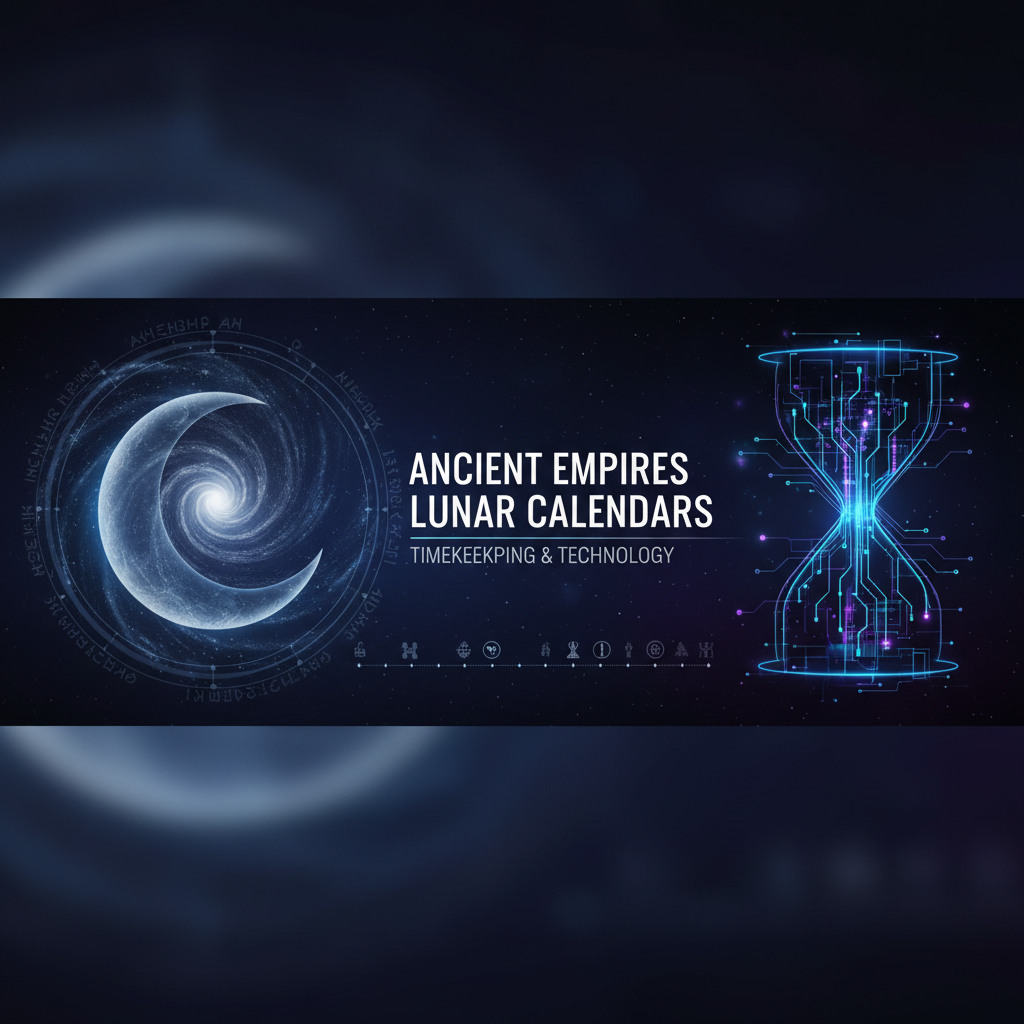
Ancient Empires and Their Lunar Calendars
 Dominic Mueller
Ancient Empires and the Rhythms of the Moon: A Celestial Chronicle of Time
From the dawn of civilization, humanity has gazed up at the night sky, captivated by its celestial dance. Among the myriad stars, one orb has consistently held a special place in our collective consciousness: the Moon. Its mesmerizing cycles of waxing and waning, its predictable phases, and its undeniable influence on tides and harvests, made it a natural clock for early societies. For many ancient empires, the Moon was not just a beautiful spectacle; it was the very heartbeat of their temporal organization, a cosmic calendar that dictated everything from religious festivals to agricultural practices.
This article delves into the fascinating world of ancient lunar calendars, exploring how diverse empires across the globe harnessed the Moon's rhythms to structure their lives. We'll uncover the ingenuity behind their astronomical observations, the cultural significance woven into their calendrical systems, and the lasting legacy of their lunar timekeeping.
The Moon as the First Clock: Why Lunar Calendars?
Before the precision of mechanical clocks or the widespread adoption of solar calendars, the Moon offered a readily observable and remarkably consistent measure of time. Unlike the Sun, whose daily cycle is straightforward, the Moon's synodic period – the time it takes to cycle through all its phases – is approximately 29.5 days. This natural division lent itself perfectly to the concept of a "month."
- Ease of Observation: The phases of the Moon are unmistakable, visible to everyone without complex instruments. The transition from new moon to crescent, first quarter, full moon, and back again provided a clear, universal marker of time's passage.
- Predictability: While precise calculations required sophisticated knowledge, the general pattern of lunar cycles is highly predictable, allowing for long-term planning.
- Agricultural Significance: Many early agricultural societies relied on the Moon's phases to guide planting and harvesting. The full moon, for instance, often marked auspicious times for specific farming activities.
- Religious and Ritualistic Importance: The Moon's mystical glow and its cyclical nature made it a powerful symbol in many ancient religions. Lunar phases often dictated the timing of religious festivals, sacrifices, and rites of passage.
The challenge, however, lay in reconciling the lunar month with the solar year – the actual time it takes for the Earth to orbit the Sun. A solar year is approximately 365.25 days, which doesn't divide neatly into 29.5-day lunar months. This discrepancy led to various ingenious solutions, primarily the development of lunisolar calendars.
Mesopotamia: The Cradle of Lunar Timekeeping
Perhaps nowhere was the Moon's calendrical influence more profound than in ancient Mesopotamia, the "land between the rivers" – home to civilizations like the Sumerians, Akkadians, Babylonians, and Assyrians. These empires were pioneers in astronomy and mathematics, and their detailed observations of the celestial sphere laid the groundwork for future astronomical developments.
The Mesopotamians utilized a lunisolar calendar with months typically beginning on the evening of the first visible crescent moon after sunset. Their year consisted of 12 lunar months, which amounted to roughly 354 days. This meant their calendar would quickly fall out of sync with the seasons. To rectify this, they employed a system of intercalation – adding an extra, or "intercalary," month periodically.
- The 13th Month: Initially, the decision to add a 13th month was made pragmatically, often by royal decree, based on agricultural needs or religious observances. If the barley harvest was late, for example, an extra month might be added to delay the New Year.
- The Metonic Cycle: Over time, Mesopotamian astronomers developed more sophisticated methods. By the 5th century BCE, the Metonic Cycle (named after the Greek astronomer Meton, though its principles were understood much earlier in Mesopotamia) was established. This cycle observed that 235 lunar months are almost precisely equal to 19 solar years. This discovery allowed for a more regular and predictable system of intercalation, adding 7 extra months over a 19-year period. This ingenious mathematical solution ensured their calendar remained aligned with the seasons.
- Significance: The Mesopotamian calendar influenced subsequent civilizations, including the Hebrews and, indirectly, the Greeks. Their meticulous cuneiform tablets, recording astronomical observations and calendrical calculations, provide invaluable insights into their sophisticated understanding of time.
Ancient Egypt: Solar Focus, Lunar Threads
While often associated with its highly accurate solar calendar (365 days, divided into 12 months of 30 days plus 5 epagomenal days), ancient Egypt also maintained a lunar calendar for religious purposes. This dual system highlights the different functions time served in their society.
The Egyptian civil calendar was remarkably practical for administrative and agricultural planning, being tied directly to the annual flooding of the Nile, a purely solar phenomenon. However, the lunar calendar, with its fluid and dynamic nature, was reserved for the more sacred aspects of life.
- Religious Festivals: Many Egyptian festivals, particularly those related to the lunar deities like Thoth and Khonsu, were timed according to the lunar cycle. The full moon often marked important celebrations or rituals.
- The Sothic Cycle: The Egyptians also observed the heliacal rising of Sirius (Sopdet), which heralded the Nile's flood and coincided with the beginning of their solar year. While not a lunar calculation, this observation demonstrates their deep connection to celestial events for timekeeping.
- Contrast with Mesopotamia: This dual calendrical system showcases a different approach to time. Where Mesopotamia continually wrestled with synchronizing moon and sun for daily life, Egypt separated the two, assigning distinct functions to each celestial clock.
The Maya and Aztec Civilizations: Intricate and Intertwined Calendars
Across the Atlantic, in Mesoamerica, civilizations like the Maya and Aztecs developed extraordinarily complex and sophisticated calendrical systems, often more intricate than their Old World counterparts. While primarily driven by solar observations, the Moon played a crucial, albeit often intertwined, role.
The Maya, renowned for their advanced mathematics and astronomy, developed several interlocking cycles:
- The Tzolkin (Sacred Round): A 260-day calendar, formed by the permutation of 20 day names with 13 day numbers. This calendar had no direct lunar correlation but was deeply significant for ritual and divination.
- The Haab' (Vague Year): A 365-day solar calendar, similar to the Egyptian civil calendar, consisting of 18 months of 20 days each, plus a 5-day "unlucky" period.
- The Calendar Round: The combination of the Tzolkin and the Haab' resulted in a 52-year cycle, after which a specific Tzolkin day and Haab' day would align again.
- Lunar Series: While not their primary calendar, the Maya also meticulously tracked lunar cycles. Inscriptions reveal a Lunar Series that recorded the age of the moon, its phase, and the length of lunar months (either 29 or 30 days) to keep pace with the Moon's true synodic period. This demonstrates a remarkably precise understanding of lunar astronomy.
The Aztecs, who inherited much of their calendrical knowledge from earlier Mesoamerican cultures, also utilized a 260-day ritual calendar (Tonalpohualli) and a 365-day civil calendar (Xihuitl). While their systems focused heavily on solar cycles and Venus, the underlying knowledge of lunar periods was present, especially in astronomical observations that informed their religious practices. The Moon, referred to as Metztli, held significant symbolic power related to water, fertility, and the night.
Ancient China: The Harmony of Heaven and Earth
Ancient China's relationship with time was deeply philosophical, viewing the calendar as a reflection of the harmonious interplay between Heaven (celestial bodies) and Earth (seasonal changes). Their calendar was fundamentally lunisolar, making it one of the longest continuously used calendrical systems in history.
The traditional Chinese calendar operates on a cycle of 12 lunar months, each beginning with the new moon. To keep pace with the solar year, an intercalary month is added roughly every three years, using a sophisticated rule based on the 24 solar terms (sections of the ecliptic).
- The 24 Solar Terms: These are 24 specific points in the Sun's annual path, marking significant seasonal changes like solstices, equinoxes, and periods for planting or harvesting. The intercalary month is added when a lunar month contains no principal solar term. This elegant system ensures agricultural activities remain aligned with the solar year while maintaining the lunar rhythm for festivals.
- The Zodiac Cycle: The Chinese calendar also incorporates a 12-year animal zodiac cycle, where each year is associated with an animal (Rat, Ox, Tiger, etc.). This cycle is tied to the movement of Jupiter, demonstrating another layer of celestial observation.
- Emperor's Mandate: The accuracy of the calendar was paramount for the emperor, as it was believed to reflect the "Mandate of Heaven." Errors in the calendar could be seen as a sign of divine disapproval, leading to meticulous astronomical observations and calculations by imperial astronomers.
Greece and Rome: From Lunar Beginnings to Solar Dominion
Early Greek city-states, like many ancient societies, used lunisolar calendars. Their months began with the new moon, and intercalation was used to realign with the solar year. However, the lack of a standardized system led to considerable confusion, with different city-states having their own unique calendrical adjustments. The Athenian calendar, for example, was a prominent lunisolar system.
The Roman calendar, in its earliest forms, was also based on the Moon. Legend attributes the earliest Roman calendar to Romulus, with 10 months and a significant gap during winter. Numa Pompilius is credited with adding January and February, creating a 12-month lunisolar calendar with 355 days and irregular intercalation.
- Political Manipulation: The Roman Republic's calendar became notoriously inaccurate and subject to political manipulation. Priests (the Pontifices) were responsible for adding intercalary months, and they often used this power to extend the terms of favored magistrates or shorten those of opponents.
- Julius Caesar's Reform: This chaos led to the monumental reform by Julius Caesar in 45 BCE. With the help of the Alexandrian astronomer Sosigenes, he introduced the Julian Calendar, a purely solar calendar of 365.25 days, with a leap day every four years. This marked a decisive shift away from lunar-based timekeeping for civil purposes in the Western world.
- Legacy: The Julian calendar, while later refined into the Gregorian calendar we use today, was a profound departure. It prioritized solar alignment for administrative efficiency and became a cornerstone of Western time. However, the influence of the lunar calendar can still be seen in the names of months (e.g., "Mensis" meaning moon/month) and in the timing of religious holidays like Easter, which is calculated based on the vernal equinox and the full moon.
Practical Takeaways and Enduring Insights
The study of ancient lunar calendars offers several compelling insights:
- Ingenuity in Observation: These cultures demonstrated incredible observational skills and mathematical prowess, developing complex systems without modern technology. Their ability to track celestial movements for millennia is a testament to human curiosity and intelligence.
- Cultural Embeddedness of Time: Calendars were never just scientific instruments; they were deeply interwoven with religion, agriculture, politics, and social life. The way a society measures time reveals its values and priorities.
- The Quest for Accuracy: Despite the challenges of reconciling lunar and solar cycles, ancient astronomers relentlessly sought greater accuracy, recognizing the practical and spiritual importance of a well-ordered calendar.
- The Cycle of Innovation: From simple observation to sophisticated intercalation rules, the evolution of lunar calendars showcases a continuous process of learning, adaptation, and refinement driven by necessity and intellectual curiosity.
- A Shared Human Experience: Across vastly different cultures and continents, the Moon served as a universal temporal guide, connecting humanity to the grander rhythms of the cosmos.
Conclusion: The Moon's Lasting Echo
Though the solar calendar now dominates global timekeeping, the legacy of ancient lunar calendars persists. Many religious traditions, from Islam to Judaism and various East Asian cultures, continue to follow lunar or lunisolar calendars for their festivals and holy days. The very concept of a "month" as an approximate lunar cycle remains etched in our language.
The ancient empires, in their meticulous observation of the Moon, weren't just charting time; they were charting their relationship with the universe. They understood that time was not merely a linear progression but a cyclical dance, a perpetual ebb and flow mirroring the Moon's eternal journey across the night sky. In their intricate lunar calendars, we find not only a testament to human ingenuity but also a profound reminder of our enduring connection to the celestial ballet that unfolds above us, night after night. The Moon, our silent witness, continues to whisper tales of ancient civilizations who looked up, understood, and built their world around its timeless rhythm.
Make Every Second Count
Inspired by this article? Take action now! Create a custom timer to help you manage your time better and reach your goals.
Create Your TimerAbout Dominic Mueller
Dominic Mueller is a German director for television and film with a deep fascination for time and time measurement. When he's not behind the camera crafting compelling visual stories, he explores the intricate world of temporal perception and timekeeping. Based in the beautiful city of Cologne, Germany, Dominic shares his life with his girlfriend and their beloved dog, Nala, finding inspiration in both the precise mechanics of time and the fleeting moments that make life meaningful.