The Sundial's Forgotten Past: Tracking Time Before the Hour
 Dominic Mueller
The Sundial's Forgotten Past: Tracking Time Before the Hour
Imagine a world where time wasn't neatly compartmentalized into 60-minute segments, where a "quarter past" or "half-to" held no meaning. For millennia, humanity navigated their days without the precision of mechanical clocks, instead relying on the celestial dance of the sun. At the heart of this ancient timekeeping lay the humble sundial – a device so fundamental, yet so often overlooked in our chronometer-obsessed world. Far from being a mere decorative garden ornament, the sundial was once the cutting-edge technology of its era, a silent sentinel marking the rhythm of life itself.
This article delves into the fascinating and often forgotten history of sundials, exploring how our ancestors tracked time before the advent of the hour as we know it, and uncovering the profound impact these ingenious devices had on the development of societies, science, and even our perception of time itself.
The Dawn of Time Measurement: Shadows as Clocks
Before humans harnessed the intricate mechanisms of gears and springs, they looked to the most reliable and universal timekeeper available: the sun. The concept is elegantly simple: as the sun traverses the sky, objects cast shadows that change in length and direction. The earliest "sundials" were likely nothing more than a stick planted vertically in the ground – a gnomon – with observations of its shadow's movement.
This primal method offered crucial insights. The shortest shadow indicated midday, the longest shadows marked dawn and dusk. Early agricultural societies, recognizing the correlation between shadow length and the sun's position, began to use these natural indicators to manage planting, harvesting, and daily routines. The concept of "midday" became a universal anchor point, irrespective of location or season.
- Evidence from Ancient Civilizations:
- Ancient Egypt: Some of the earliest known sundials date back to ancient Egypt, around 1500 BCE. These were often simple T-shaped instruments or elaborate structures within temples, used to divide the day into segments. The "shadow clock" was a popular portable device, essentially a small gnomon attached to a base with markings.
- Mesopotamia: Babylonian astronomers also made significant advancements in timekeeping. Their sophisticated understanding of celestial movements led to more accurate shadow-casting devices and the development of early astronomical calendars.
- China: Ancient Chinese texts describe the use of sundials, particularly the gǖi biǎo (a gnomon and a horizontal scale), for determining the equinoxes and solstices, crucial for agricultural and ceremonial calendars.
These early devices, while rudimentary by modern standards, laid the groundwork for sophisticated timekeeping. They weren't just about knowing "what time it is" in our modern sense; they were about understanding the sun's journey, the changing seasons, and the grand cosmic order.
Dividing the Day: Beyond the Hour
One of the most crucial distinctions between ancient sundials and modern timekeeping lies in how the day was divided. For much of antiquity, the concept of a fixed, 60-minute "hour" didn't exist. Instead, the period between sunrise and sunset was divided into a certain number of equal parts, typically 12. These were known as temporal hours or unequal hours.
- Temporal Hours: The ingenious, yet ultimately problematic, aspect of temporal hours was that their duration varied with the seasons. In summer, when days were longer, each "hour" was longer. In winter, when days were shorter, each "hour" was shorter. This meant that an "hour" in June was not the same length as an "hour" in December.
*   **Why temporal hours?** This system made intuitive sense in agrarian societies deeply connected to the sun's cycle. The working day naturally expanded and contracted with the available daylight. It provided a consistent division of the *daylight period*, irrespective of its total length.
*   **Impact on daily life:** Imagine scheduling an appointment! "Meet me three hours after sunrise" would mean a different clock time depending on the season. This system necessitated a constant recalculation or understanding based on the sun's current position.
- Fixed Hours: The transition to "fixed hours" – where each hour was a consistent length of time (1/24th of a full day) – was a slow and complex process. Early attempts at fixed hours often involved water clocks (clepsydras) which could measure consistent intervals regardless of daylight. However, sundials continued to be the primary public timekeepers.
The shift from temporal to fixed hours marked a profound change in humanity's relationship with time. It began to detach time from the immediate, visible rhythms of the sun, paving the way for a more abstract, standardized, and eventually, universally synchronized understanding of the day.
The Sundial's Anatomy: More Than Just a Stick
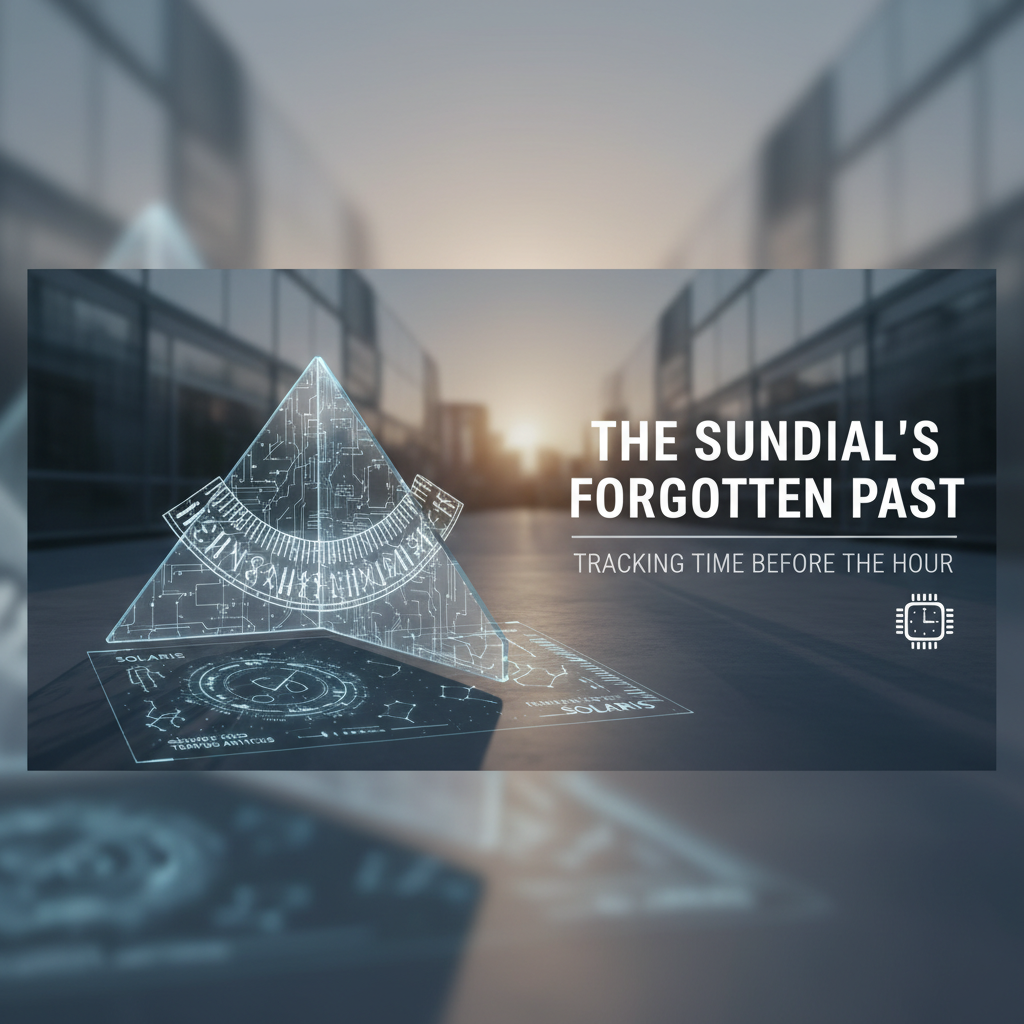
While the gnomon is the heart of any sundial, the sophistication of these devices evolved dramatically over centuries. Different types of sundials emerged, each designed to optimize accuracy or portability for specific geographical locations and purposes.
- Horizontal Sundials: The most common type, where the dial plate is horizontal. The gnomon is angled to point towards the celestial pole (parallel to the Earth's axis), making it specific to a particular latitude.
- Vertical Sundials: Mounted on a wall, typically facing south (in the Northern Hemisphere). These were popular on churches and public buildings, often decorated with elaborate carvings.
- Equatorial Sundials: The dial plate is parallel to the Earth's equator, and the gnomon is perpendicular to it. These are highly accurate, as the hour lines are evenly spaced.
- Analemmatic Sundials: A fascinating type where the gnomon is a human shadow! The person stands on a monthly scale, and their shadow then falls onto an elliptical scale marked with hours. These are often found in public parks today.
- Portable Sundials: Small, often ivory or metal devices, sometimes incorporating a compass. These allowed individuals to tell time on the go, though their accuracy was generally lower than fixed dials.
The construction of accurate sundials required a deep understanding of geometry, trigonometry, and astronomy. Master dial-makers, or gnomonists, were highly skilled artisans and scientists. They had to account for:
- Latitude: The angle of the gnomon had to precisely match the latitude of its location.
- Solar Declination: The sun's apparent path varies throughout the year. While basic sundials show mean solar time, more advanced ones might include an analemma curve to correct for the equation of time (the difference between mean solar time and apparent solar time).
- True North: Accurate alignment with the Earth's rotational axis was paramount.
The intricacy of these devices underscores the profound intellectual effort dedicated to timekeeping long before the industrial revolution.
The Sundial's Cultural Resonance: Time, Religion, and Power
Beyond its practical utility, the sundial held deep cultural and symbolic significance.
- Religious Significance: In many cultures, the sun was a divine entity, and its movements were seen as manifestations of cosmic order. Sundials, by tracking the sun's path, became sacred objects, often inscribed with prayers, blessings, or moral injunctions about the fleeting nature of time. "Tempus Fugit" ("Time Flies") is a common inscription, reminding observers of mortality. Churches frequently featured sundials, linking earthly time to divine cycles.
- Power and Authority: The ability to accurately tell time was a symbol of knowledge, power, and prestige. Rulers and priests used timekeeping to regulate public life, religious festivals, and agricultural cycles. Commissioning a grand sundial was a display of wealth and scientific prowess.
- Philosophical Reflection: The sundial's silent, relentless tracking of time invited contemplation. It served as a constant reminder of the passage of life, the inevitability of change, and the importance of living in the present. Many sundials include mottos that encourage reflection on these themes.
The Decline and Rediscovery: From Necessity to Novelty
The reign of the sundial as the primary timekeeper began to wane with the invention and refinement of mechanical clocks.
- Mechanical Clocks: Originating in Europe around the 13th and 14th centuries, mechanical clocks offered several advantages:
- Independence from the Sun: They worked day and night, indoors and outdoors.
- Fixed Hours: They naturally measured fixed-length hours, which gradually standardized timekeeping.
- Portability: Early clocks were large, but eventually became smaller and more personal.
As mechanical clocks became more accurate and affordable, particularly after the 17th century with the invention of the pendulum clock, sundials transitioned from essential tools to symbolic, decorative, or backup devices. They were no longer needed for daily precision but retained their charm and historical value.
However, the art and science of gnomonics never entirely disappeared. In recent times, there's been a resurgence of interest in sundials, driven by several factors:
- Historical Appreciation: A desire to connect with past technologies and understand the ingenuity of our ancestors.
- Educational Value: Sundials serve as excellent teaching tools for astronomy, geometry, and the history of science.
- Aesthetic Appeal: Modern sundials, often crafted from durable materials and incorporating sophisticated designs, are prized as garden features and public art installations.
- Sustainable Timekeeping: In an age of digital overload, the simple, solar-powered elegance of a sundial offers a refreshing connection to natural rhythms.
Practical Takeaways and Insights: Time in a New Light
The journey through the sundial's forgotten past offers several profound insights that remain relevant today:
- The Subjectivity of Time: Our concept of the "hour" is a human construct, not an immutable law of nature. Understanding temporal hours reminds us that time perception is influenced by cultural context and technological advancements.
- Connection to Nature: Before artificial light and synchronized global clocks, humanity lived far more attuned to the sun's rhythm. Reconnecting with simple timekeeping methods like observing shadows can foster a greater appreciation for natural cycles.
- The Evolution of Precision: The desire for greater accuracy in timekeeping fueled scientific and technological innovation for millennia. This relentless pursuit of precision continues to drive advancements in fields ranging from GPS to atomic clocks.
- Beyond the Digital Clock: While digital devices are indispensable, occasionally looking to a sundial can offer a different perspective. It doesn't tell us "the time" with absolute precision, but rather where the sun is – a fundamental truth often lost in our numerically defined world.
- The Philosophy of "Now": Sundials, through their inscriptions and their very nature, invite us to ponder the ephemeral quality of time. They remind us that each passing shadow is a moment gone, encouraging mindfulness and an appreciation for the present.
Conclusion: The Enduring Legacy of Sunlight and Shadow
The sundial, often seen as a relic of a bygone era, is far more than a simple antique. It is a testament to human ingenuity, a chronicle of scientific advancement, and a silent narrator of humanity's evolving relationship with time. From rudimentary sticks in the ground to exquisitely crafted instruments, sundials guided civilizations, shaped daily routines, and inspired philosophical contemplation for thousands of years.
While we now carry atomic clocks in our pockets, the sundial's gentle whisper about the sun's journey reminds us of a time when the world moved at a different pace. It encourages us to occasionally glance away from our screens and towards the sky, to observe the dance of light and shadow, and to reconnect with the timeless rhythm that first taught humanity to mark the passing of a day. The forgotten past of the sundial is, in fact, a vivid reminder of the eternal present, carved by the sun's unwavering hand.
Make Every Second Count
Inspired by this article? Take action now! Create a custom timer to help you manage your time better and reach your goals.
Create Your TimerAbout Dominic Mueller
Dominic Mueller is a German director for television and film with a deep fascination for time and time measurement. When he's not behind the camera crafting compelling visual stories, he explores the intricate world of temporal perception and timekeeping. Based in the beautiful city of Cologne, Germany, Dominic shares his life with his girlfriend and their beloved dog, Nala, finding inspiration in both the precise mechanics of time and the fleeting moments that make life meaningful.