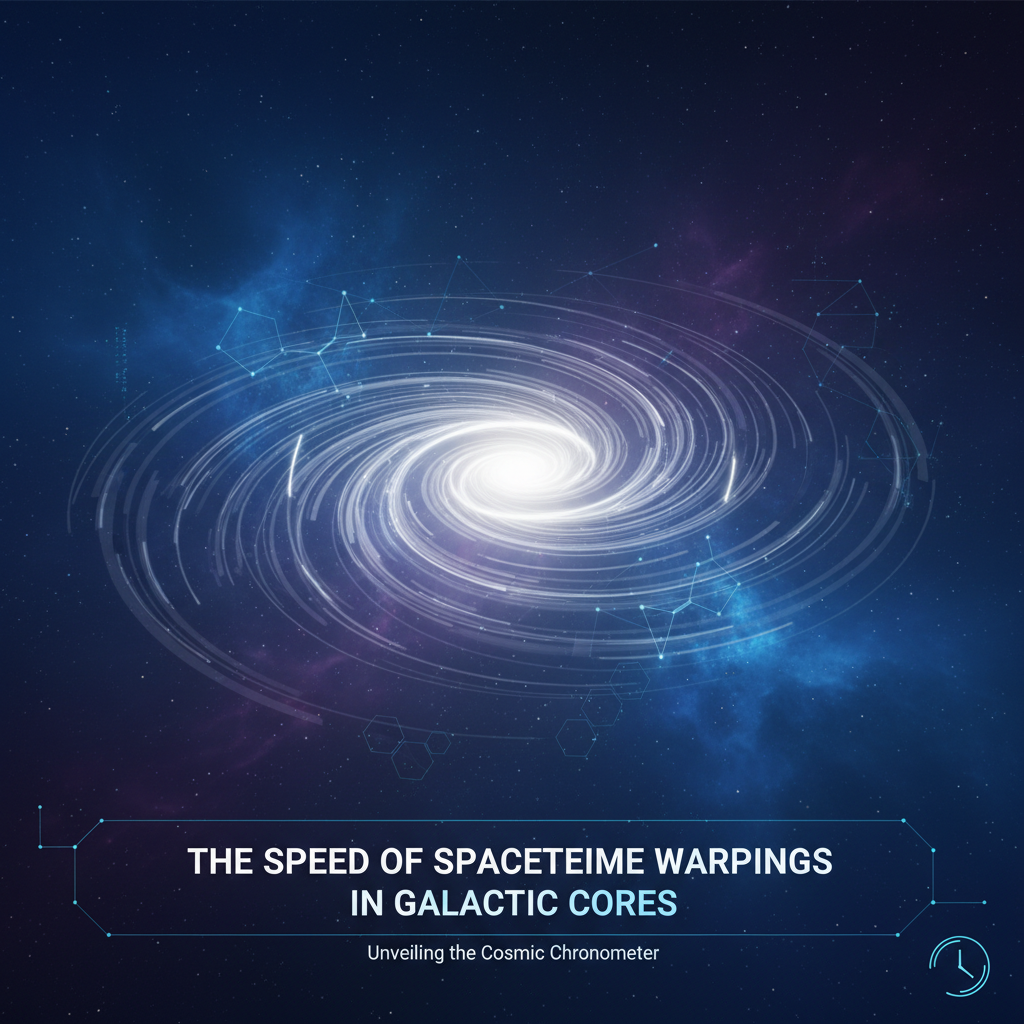
The Speed of Spacetime Warpings in Galactic Cores
 Dominic Mueller
The Unseen Currents: How Fast Spacetime Warps in Galactic Cores
Imagine a cosmic dance, not of planets and stars, but of the very fabric of existence. In the heart of every large galaxy, including our own Milky Way, lies a gravitational behemoth – a supermassive black hole. These enigmatic entities aren't just cosmic vacuum cleaners; they are the ultimate spacetime sculptors, twisting and bending the universe around them in ways that defy our everyday intuition. But how quickly does this cosmic clay respond to the immense gravitational pull? How fast do these "spacetime warpings" propagate through the galactic core? The answers are not just mind-bending physics; they're critical to understanding the evolution of galaxies and the very nature of time itself.
For millennia, time was perceived as a universal constant, a steady river flowing uniformly for everyone. Then came Einstein, and with his theories of relativity, the river became a turbulent, dynamic ocean, its currents manipulated by gravity. In the extreme environments of galactic cores, these currents churn at speeds that are both breathtaking and profoundly impactful on the passage of time.
The Fabric of Reality: A Brief Dive into Spacetime
Before we delve into the speed of these warps, let's briefly revisit what spacetime actually is. It's not an empty void; it's a four-dimensional continuum that combines the three dimensions of space with the one dimension of time. Think of it like a giant, invisible trampoline. When you place a bowling ball on it, the trampoline sags. This sagging is analogous to the curvature of spacetime caused by massive objects. The heavier the object, the deeper the sag.
- Gravity isn't a force, it's a consequence of this curvature. Objects like planets and stars don't get "pulled" by gravity; they follow the curves and dips in spacetime created by other massive objects.
- Time is intrinsically linked to space. When spacetime warps, it doesn't just distort distances; it also distorts how time passes. This phenomenon is known as gravitational time dilation.
In the vicinity of a supermassive black hole, this curvature becomes incredibly extreme. The "trampoline" is not just sagging; it's being stretched, twisted, and contorted into a deep, inescapable well.
The Ripples of Change: Gravitational Waves and the Speed Limit
Now, to the heart of the matter: how fast do these spacetime warpings propagate? The answer, elegantly provided by Einstein's theory of general relativity, is the speed of light.
Yes, just like ripples on a pond, but on a cosmic scale, changes in spacetime curvature travel at the fastest speed allowed in the universe: approximately 299,792,458 meters per second. These ripples are what we call gravitational waves.
- Not an instantaneous effect: When a supermassive black hole accretes new matter, or when two black holes merge, the resulting change in the gravitational field doesn't instantaneously warp spacetime across the entire galaxy. Instead, the "news" of this change travels outward as a gravitational wave, at the speed of light.
- Directly observed: For decades, gravitational waves were a theoretical prediction. However, in 2015, the LIGO (Laser Interferometer Gravitational-Wave Observatory) experiment made history by directly detecting gravitational waves from the merger of two stellar-mass black holes. This incredible achievement provided direct evidence that spacetime disturbances propagate at the speed of light.
While LIGO has primarily detected waves from merging stellar-mass black holes, the principles apply equally to the much larger and more powerful events happening in galactic cores. Imagine a supermassive black hole swallowing a star – the resulting cosmic burp would send powerful ripples of spacetime distortion outward at light speed.
The Unfathomable Depths: Time Dilation in Galactic Cores
The speed at which spacetime warps has profound implications for the passage of time. Because these changes propagate at the speed of light, it means that gravitational influences, and thus time dilation, are not instantaneous.
Consider an astronaut orbiting very close to Sagittarius A*, the supermassive black hole at the center of our Milky Way. Due to the extreme spacetime curvature, time for this astronaut would pass significantly slower than for someone on Earth. If this astronaut were to send a signal to Earth, even though the signal itself travels at the speed of light, the journey would still be influenced by the warped spacetime.
- Relative perception of time: The core concept here is that time is relative. There isn't a universal "tick-tock" that everyone experiences uniformly. The stronger the gravitational field, the slower time passes for an observer within that field, relative to an observer in a weaker field.
- The event horizon: The ultimate time-warping boundary is the event horizon of a black hole. For an observer outside, anything that crosses the event horizon appears to slow down indefinitely, never quite reaching it. For an object falling in, time continues its normal march from its perspective, but eventually, all paths lead to the singularity.
This leads to a fascinating thought experiment: if we could observe a clock falling into a black hole, we would see it tick slower and slower, eventually freezing just as it reached the event horizon. From the clock's perspective, however, it would cross the event horizon in a finite amount of its own time.
Researching the Unseeable: Probing Spacetime Dynamics
Studying the speed and effects of spacetime warping in galactic cores is incredibly challenging. Black holes are, by definition, invisible, and the regions around them are obscured by vast amounts of dust and gas. However, scientists are employing ingenious methods:
- Gravitational Wave Astronomy: As mentioned, observatories like LIGO and Virgo are leading the charge. Future gravitational wave detectors, such as the proposed LISA (Laser Interferometer Space Antenna), will be specifically designed to detect lower-frequency gravitational waves, which are characteristic of supermassive black hole mergers. These observations would directly measure the propagation of spacetime warps from the most energetic events in the universe.
- Pulsar Timing Arrays (PTAs): Certain rapidly spinning neutron stars, known as pulsars, act as incredibly precise cosmic clocks. By meticulously monitoring the arrival times of pulses from an array of these pulsars across the galaxy, astronomers can detect subtle variations caused by the passage of very long-wavelength gravitational waves. These waves are thought to originate from the mergers of supermassive black holes in distant galaxies. While PTAs don't directly measure the speed of the warp from a single event, they infer the presence of a gravitational wave background, which is a cumulative effect of these light-speed disturbances.
- Accretion Disk Dynamics: The glowing disks of gas and dust spiraling into supermassive black holes (accretion disks) are highly sensitive to the black hole's gravitational field. By observing the dynamics, temperature, and X-ray emissions from these disks, scientists can infer the properties of the spacetime around the black hole. Sudden changes in these emissions could signal a new warping event, providing an indirect measure of how quickly its effects propagate.
- Star Orbits near Sagittarius A:* The European Southern Observatory's Very Large Telescope (VLT) has been tracking individual stars orbiting Sagittarius A* for decades, most notably star S2. The observed highly elliptical orbit and its precession (the slight shift in its path with each orbit) perfectly match the predictions of General Relativity for spacetime curvature around a supermassive object. While not a direct measurement of the speed of a warp, these observations confirm the extreme nature of spacetime bending in our galactic core and its impact on the precise movements of celestial bodies. The slight variations in the orbital period and velocity of S2 are gravitational redshift effects, another manifestation of time dilation.
The Practical Takeaways: Why Does This Matter?
Beyond the intrinsic fascination of fundamental physics, understanding the speed and effects of spacetime warping in galactic cores has several crucial implications:
- Understanding Galaxy Evolution: Supermassive black holes are not just passive residents; they drive galaxy evolution. The energy released by gas falling into them, and the gravitational waves produced by their mergers, influence star formation, the distribution of matter, and the overall structure of galaxies. Knowing how quickly these influences propagate helps us model these complex processes.
- Probing the Universe's History: Detecting gravitational waves from supermassive black hole mergers allows us to "listen" to events from the early universe, giving us insights into how the first galaxies and black holes formed and grew. The travel time of these gravitational waves back to us is essentially a cosmic time machine, telling us about the universe as it was billions of years ago.
- Refining General Relativity: While incredibly robust, General Relativity is not necessarily the final word on gravity. Extreme environments like galactic cores provide natural laboratories to test its predictions to their limits. Any deviation in the observed speed of gravitational waves or the effects of time dilation could signal new physics beyond Einstein.
- The Nature of Time Itself: The relativity of time, a direct consequence of spacetime warping, changes our fundamental understanding of time. It's not a universal clock but deeply entwined with matter, energy, and gravity. In galactic cores, where gravity reigns supreme, time loses its Newtonian constancy and becomes a fluid, dynamic dimension.
The Pulsating Heart of Time
In an era where technology allows us to peer into the deepest corners of the cosmos, the galactic core stands as a powerful testament to the intricate dance of spacetime. Here, the very fabric of reality is stretched, squeezed, and contorted by gravity, and the "news" of these cosmic dislocations travels at the ultimate speed limit: the speed of light.
This isn't just an abstract scientific concept; it's a profound statement about the nature of our universe and the relativistic flow of time within it. For every change in the monumental gravitational landscape of a galactic core, a wave of spacetime distortion ripples outward, carrying with it the cosmic implications of altered distances and, more fascinatingly, altered moments. The universe, in its grandest scale, is a constantly dynamic entity where even time itself is a variable, orchestrated by the unseen, powerful currents of spacetime warping. As we continue to refine our instruments and unlock the universe's secrets, we will undoubtedly uncover even more astonishing facets of these cosmic rhythms, further illuminating the profound connections between space, time, and gravity.
Make Every Second Count
Inspired by this article? Take action now! Create a custom timer to help you manage your time better and reach your goals.
Create Your TimerAbout Dominic Mueller
Dominic Mueller is a German director for television and film with a deep fascination for time and time measurement. When he's not behind the camera crafting compelling visual stories, he explores the intricate world of temporal perception and timekeeping. Based in the beautiful city of Cologne, Germany, Dominic shares his life with his girlfriend and their beloved dog, Nala, finding inspiration in both the precise mechanics of time and the fleeting moments that make life meaningful.