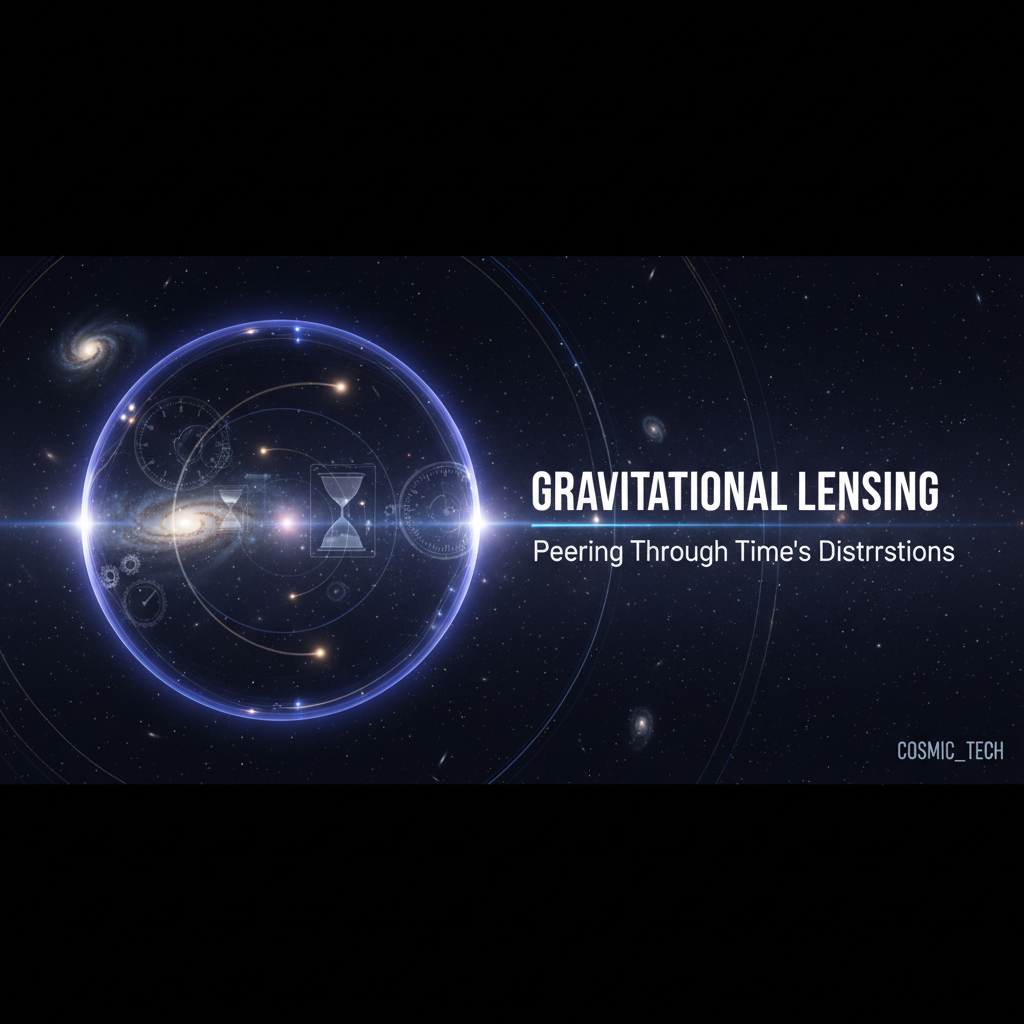
Gravitational Lensing: Peering Through Time's Distortions
 Dominic Mueller
Gravitational Lensing: Peering Through Time's Distortions
Imagine gazing at a distant galaxy, its ethereal light traveling billions of years to reach your telescope. Now, imagine that light taking a detour, bending and twisting around a massive, unseen object before finally arriving at your cosmic doorstep. What you're witnessing isn't a trick of the eye, but one of the universe's most profound and mind-bending phenomena: gravitational lensing. More than just a cosmic magnifying glass, gravitational lensing offers a unique window into the fabric of spacetime itself, revealing not only the hidden structures of the cosmos but also peering through the very distortions of time.
In the vast cosmic ballet, everything from individual stars to colossal galaxy clusters possess a gravitational pull. According to Albert Einstein's revolutionary theory of General Relativity, gravity isn't merely a force; it's a manifestation of the curvature of spacetime caused by mass and energy. Massive objects literally warp the spacetime around them, and just as light bends when it passes through a magnifying glass, so too does it bend when it traverses these cosmic curves. This bending of light, gravitational lensing, is an extraordinary tool for astronomers, allowing us to explore the darkest corners of the universe and, in a truly remarkable way, understand the deep interplay between gravity, light, and the passage of time.
The Genesis of a Cosmic Magnifying Glass: Einstein's Vision
The concept of light bending due to gravity wasn't entirely new to Einstein. Isaac Newton had previously speculated about light being affected by gravity, albeit within the confines of his classical mechanics. However, it was Einstein, with his radical redefinition of gravity as the curvature of spacetime, who provided the foundational framework for gravitational lensing.
In 1915, with the publication of his General Theory of Relativity, Einstein predicted that massive objects would deflect light. His calculations showed that the Sun, during a total solar eclipse, would bend the light from background stars by a measurable amount. In 1919, Arthur Eddington led an expedition to observe such an eclipse, and his measurements famously confirmed Einstein's prediction, catapulting him to international fame. This groundbreaking observation was the first empirical evidence that spacetime itself could be warped, and it laid the intellectual groundwork for what we now understand as gravitational lensing.
Initially, Einstein himself was skeptical about the practical observation of lensing by galaxies, deeming the effect too small to be detected. However, subsequent theoretical work and, crucially, technological advancements in telescopes have proven him delightfully wrong. Today, gravitational lensing is not just a theoretical curiosity but a vital observational tool, continuously pushing the boundaries of our cosmic understanding.
How Gravitational Lensing Works: A Cosmic Kaleidoscope
At its core, gravitational lensing is a direct consequence of spacetime curvature. Imagine space as a stretched rubber sheet. Placing a bowling ball (a massive galaxy cluster) on it creates a depression. If you then roll a marble (a photon of light) across this sheet, its path will be deflected by the depression. This analogy, while imperfect, provides a good intuitive grasp of the phenomenon.
When light from a distant "source" object travels towards us, and a massive "lens" object (like a galaxy or a galaxy cluster) lies between the source and the observer, the lens's gravity bends the light rays. This bending can manifest in several fascinating ways:
- Strong Lensing: This occurs when the lens is extremely massive and the alignment between the source, lens, and observer is nearly perfect. The result is often dramatic distortions: multiple images of the source (sometimes forming an "Einstein Cross"), arcs, or even complete rings of light (an "Einstein Ring"). These strong lensing events provide magnified views of incredibly distant and faint galaxies, effectively acting as cosmic telescopes.
- Weak Lensing: In this more common scenario, the alignment is not perfect, and the lens's mass is less extreme. The effect is subtle, causing slight, coherent distortions or shears in the shapes of background galaxies. While individually imperceptible, statistical analyses of many weakly lensed galaxies allow astronomers to map out the distribution of dark matter across vast cosmic scales.
- Microlensing: This is a much smaller-scale phenomenon, where the lens is typically a star or a compact object within our own galaxy or a nearby one. Instead of creating multiple images or arcs, microlensing causes a temporary brightening of a background star as the foreground object passes in front of it. This transient brightening is an invaluable tool for detecting exoplanets and even unseen "dark" objects in our galaxy.
Time, Light, and the Cosmic Detour: The Chronological Dimension of Lensing
The most fascinating aspect of gravitational lensing, especially when we consider its "peering through time" capability, lies in the fact that the bending of light isn't just a spatial distortion; it introduces a time delay.
Think about it: light from the same distant source takes different paths around the gravitational lens to reach our telescopes. These paths have different lengths, and crucially, they pass through different regions of warped spacetime. According to General Relativity, time itself is affected by gravity; clocks run slower in stronger gravitational fields. Therefore, the light traveling along different paths experiences different gravitational time delays.
This means that if a distant supernova or a variable quasar is gravitationally lensed into multiple images, we might observe those images at different times. The light from one path might arrive today, while the light from another path, having taken a slightly longer or more gravitationally "slowed" route, might arrive weeks, months, or even years later!
Interesting Fact: The first instance of a multiply-imaged supernova, SN Refsdal, discovered in 2014, perfectly demonstrated this time delay. Astronomers observed four images of the supernova in 2014-2015, forming an Einstein Cross. Based on models of the lensing galaxy cluster, they predicted that a fifth image of the same supernova would appear at a different location years later, as the light from another path finally arrived. True to prediction, a fifth image of SN Refsdal was indeed observed in 2015-2016, confirming the time-delay phenomenon and offering a remarkable validation of our understanding of cosmic distances and gravitational effects.
Practical Takeaways and Insights: Unveiling the Universe's Secrets
Gravitational lensing isn't just a fascinating theoretical concept; it's a workhorse of modern astrophysics, offering unparalleled insights into some of the universe's deepest mysteries:
- Mapping Dark Matter: The vast majority of the universe's mass is invisible dark matter. Since dark matter interacts only gravitationally, it cannot be directly observed. However, its gravitational pull bends light. Weak lensing, in particular, allows astronomers to map the distribution of dark matter on cosmic scales, revealing the hidden scaffolding of the universe. This is a critical step in understanding galaxy formation and the large-scale structure of the cosmos.
- Magnifying the Farthest Galaxies: Strong lensing acts as a natural cosmic telescope, magnifying the light from incredibly distant and faint galaxies that would otherwise be beyond our observational reach. By studying these magnified images, astronomers can investigate the properties of the very first galaxies formed in the early universe, providing crucial clues about cosmic evolution. We are, in essence, looking further back in time, seeing galaxies as they were just a few hundred million years after the Big Bang.
- Measuring the Hubble Constant: The expansion rate of the universe, quantified by the Hubble Constant ($H_0$), is a cornerstone of cosmology. The time delays observed in multiply-imaged quasars or supernovae provide a unique and independent way to measure $H_0$. By precisely measuring the time difference in the arrival of light from different images, and knowing the geometry of the lens system, astronomers can infer the distances involved and thus the expansion rate. This method offers a crucial cross-check against other techniques, helping to resolve the ongoing "Hubble tension" – the discrepancy between different measurements of $H_0$.
- Detecting Exoplanets and Stellar Remnants: Microlensing is a powerful technique for finding planets beyond our solar system, especially those that are too small or too distant to be detected by other methods. It can also detect rogue planets (planets not orbiting a star) and dark, compact objects like brown dwarfs, neutron stars, and even isolated black holes within our galaxy, providing a census of the "invisible" inhabitants of our cosmic neighborhood.
- Probing the Nature of Gravity: The precision with which lensing observations match Einstein's General Relativity continuously reinforces our understanding of gravity. Any deviations or anomalies in lensing patterns could potentially hint at new physics beyond General Relativity, though thus far, the theory holds remarkably well.
The Future of Lensing: A Multiverse of Possibilities
The era of advanced observatories, like the James Webb Space Telescope (JWST), the upcoming Euclid mission, and ground-based giants like the Vera C. Rubin Observatory (which will conduct the Legacy Survey of Space and Time), promises an explosion of new gravitational lensing discoveries.
JWST, with its infrared capabilities, is already revolutionizing our view of highly redshifted, strongly lensed galaxies, seeing them with unprecedented clarity and pushing the boundaries of our early universe observations. Euclid and Rubin will vastly increase the number of observed weak lensing events, creating 3D maps of dark matter with incredible precision.
Future observatories will undoubtedly uncover even more rare and extreme lensing events, including the potential for "gravitational lensing of gravitational waves" – a phenomenon still in its theoretical infancy but with profound implications for understanding the most energetic events in the universe.
Conclusion: Through the Looking Glass of Spacetime
Gravitational lensing is a profound testament to the elegance and accuracy of Einstein's General Theory of Relativity. It's a phenomenon that weaves together gravity, light, and the very fabric of spacetime, offering a unique "looking glass" into the universe's most elusive components. From mapping the invisible dark matter that holds galaxies together to peering at the first flickering lights of the early cosmos, lensing continues to reveal the universe's hidden depths.
More than just a cosmic optical illusion, gravitational lensing provides a tangible, observable link between the vastness of space and the relentless march of time. By revealing multiple images of the same cosmic event arriving at different moments, it underscores the profound reality that time is not an absolute, but a flexible dimension, warped and sculpted by the universe's most massive inhabitants. As we continue to refine our observational tools and theoretical models, gravitational lensing will remain at the forefront of discovery, continually inviting us to peer through time's distortions and unravel the universe's most captivating secrets.
Make Every Second Count
Inspired by this article? Take action now! Create a custom timer to help you manage your time better and reach your goals.
Create Your TimerAbout Dominic Mueller
Dominic Mueller is a German director for television and film with a deep fascination for time and time measurement. When he's not behind the camera crafting compelling visual stories, he explores the intricate world of temporal perception and timekeeping. Based in the beautiful city of Cologne, Germany, Dominic shares his life with his girlfriend and their beloved dog, Nala, finding inspiration in both the precise mechanics of time and the fleeting moments that make life meaningful.