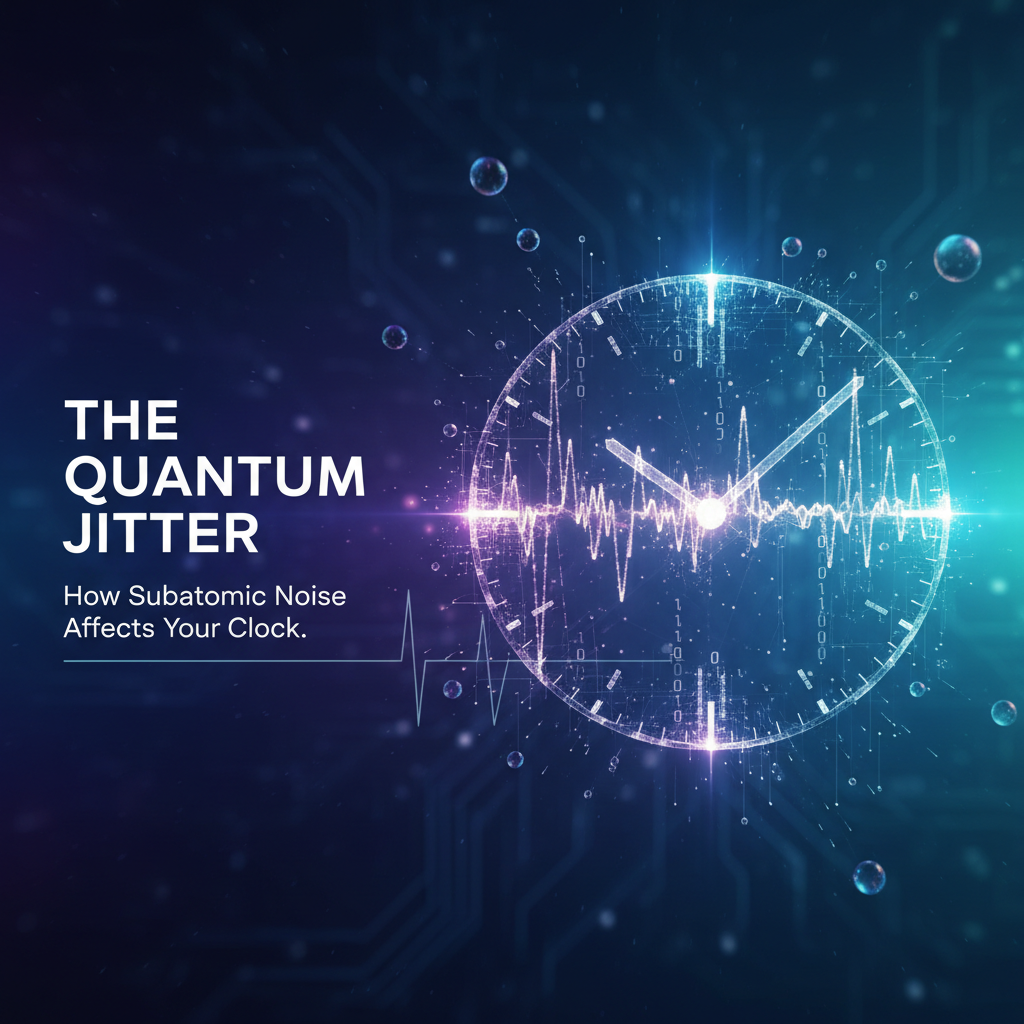
The Quantum Jitter: How Subatomic Noise Affects Your Clock
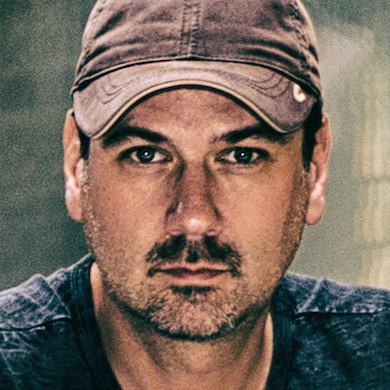 Dominic Mueller
The Quantum Jitter: How Subatomic Noise Affects Your Clock
Introduction: The Unseen Dance of Time
Imagine a world where time isn't a smooth, continuous river, but a bubbling, frothing stream, constantly agitated by invisible forces. We rely on clocks for nearly everything – from coordinating global financial markets and navigating satellites, to ensuring our morning coffee machine brews on time. We demand precision, seeking ever-more accurate timekeeping devices. Yet, beneath the serene ticking of the most advanced atomic clocks lies a hidden reality: a fundamental restlessness at the quantum level, a phenomenon we're calling "The Quantum Jitter."
This isn't just about a tiny, imperceptible wiggle; it's a profound challenge to our understanding and measurement of time itself. The quantum world, that bizarre realm of subatomic particles, doesn't just influence our clocks; it defines the very limits of their precision. In this comprehensive exploration, we'll delve into how the inherent uncertainty and chaotic dance of quanta manifest as a "jitter" in the fabric of time, affecting everything from the atomic clocks that define our global time standard to the future of quantum computing and fundamental physics.
The Quest for Perfect Time: A Brief History of Chronometry
Humanity's obsession with timekeeping is ancient, driven by practical needs like agriculture and navigation, and a deep philosophical curiosity. From sundials and water clocks to pendulum clocks, each innovation brought greater accuracy.
- Mechanical Clocks: The invention of the pendulum clock by Christiaan Huygens in the 17th century revolutionized timekeeping, reducing daily errors from minutes to seconds.
- Quartz Clocks: The 20th century saw the rise of quartz clocks, leveraging the piezoelectric properties of quartz crystals to achieve even higher stability. These clocks are still ubiquitous in watches and computers.
- Atomic Clocks: The true leap came with atomic clocks, developed in the mid-20th century. Instead of mechanical oscillations or crystal vibrations, these clocks exploit the incredibly stable and precise energy transitions of atoms. The first practical atomic clock, based on cesium-133, was built in 1955.
Today, the international definition of the second, the fundamental unit of time, is based on the radiation frequency corresponding to the transition between two hyperfine levels of the ground state of the cesium-133 atom, specifically 9,192,631,770 cycles per second. These clocks are marvels of engineering, achieving accuracies that would lose only one second in hundreds of millions of years. But even these titans of time are not immune to the quantum jitter.
What is "Quantum Jitter"? Understanding the Subatomic Shimmy
To understand quantum jitter, we need to briefly dip our toes into the quantum realm. Unlike the classical world, where particles have definite positions and momenta, the quantum world is characterized by uncertainty and probabilistic behavior.
At its core, quantum jitter refers to the fundamental noise and inherent limitations imposed on any measurement, especially time, by the principles of quantum mechanics. It's not a flaw in our engineering, but a fundamental property of reality itself.
Here are the key quantum phenomena contributing to this jitter:
- Heisenberg's Uncertainty Principle: This cornerstone of quantum mechanics states that certain pairs of properties of a particle, like position and momentum, or energy and time, cannot both be known with arbitrary precision simultaneously.
- For clocks, this is particularly relevant to the energy-time uncertainty principle. If you try to measure the energy of an atomic transition with extreme precision (which is what atomic clocks do), there will be an inherent uncertainty in the time at which that transition occurs, or how long the atom stays in that state. Conversely, to define a time interval extremely precisely, the energy spread becomes larger.
- Quantum Shot Noise (Projection Noise): Atomic clocks work by counting transitions in a collection of atoms. Imagine you have a gas of atoms, some in a "ground" state and some in an "excited" state. To read the clock, you send a laser pulse and then measure how many atoms transitioned. This measurement is inherently statistical. If you have N atoms, the precision of your measurement is fundamentally limited by $\sqrt{N}$. This means that even with a perfect laser and detector, there's always a statistical fluctuation in the number of atoms you count, leading to a slight "noise" or "jitter" in the time measurement. This is often the dominant source of quantum noise in many atomic clocks.
- Quantum Fluctuations of Fields: Even in a perfect vacuum at absolute zero temperature, quantum field theory predicts that electromagnetic fields are not truly static. They constantly fluctuate, giving rise to "virtual particles" that pop into and out of existence. These zero-point fluctuations can slightly perturb the energy levels of atoms, adding another layer of irreducible noise to atomic transitions.
- Decoherence: When a quantum system interacts with its environment (even a stray photon or a distant magnetic field), its delicate quantum superposition states can collapse, losing their "quantumness." This process, called decoherence, effectively introduces noise and limits the time over which an atom can reliably maintain its quantum state for a precise measurement.
Together, these phenomena mean that the very atoms we use to define time are not perfectly still or predictable. They are constantly "jittering" due to their quantum nature, and this jitter propagates directly into the accuracy of our most precise timekeeping devices.
The Impact on Atomic Clocks: Where Precision Meets Its Limit
Modern atomic clocks come in several forms, each pushing the boundaries of precision:
- Cesium Fountain Clocks: These are the workhorses of global timekeeping, defining the second. They launch a cloud of cesium atoms upwards, allowing them to spend a longer time interacting with microwaves, which improves accuracy. However, they are still limited by quantum shot noise from the finite number of atoms.
- Optical Clocks: These are the cutting-edge. Instead of microwave transitions, they use much higher frequency optical transitions (visible light range) in atoms like strontium, ytterbium, or aluminum ions. The higher frequency means more "ticks" per second, offering potentially orders of magnitude greater precision.
- Single-Ion Clocks: Some optical clocks trap a single ion. This eliminates atom-to-atom interactions, but means the measurement is effectively on one "quantum object," making it highly susceptible to quantum projection noise for that single entity.
- Optical Lattice Clocks: These trap thousands of atoms in a grid formed by intersecting laser beams (an "optical lattice"). This allows for a large number of atoms to be interrogated simultaneously, reducing the relative impact of quantum shot noise.
Despite their incredible advancements, quantum jitter remains a fundamental obstacle. For optical lattice clocks, the dream is to surpass the standard quantum limit, which is imposed by quantum shot noise. Scientists are exploring exotic states of matter and quantum entanglement to achieve this.
Interesting Fact: The best optical clocks today are so precise that if they had been running since the Big Bang (13.8 billion years ago), they would have lost or gained less than one second. Yet, even they are battling the quantum jitter at their operational limits.
How Quantum Jitter Affects Our World (and What We Can Do About It)
While the average person's wrist watch isn't affected by quantum jitter, its implications ripple through critical technologies and scientific endeavors.
1. Global Positioning Systems (GPS) and Satellite Navigation
GPS relies on incredibly precise timing. Satellites orbiting Earth carry atomic clocks, and receivers on the ground calculate their position by measuring the tiny time differences in signals received from multiple satellites. An error of just one nanosecond (a billionth of a second) can lead to a positioning error of about 30 centimeters (roughly a foot).
- Impact: While current GPS systems are designed with enough redundancy and error correction to operate reliably even with existing atomic clock jitters, the next generation of precise navigation (e.g., for autonomous vehicles, drone delivery) will demand even higher accuracy. Future GPS systems, potentially incorporating quantum technologies, will need to account for these quantum limits more rigorously.
2. Telecommunications and Data Transfer
Synchronized clocks are crucial for high-speed data networks, ensuring that bits of information are transmitted and received in the correct order. Fiber optic networks, for instance, rely on precise timing to manage vast amounts of data traffic.
- Impact: As data rates increase and networks become more complex (e.g., 5G and beyond), the demands on timing synchronization grow. Quantum jitter, though minuscule, sets the ultimate limit on how perfectly these networks can be synchronized without specialized quantum-enhanced clocks.
3. Fundamental Physics Research
Atomic clocks are not just timekeepers; they are powerful scientific instruments. They are used to test fundamental theories of physics, such as Einstein's theory of General Relativity.
- Relativity and Time Dilation: General Relativity predicts that time runs slower in stronger gravitational fields. Optical clocks are now so sensitive they can measure the minuscule time dilation caused by a height difference of just a few millimeters! This opens up possibilities for "relativistic geodesy" – using clocks to precisely map Earth's gravitational field.
- Searching for New Physics: Any unexpected deviations in clock measurements could indicate the presence of new fundamental forces or particles, or even variations in fundamental constants of nature. Quantum jitter defines the noise floor against which these incredibly subtle effects must be detected.
4. Quantum Computing and Quantum Networks
The future of computation and communication lies in quantum technologies. Quantum computers rely on the precise manipulation of quantum states, often for very short durations. Quantum networks aim to transmit quantum information across vast distances.
- Impact: The coherence time (how long a quantum state can be maintained) is a critical factor in quantum computing. Quantum jitter and decoherence are the arch-nemeses of long coherence times. Understanding and mitigating these effects is paramount for building robust quantum computers and ensuring the integrity of quantum communications.
5. Metrology and Standards
Atomic clocks are the backbone of metrology, the science of measurement. They define the second, which in turn underpins measurements of frequency, length (via the speed of light), and other fundamental constants.
- Impact: Pushing beyond the current limits of atomic clock precision requires confronting quantum jitter head-on. New techniques to squeeze quantum noise or create entangled states of atoms could lead to "quantum-enhanced" clocks that surpass the standard quantum limit, redefining the future of precision metrology.
Mitigating the Jitter: Pushing the Quantum Boundaries
Scientists are actively researching ways to minimize the effects of quantum jitter and even use quantum mechanics to their advantage.
- Quantum Nondemolition (QND) Measurements: Instead of destroying the quantum state of an atom during measurement, QND techniques aim to extract information without disturbing the atom's state. This could potentially allow for repeated measurements on the same atom, improving precision.
- Entanglement: One of the most promising avenues is to use quantum entanglement. If atoms in a clock are entangled, their collective quantum state is known with greater precision than if they were independent. This "squeezed state" can theoretically reduce the quantum shot noise below the standard quantum limit, leading to "quantum-enhanced" or "entangled clocks." Experiments have already demonstrated this principle in small ensembles of atoms.
- Improved Atom Trapping and Cooling: Extreme cooling (to nanokelvin temperatures) and sophisticated trapping techniques (like optical lattices) reduce atomic motion and minimize environmental disturbances, thereby increasing the coherence time and improving the signal-to-noise ratio.
- Better Shields and Vacuums: Minimizing interactions with stray electromagnetic fields, background gas atoms, and thermal radiation reduces decoherence and external sources of noise.
The goal is not to eliminate quantum jitter entirely – that's impossible due to fundamental physics – but to engineer systems that are less susceptible to it or even exploit quantum phenomena to make measurements more precise than classical physics would allow.
Practical Takeaways and Future Prospects
While you won't need to adjust your smartwatch for quantum jitter, the journey to understand and overcome it has profound implications:
- Fundamental Limits of Precision: Quantum jitter reminds us that there are inherent, fundamental limits to how precisely we can measure time and other physical quantities. Nature itself has a certain "fuzziness."
- The Quantum Advantage: Paradoxically, quantum mechanics, which introduces this jitter, also offers solutions. Technologies like quantum entanglement and squeezed states could unlock even greater precision in the future, moving beyond classical limits.
- A Deeper Understanding of Reality: The pursuit of better clocks isn't just engineering; it's a profound journey into understanding the very fabric of spacetime and the universe's fundamental laws.
- Enabling Future Technologies: From super-accurate navigation for autonomous systems to distributed quantum computing across global networks, mitigating quantum jitter is crucial for the next generation of technological breakthroughs.
The evolution of timekeeping has always been intertwined with scientific discovery and technological advancement. From the sundial to the atomic clock, each step has brought us closer to a perfect understanding of time. The quantum jitter is not an end to this journey but a new, exciting frontier, pushing physicists and engineers to devise ingenious ways to dance with the quantum world, rather than fight against it.
Conclusion: The Pulsing Heart of the Universe
The notion of "The Quantum Jitter" is a powerful reminder that even at the most fundamental level, the universe is alive with activity. Our most precise timekeeping instruments, the atomic clocks that define our second and underpin our modern world, are not ticking in perfect, silent unison. Instead, they resonate with the subatomic shimmy of quantum mechanics, a restless dance of probability and uncertainty that sets the ultimate bounds of their precision.
Far from being a frustrating limitation, this quantum jitter is a profound window into the nature of reality. It forces us to confront the fact that time, for all its apparent linearity and predictability in our macroscopic world, emerges from a chaotic, probabilistic quantum substrate. As we continue to push the boundaries of timekeeping, developing "quantum-enhanced" clocks that leverage entanglement and other exotic phenomena, we are not just building better devices. We are engaging in a deeper conversation with the universe itself, listening to its subtlest whispers, and perhaps, eventually, learning to synchronize our clocks with the very pulse of spacetime. The quest for perfect time continues, guided and challenged by the beautiful, bewildering world of the quantum.
Make Every Second Count
Inspired by this article? Take action now! Create a custom timer to help you manage your time better and reach your goals.
Create Your TimerAbout Dominic Mueller
Dominic Mueller is a German director for television and film with a deep fascination for time and time measurement. When he's not behind the camera crafting compelling visual stories, he explores the intricate world of temporal perception and timekeeping. Based in the beautiful city of Cologne, Germany, Dominic shares his life with his girlfriend and their beloved dog, Nala, finding inspiration in both the precise mechanics of time and the fleeting moments that make life meaningful.