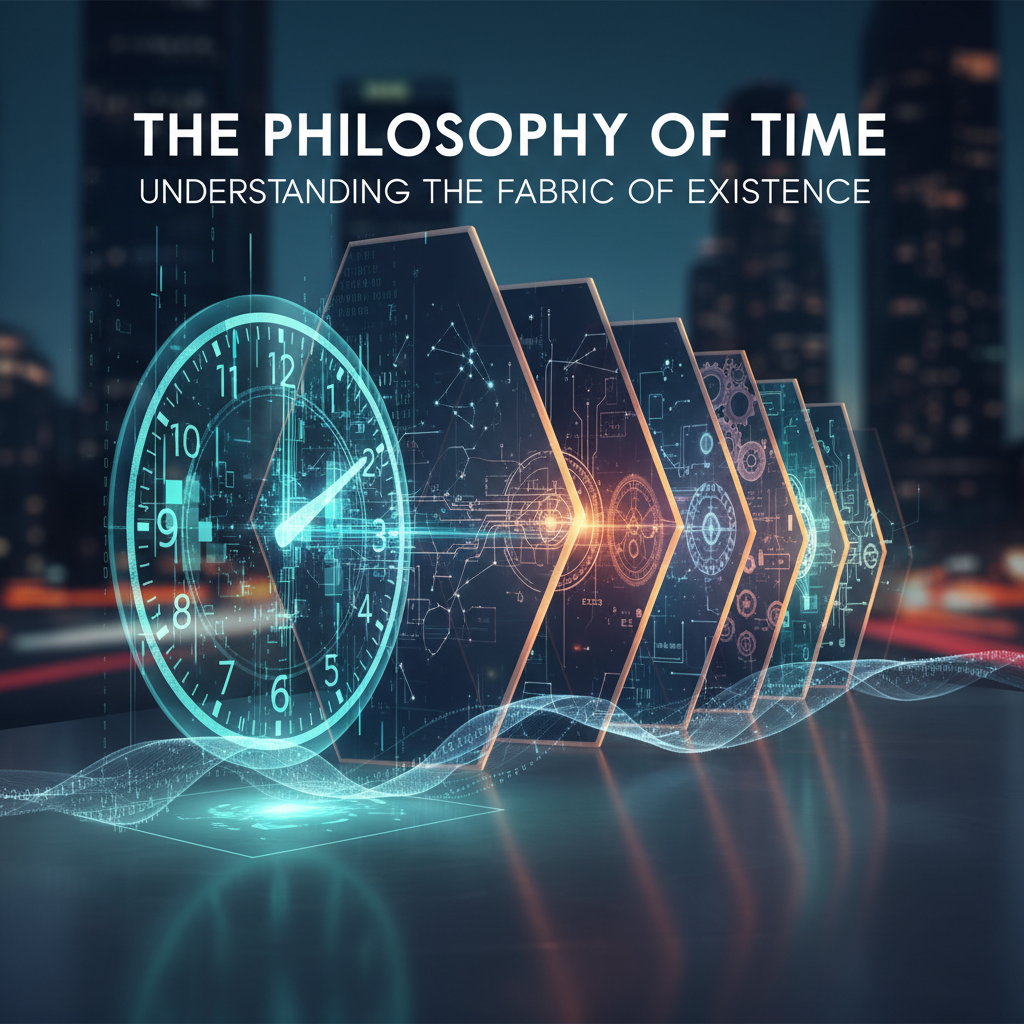
The Philosophy of Time
 Dominic Mueller
The Unseen River: Navigating the Philosophy of Time
Time. We feel it, we mark it, we chase it, and yet, it remains one of the most enigmatic concepts known to humanity. It’s the invisible current that carries us from birth to old age, the backdrop against which all of history unfolds, and the very fabric of our subjective experience. But what is time, fundamentally? Is it an objective reality, an independent dimension through which we travel, or is it a mere construct of the human mind, a tool for ordering our perceptions?
For millennia, philosophers, scientists, and spiritual thinkers have wrestled with these profound questions, each discipline offering unique perspectives on time’s elusive nature. From ancient Greek contemplation to modern physics, the philosophy of time is a rich tapestry woven with intricate theories, paradoxes, and revolutionary insights. Join us as we embark on a journey through this intellectual landscape, exploring the various ways we've tried to capture and comprehend the "unseen river" that shapes our existence.
The Greeks and the Ever-Flowing Moment: Early Philosophical Musings
The earliest recorded philosophical inquiries into time often stemmed from observations of change and permanence. The ancient Greeks, in particular, offered foundational ideas that continue to resonate today.
- Heraclitus and the Flux: The pre-Socratic philosopher Heraclitus famously declared, "No man ever steps in the same river twice, for it's not the same river and he's not the same man." This assertion highlights the idea of perpetual flux – that everything is constantly changing, and therefore, time is an integral part of this ceaseless transformation. For Heraclitus, change was the only constant, and time was the manifestation of this dynamic reality.
- Parmenides and the Illusion of Change: Opposing Heraclitus was Parmenides, who argued that change was an illusion. For him, true reality was eternal and unchanging. Time, therefore, was merely an appearance, a human misinterpretation of an underlying, static truth. This radical idea laid the groundwork for later debates about the reality of time.
- Aristotle and Time as a Measure of Motion: Aristotle offered a more pragmatic view, defining time not as an independent entity, but as "the number of motion with respect to 'before' and 'after'." In other words, time was a way of quantifying and ordering changes. It wasn't something that existed without motion; rather, it was a property of motion itself. This perspective emphasizes time's relational nature.
These early Greek insights established a dichotomy that continues to frame much of the philosophical discourse: Is time a fundamental aspect of reality (like Heraclitus's flux) or an emergent property arising from our perception of change (like Aristotle's measure)?
From Augustine to Newton: The Western Conception of Time
The Abrahamic religions, particularly Christianity, significantly shaped the Western understanding of time, introducing concepts like creation, linear progression, and the end of days.
- St. Augustine's Inner Time: In his Confessions, St. Augustine famously pondered, "What then is time? If no one asks me, I know what it is. If I wish to explain it to him who asks, I do not know." He grappled with the ephemeral nature of the present, the non-existence of the past (which is gone), and the non-existence of the future (which is not yet). Augustine concluded that time primarily exists in the human mind, as a distention of the soul measuring memory (of the past), attention (to the present), and expectation (of the future). This was a groundbreaking move towards a more subjective view of time.
- Isaac Newton and Absolute Time: With the rise of modern science, particularly the work of Isaac Newton, a new model of time emerged. Newton posited the existence of absolute, true, and mathematical time, which "of itself, and from its own nature, flows equably without relation to anything external." This was an independent, universal dimension, a cosmic clock ticking uniformly for everyone and everything, unaffected by events. This "Newtonian time" became the bedrock of classical physics and our everyday intuition about time. It was a container in which all events occurred, a separate entity from the physical world it described.
The March of Modern Philosophy: Time's Subjectivity and Objectivity Reconsidered
The scientific revolution and subsequent philosophical movements continued to refine our understanding, often challenging Newton's absolute framework.
- Immanuel Kant and A Priori Intuition: The German philosopher Immanuel Kant argued that time is not an objective reality out there but is instead an a priori intuition, a fundamental structure of our minds that allows us to perceive and organize sensory experience. For Kant, time and space are the lenses through which we view the world; they are not properties of the world itself, but rather preconditions for any experience. We cannot think without them. This powerful idea further solidified the subjective dimension of time.
- Henri Bergson and Durée (Duration): The French philosopher Henri Bergson offered a vitalist perspective in the late 19th and early 20th centuries. He distinguished between "clock time" (the spatialized, quantifiable time of science and daily life) and "duration" (durée), which is the continuous, flowing, qualitative experience of time as lived by consciousness. Durée is irreducible; it cannot be broken into discrete moments without distorting its essence. For Bergson, true time is the ongoing process of becoming, the indivisible flow of experience. This concept challenged the reductionist view of time as merely a sequence of points.
Einstein's Revolution: Spacetime and the Relativity of Time
The 20th century brought the most profound scientific shift in our understanding of time, courtesy of Albert Einstein's theories of relativity.
- Special Relativity and Time Dilation: Einstein's Special Theory of Relativity (1905) demonstrated that time is not absolute but relative to the observer's motion. The faster an object moves through space, the slower it experiences time. This phenomenon, known as time dilation, means that there is no universal "now" – two observers in relative motion will disagree on the simultaneity of events. This shattered Newton’s concept of absolute time.
- General Relativity and Spacetime Curvature: His General Theory of Relativity (1915) further revolutionized our understanding by linking time not just to motion, but to gravity. Mass and energy curve the fabric of spacetime, and this curvature affects the flow of time. Time runs slower in stronger gravitational fields. This means that time is not merely a backdrop, but an active, dynamic component of the universe, intricately interwoven with space into a four-dimensional "spacetime" continuum.
- The Block Universe Theory: Einstein's relativity theories often lead to the philosophical interpretation known as the "Block Universe" or "Eternalism." In this view, past, present, and future are all equally real and exist simultaneously within spacetime. Our perception of a "flowing" present is an illusion, akin to moving through a fixed landscape. All moments are "there," just as all points in space are "there." This view challenges our intuitive sense of time's passage and the specialness of the present.
These discoveries moved time from the realm of pure philosophical speculation into verifiable scientific prediction, fundamentally altering both physics and our philosophical outlook.
The Arrow of Time: Why Does Time Only Go Forward?
One of the most persistent puzzles in the philosophy of time is its directionality. Why do we remember the past but not the future? Why does a dropped cup shatter but never spontaneously reassemble? This is known as the "Arrow of Time."
- Thermodynamic Arrow: The most widely accepted explanation for time's arrow comes from the Second Law of Thermodynamics, which states that the entropy (disorder or randomness) of a closed system always increases over time. Things naturally move from order to disorder. This irreversible tendency provides a clear direction for time. The universe began in a state of extremely low entropy (the Big Bang) and is constantly moving towards higher entropy. This concept is incredibly powerful but leaves some questions unanswered, such as whether the universe must have started in a low entropy state.
- Psychological Arrow: Our subjective experience of time – the feeling of moving from past to future, remembering the past but not the future – constitutes the psychological arrow. This is intimately linked to our memory and consciousness.
- Cosmological Arrow: The expansion of the universe itself provides a cosmological arrow. As the universe expands, its structures change and evolve, providing a directional indicator.
The arrow of time remains an active area of research, with physicists and philosophers exploring the interplay between these various arrows and their ultimate origin.
Practical Takeaways and Insights
Beyond the abstract theories, grappling with the philosophy of time offers profound insights into our daily lives and decision-making.
- Embrace the Present (Mindfulness): If time's true nature is a continuous flow (durée) or if the present is our only access point to reality (Augustine), then cultivating mindfulness becomes paramount. Dwelling excessively on an unchangeable past or an uncertain future can detract from the richness of the now.
- Appreciate Relativity: While you won't experience significant time dilation in your daily life, the concept serves as a powerful metaphor. Our perception of time is relative to our experiences, emotions, and focus. An hour spent doing something you love flies by, while an hour in a waiting room can drag interminably. Understanding this subjective relativity can help us manage our relationship with time better.
- Recognize the Irreversibility: The "Arrow of Time," particularly the thermodynamic arrow, reminds us of the irreversible nature of many processes. Decisions made, words spoken, moments lived – they cannot be undone. This fosters a sense of responsibility and encourages thoughtful action.
- Reframe "Wasting Time": If time is a continuous flow and our experience of it is subjective, then "wasting time" might be better understood as "spending time in a way that doesn't align with our values." Instead of feeling guilty, we can reflect on how we truly want to invest our finite moments.
- Historical Perspective Shapes Identity: Understanding how humanity's perception of time has evolved – from cyclical nature to linear progression, from absolute to relative – enriches our appreciation of history itself. Each era grappled with time in ways that shaped its culture, science, and philosophy. Our current understanding is just one point in an ongoing inquiry.
The Enduring Mystery
From the ancient river to the cosmic block, from an external flow to an inner experience, the philosophy of time reveals a concept that is both deeply personal and universally significant. It is a dimension so fundamental to our existence that its true nature often eludes our grasp, like trying to hold water in our hands.
While science has provided incredible insights, particularly with Einstein's revolution, the philosophical questions remain. Does time truly "flow," or is that merely how we perceive a static reality? Is the past truly gone, and the future not yet real, or do they exist in a timeless expanse? What is the nature of the "now"?
The journey through the philosophy of time is not about finding a single, definitive answer, but about continually refining our questions. It's about appreciating the complexity of our most fundamental experiences and recognizing that the unseen river, though constant, is forever challenging our assumptions and expanding our minds. As we continue to navigate its currents, we not only better understand time but, perhaps, better understand ourselves within its boundless flow.
Make Every Second Count
Inspired by this article? Take action now! Create a custom timer to help you manage your time better and reach your goals.
Create Your TimerAbout Dominic Mueller
Dominic Mueller is a German director for television and film with a deep fascination for time and time measurement. When he's not behind the camera crafting compelling visual stories, he explores the intricate world of temporal perception and timekeeping. Based in the beautiful city of Cologne, Germany, Dominic shares his life with his girlfriend and their beloved dog, Nala, finding inspiration in both the precise mechanics of time and the fleeting moments that make life meaningful.