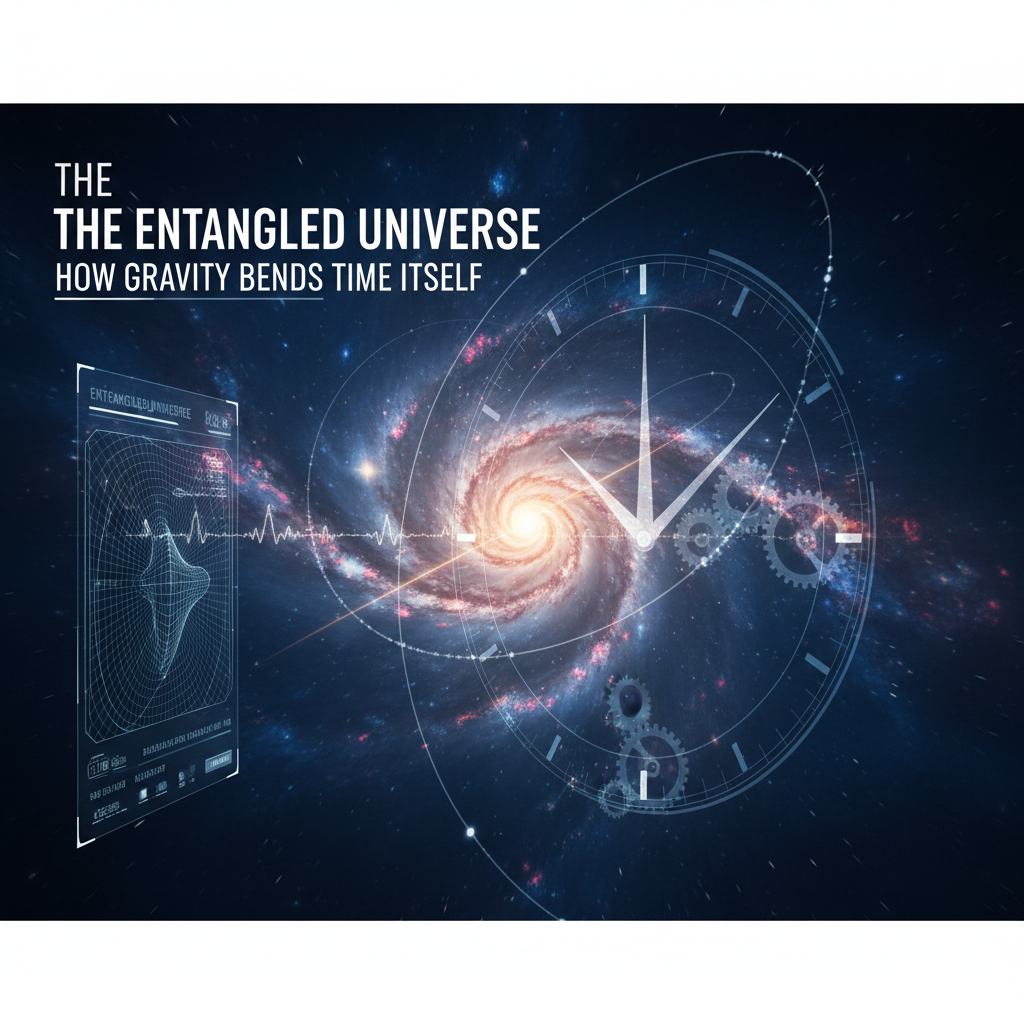
The Entangled Universe: How Gravity Bends Time Itself
 Dominic Mueller
The Entangled Universe: How Gravity Bends Time Itself
In the grand tapestry of our cosmos, few concepts are as fundamental, yet as mystifying, as time. We experience it as a relentless, forward-moving march, a constant backdrop to our lives. Yet, beneath this seemingly simple flow lies a profound complexity, one intricately woven with the very fabric of space and gravity. For centuries, philosophers and scientists alike pondered the nature of time. Was it an absolute, universal drumbeat, or something more malleable? The answer, as it turns out, is far more mind-bending than anyone could have imagined before the 20th century: gravity doesn't just pull on matter, it literally bends time itself.
Welcome to the entangled universe, where the colossal forces of the cosmos don't just shape galaxies, but subtly, yet fundamentally, alter our perception and experience of time. This isn't science fiction; it's the elegant, astonishing reality unveiled by Einstein's theories of relativity. Prepare to embark on a journey that will challenge your deepest assumptions about time, space, and the very structure of our existence.
The Newtonian Straitjacket: Time as an Absolute
For centuries, Isaac Newton's revolutionary work dominated our understanding of the universe. In his framework, space was a fixed, unchanging stage, and time was an absolute, universal river flowing uniformly for everyone, everywhere. Picture a cosmic clock ticking precisely the same for a farmer on Earth as for a distant star. Newton's laws of motion worked flawlessly to describe everything from falling apples to planetary orbits, and this absolute view of time was a cornerstone of his success.
Key features of Newtonian time:
- Universal: The same for all observers.
- Absolute: Independent of events or observers.
- Unchanging: Flows uniformly and continuously.
- Detached: Separate from space and matter.
This intuitive understanding of time mirrored our everyday experience. We measure time with clocks, synchronize events, and assume that "now" is the same moment for everyone, regardless of their location or speed. It was a comforting, stable universe, but it was about to be profoundly shaken.
Einstein's Revelation: Spacetime and the Fabric of Reality
The 20th century brought a seismic shift in our understanding of physics, primarily through the genius of Albert Einstein. His theories of relativity—special relativity (1905) and general relativity (1915)—completely dismantled the Newtonian concept of absolute time and space, replacing them with a unified, dynamic entity: spacetime.
Special Relativity: Speed Warps Time
Einstein's special theory of relativity, developed when he was just 26, focused on the relationship between space and time for objects moving at constant velocities relative to each other. Its central tenets are groundbreaking:
- The laws of physics are the same for all observers in uniform motion.
- The speed of light in a vacuum is the same for all observers, regardless of their motion relative to the source of light.
From these two seemingly simple postulates emerged astonishing consequences, the most famous being time dilation.
- Time Dilation: For an observer in motion relative to another, time will appear to pass slower for the moving object. The faster you move, the slower your time flows relative to a stationary observer. This isn't just an illusion; it's a real physical effect. Imagine identical twins, one embarking on a high-speed space journey and the other remaining on Earth. When the space-faring twin returns, they will have aged less than their Earth-bound sibling. This isn't just theoretical; it's been repeatedly confirmed by experiments involving high-speed particles and even atomic clocks on airplanes.
While special relativity showed how motion could warp time, it didn't yet incorporate gravity. That came with the masterpiece: general relativity.
General Relativity: Gravity Bends Spacetime
Ten years later, Einstein unveiled his general theory of relativity, a revolutionary geometric theory of gravity. Instead of gravity being a mysterious force acting at a distance (as in Newton's view), Einstein proposed that gravity is a manifestation of the curvature of spacetime itself.
Imagine spacetime as a gigantic, invisible trampoline. If you place a bowling ball (a massive object like a star or planet) on it, the fabric of the trampoline will stretch and sag. Now, if you roll a marble (a smaller object or even light) near the bowling ball, the marble won't travel in a straight line; it will follow the curve in the trampoline created by the bowling ball.
This analogy is key to understanding gravity:
- Mass and Energy Warp Spacetime: Massive objects (like planets, stars, and black holes) and even energy (like light) literally warp and curve the fabric of spacetime around them.
- Gravity is the Curvature: What we perceive as gravity is simply objects (and light) following the shortest path (a geodesic) through this curved spacetime. There's no "force" pulling them; they are just following the contours of the universe.
And here's where the magic for our discussion truly happens: this curvature of spacetime doesn't just affect spatial dimensions; it also affects the temporal dimension.
Gravitational Time Dilation: Time's Uneven Flow
If massive objects curve spacetime, and spacetime includes time, then it logically follows that gravity must affect the passage of time. This phenomenon is known as gravitational time dilation.
The principle is simple:
- Clocks tick slower in stronger gravitational fields.
- Clocks tick faster in weaker gravitational fields.
Think about it: the "bowling ball" of a massive object creates a deeper well in spacetime, and within that well, time slows down. As you move away from that massive object, and the spacetime curvature lessens, time speeds up.
Striking Examples and Real-World Evidence:
- Mountaintops vs. Sea Level: You might not notice it, but a clock on top of Mount Everest actually runs slightly faster than a clock at sea level. Why? Because the gravitational pull is marginally weaker at higher altitudes, further from the Earth's center of mass. While incredibly small (nanoseconds over a lifetime), it's a measurable difference.
- GPS Satellites: This isn't just a theoretical curiosity; it's a critical factor in modern technology. GPS satellites orbit Earth at an altitude where gravity is significantly weaker than on the surface. Due to gravitational time dilation, their clocks run faster than ground-based clocks (by about 45 microseconds per day). Simultaneously, due to their speed, they experience time dilation predicted by special relativity, which makes their clocks run slower (by about 7 microseconds per day). The net effect is that without correction for both special and gravitational time dilation, GPS systems would accumulate errors of over 10 kilometers per day, rendering them useless. Our smartphones rely on Einstein's relativity!
- Black Holes: The Ultimate Time Warps: Nothing illustrates gravitational time dilation better than black holes. These cosmic behemoths are regions where spacetime is curved so intensely that nothing, not even light, can escape their gravitational grasp once it crosses the event horizon. For an outside observer looking at an object falling into a black hole, time for the falling object appears to slow down dramatically. It would seem to take an infinite amount of time for the object to reach the event horizon, its light becoming increasingly redshifted until it fades out of existence. For the falling object itself, however, time continues normally until it reaches the singularity. It's a dizzying concept, where "eternal" and "instantaneous" become entangled.
- Cosmological Implications: The expanding universe itself experiences gravitational time dilation. Distant galaxies, because of the expansion of space and the stretching of light waves, appear to evolve in "slow motion" compared to galaxies closer to us. We observe supernovae in far-off galaxies lasting longer in our observed time frame than identical supernovae closer to home, a direct consequence of gravitational time dilation on a cosmic scale.
The Arrow of Time and the Entangled Future
While gravity beautifully explains why time can pass at different rates, it doesn't solve the deeper mystery of why time only moves forward. This is often referred to as the "arrow of time." The laws of physics, at a fundamental level, are mostly time-symmetric – they work equally well whether time flows forward or backward. Yet, in our macroscopic world, raw eggs don't unscramble, shattered glasses don't reassemble, and we remember the past but not the future.
This unidirectional flow of time is largely attributed to the Second Law of Thermodynamics, which states that the entropy (disorder) of a closed system always increases or remains constant. The universe, as a whole, appears to be an expanding, increasingly disordered system, and this steady march towards greater entropy seems intrinsically linked to our experience of time's forward progression.
Gravitational time dilation adds another layer of complexity to this. If clocks run at different rates depending on gravitational potential, then "now" isn't truly universal. An event happening "now" on Earth happened at a different "now" in a weaker gravitational field, when that stronger field's clock was ticking slower. This leads to a view of spacetime where past, present, and future are not rigid, but are part of a four-dimensional block, with gravity shaping the local rate at which we traverse it.
Key takeaways about time's direction and entanglement:
- No Universal "Now": Due to relativity, there isn't a single, universally agreed-upon "now" throughout the cosmos.
- Spacetimeเป็น A Block: Many physicists view spacetime as a fixed, unchanging "block," where all events, past, present, and future, exist simultaneously. Our experience of time passing is merely our conscious journey through this block.
- Gravity's Subtle Hand: Gravity, by stretching and compressing the temporal dimension, subtly influences the "speed" of our journey through this block, making our personal "present" a relative experience.
Practical Insights and Future Frontiers
Understanding gravitational time dilation isn't just about intellectual curiosity; it has profound implications and practical applications:
- Precision Timing: Beyond GPS, next-generation technologies like quantum computers and even more precise atomic clocks will need to account for gravitational time dilation with ever-increasing accuracy. Quantum sensors operating in varying gravitational fields are a new frontier.
- Astrophysics and Cosmology: The study of black holes, neutron stars, and the early universe heavily relies on general relativity and its predictions about time. Observing gravitational waves (ripples in spacetime caused by massive cosmic events) is directly probing the dynamic nature of spacetime.
- The Search for a Quantum Gravity Theory: General relativity, while incredibly successful, doesn't seamlessly integrate with quantum mechanics, the other pillar of modern physics. Developing a theory of "quantum gravity"—like string theory or loop quantum gravity—that describes gravity at the subatomic level is one of the greatest challenges in physics, and a complete picture of time will be central to it. How does time behave at the Planck scale? Does it even exist as we understand it?
- What if we could harness it? While far-fetched for now, the ultimate dream of interstellar travel often involves theoretical concepts like warp drives or wormholes, which fundamentally involve manipulating spacetime. If such technologies were ever conceivable, they would undoubtedly leverage the principles of gravity's influence on time.
Conclusion: Time, A Personal Journey
We began by seeing time as a universal, unchanging constant. We end with a vision of time as a deeply personal, relative experience, intricately linked to the massive objects that populate our universe. Gravity, far from being just a force that keeps our feet on the ground, is a cosmic shaper, dictating how fast our clocks tick, how long a star's life appears, and even challenging our very notion of what "now" means.
The entangled universe is one where space and time are inseparable, where mass and energy are the architects of reality, bending and stretching the very fabric of existence. Every second you experience is subtly different from a second experienced on a mountaintop, near a neutron star, or at the edge of a black hole.
This mind-bending revelation from general relativity doesn't diminish the wonder of time; it amplifies it. It teaches us that our universe is far stranger, far more beautiful, and far more dynamic than we ever imagined. The flowing river of time isn't a perfectly straight current; it's a majestic, meandering river, with eddies and rapids shaped by the gravitational landscapes it traverses, making each journey through the cosmos a truly unique and entangled experience. As we continue to explore the depths of physics, the mysteries of time will undoubtedly continue to unfold, revealing even more profound connections in our magnificent, gravitational tapestry.
Make Every Second Count
Inspired by this article? Take action now! Create a custom timer to help you manage your time better and reach your goals.
Create Your TimerAbout Dominic Mueller
Dominic Mueller is a German director for television and film with a deep fascination for time and time measurement. When he's not behind the camera crafting compelling visual stories, he explores the intricate world of temporal perception and timekeeping. Based in the beautiful city of Cologne, Germany, Dominic shares his life with his girlfriend and their beloved dog, Nala, finding inspiration in both the precise mechanics of time and the fleeting moments that make life meaningful.