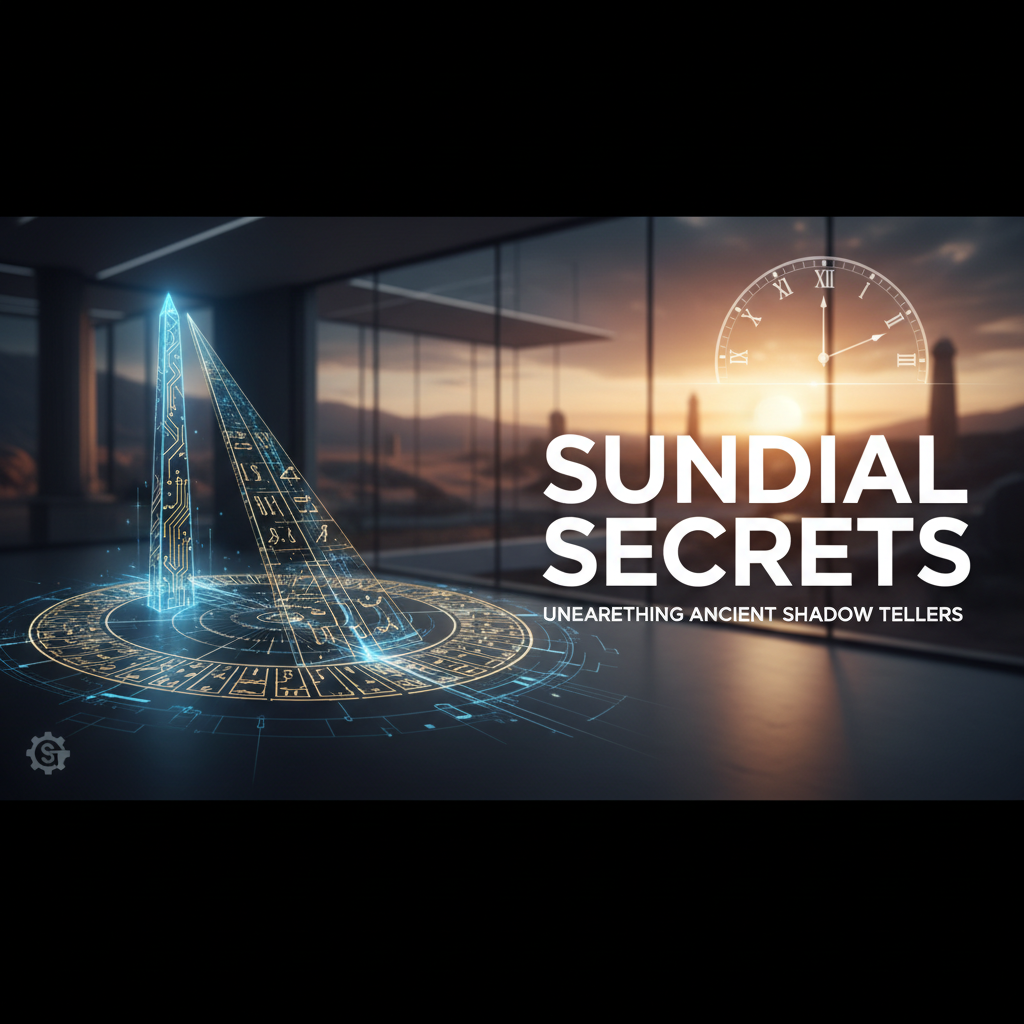
Sundial Secrets: Unearthing Ancient Shadow Tellers
 Dominic Mueller
Sundial Secrets: Unearthing Ancient Shadow Tellers
Imagine a world without clocks. No smartphones buzzing with alarms, no digital displays on microwaves, no grand tower clocks chiming the hour. How would you know when to plant your crops, when to gather for a meal, or even when to begin a journey? For millennia, humanity relied on a silent, steadfast companion embedded in the very fabric of our world: shadows. The sun, our ultimate timekeeper, cast its ever-changing silhouette, and our ancestors, with remarkable ingenuity, learned to read these subtle shifts, transforming them into the world's first reliable time-telling devices: sundials.
Sundials aren't just quaint garden ornaments; they are sophisticated instruments that whisper tales of astuteness, mathematical prowess, and a profound connection to the cosmos. From monumental obelisks dominating ancient cityscapes to intricate pocket-sized devices carried by scholars, the sundial holds a rich and fascinating history, revealing much about the cultures that conceived and perfected them. Join us as we delve into the secrets of these ancient shadow tellers, exploring their evolution, their hidden complexities, and the timeless wisdom they continue to impart.
The Dawn of Time Measurement: From Obelisks to Shadow Sticks
The concept of using shadows to tell time is as old as humanity's observation of the sun. The earliest, simplest sundials were likely nothing more than a stick planted vertically in the ground. As the sun moved, the stick's shadow would lengthen, shorten, and shift direction, offering a rudimentary sense of the day's progression. This basic principle forms the foundation of all sundials, regardless of their complexity.
The ancient Egyptians were pioneers in formalized shadow timekeeping. Their towering obelisks, stone monoliths that punctuated their cities and temples, served a dual purpose: architectural marvels and monumental sundials. The shadow cast by an obelisk would sweep across calibrated marks on the ground, indicating the time of day. This ingenious use of existing structures demonstrates an early understanding of the sun's predictable path across the sky.
Around 1500 BCE, the Egyptians developed the "shadow stick" or "shadow clock," a portable device that could be used in various locations. This consisted of a horizontal bar with a raised cross-piece at one end. Marks on the bar indicated specific hours as the shadow of the cross-piece fell upon them. These early instruments, though simple by modern standards, marked a significant leap in precision and portability for timekeeping.
Anatomy of a Sundial: Decoding the Gnomon and Dial Plate
At its heart, every sundial consists of two fundamental components:
- The Gnomon: This is the shadow-casting element. Its Latin root, gnomon, means "one who knows" or "an indicator." The gnomon is crucial, as the accuracy of the sundial depends entirely on its shape, angle, and orientation. In sophisticated sundials, the gnomon isn't just a vertical stick; it's often a thin, angled plate, rod, or even a triangular vane. Crucially, for a sundial to indicate true solar time accurately throughout the year, the gnomon's shadow-casting edge (known as the style) must be parallel to the Earth's axis of rotation. This means it points directly at the celestial North Pole (or South Pole, in the Southern Hemisphere). This precise alignment is what allows the sundial to compensate for the Earth's tilt relative to its orbit.
- The Dial Plate: This is the surface upon which the shadow falls, marked with lines or numerals representing the hours. The design of the dial plate varies wildly depending on the type of sundial and its desired precision. Hour lines can be straight, curved, or geometrically complex, reflecting the intricate mathematics involved in their creation.
The interplay between the gnomon and the dial plate is where the magic happens. As the sun appears to move across the sky, the gnomon's shadow sweeps across the dial plate, indicating the hour. The specific angle at which the hour lines are marked is determined by the latitude at which the sundial is intended to be used. A sundial designed for London would not work accurately in Cairo without recalculation and adjustment of its dial plate and gnomon angle.
A Kaleidoscope of Designs: Types of Sundials
The principles of gnomon and dial plate can be applied in countless ways, leading to a stunning diversity of sundial designs:
- Horizontal Sundial: The most common garden sundial. The dial plate is flat and horizontal, and the gnomon is typically a triangular plate with its upper edge pointing towards the celestial pole.
- Vertical Sundial: Mounted on a wall, such as a church or a house. The dial plate is vertical, and the gnomon protrudes perpendicular to the wall, with its style angled to point to the celestial pole. These are often particularly beautiful, incorporating artistic flourishes.
- Equatorial Sundial: The dial plate is parallel to the Earth's equatorial plane, essentially tilted at an angle equal to (90° minus the latitude) from the horizontal. The gnomon is a simple rod perpendicular to the dial plate. Hour lines are equally spaced, making them particularly elegant in their simplicity.
- Armillary Sphere: A complex and beautiful instrument, often found in ancient observatories. It consists of a sphere of interconnected rings representing celestial circles (equator, ecliptic, meridians). A central gnomon (usually a rod) casts a shadow onto the inner surface of an equatorial ring, marking the hours.
- Portable Sundials (Diptyches, Ring Dials, Compass Dials): These smaller, often elaborate devices allowed individuals to carry their timekeepers.
- Diptyches typically consisted of two hinged plates. One plate housed a compass (for orientation) and a horizontal dial, while the other held a vertical dial. A string stretched between the plates served as the gnomon.
- Ring Dials, or shepherd's dials, were simple rings with a small hole. Held up to the sun, a spot of light would fall on an inner scale, indicating the time. Some required knowledge of the date to be accurate.
- Compass Dials integrated a compass directly, allowing for accurate alignment.
This sheer variety underscores the ingenuity of ancient cultures in adapting the fundamental principle of shadow casting to different environments, uses, and aesthetic preferences.
Beyond the Hours: Equating Time and the Equation of Time
Early sundials primarily indicated apparent solar time, also known as "sundial time." This is based on the sun's actual position in the sky. However, apparent solar time doesn't run uniformly. The Earth's orbit around the sun is not a perfect circle but an ellipse, and its speed varies throughout the year (moving faster when closer to the sun). The Earth's axial tilt also contributes to this irregularity.
This means that a sundial's "noon" (when the shadow is shortest and points due north/south) might not perfectly align with 12:00 PM on a mechanical clock, which measures mean solar time (an average of the apparent solar time over the year).
The difference between apparent solar time and mean solar time is known as the Equation of Time (EoT). This fascinating astronomical phenomenon can vary by as much as plus or minus 16 minutes throughout the year. As sundial design became more sophisticated, especially during the Renaissance and later, dial makers began to incorporate corrections for the Equation of Time onto their dial plates, allowing observers to convert sundial time to clock time. Some even included a graph resembling a figure-eight (a lemniscate) showing the daily correction, a graphical representation of the EoT's annual variation.
Understanding the Equation of Time reveals the advanced astronomical knowledge possessed by sundial makers. It transforms the sundial from a simple indicator of the sun's position into a scientific instrument capable of revealing the complexities of celestial mechanics.
Sundials as Scientific Instruments and Cultural Markers
For centuries, sundials were not just time-telling devices; they were indispensable scientific instruments. Astronomers used them for calculating the height of the sun, determining latitude, and even tracking the progression of seasons. Their precision was critical for navigation, agriculture, and religious observances.
Beyond their scientific utility, sundials also held significant cultural and symbolic meaning:
- Religious Significance: In many cultures, the sun was worshipped as a deity, and sundials, by harnessing the sun's power, took on sacred connotations. Their presence on churches and temples was not just practical but also spiritual. The phrase "Tempus Fugit" (time flees) or "Carpe Diem" (seize the day) often inscribed on sundials served as moral reminders.
- Status Symbols: Intricate and ornate sundials were often commissioned by the wealthy and powerful, showcasing their scientific knowledge, artistic taste, and status. The craftsmanship involved could be extraordinary, turning a functional object into a work of art.
- Architectural Integration: Many sundials were seamlessly integrated into buildings, becoming permanent features that defined the rhythm of daily life within a community. Whole public squares often had central gnomons casting shadows across surrounding pavements, demonstrating time for the entire populace.
The transition from ancient, widely distributed time zones (where local noon was simply when the sun was highest) to standardized time zones (driven by the advent of railways in the 19th century) eventually led to the decline of the sundial as a primary timekeeper. Mechanical clocks, and later electronic devices, offered constant, indoor, and standardized time, a convenience that sundials simply couldn't match.
Practical Takeaways and Insights Today
While we no longer rely on sundials to catch our trains, their legacy offers valuable insights:
- A Deeper Connection to Nature: Engaging with a sundial forces us to observe the sun's path, the subtle changes in light, and the passage of seasons. It reconnects us to the natural rhythms of our planet, a connection often lost in our digitally-driven lives. It encourages mindful observation of our environment.
- Appreciation for Ingenuity: Sundials are powerful reminders of human ingenuity and our ancestors' ability to derive complex information from simple observations. They teach us that even with limited technology, profound scientific understanding can be achieved.
- The Relativity of Time: Understanding apparent solar time vs. mean solar time, and the Equation of Time, illustrates that "time" itself isn't a singular, perfectly uniform entity. It's a concept influenced by astronomical realities, a notion later echoed in Einstein's theories.
- A Call for Patience: Unlike the instant gratification of modern timekeeping, sundials demand a moment of pause, reflection, and quiet observation. They invite us to slow down and appreciate the measured, deliberate march of time.
You can even create your own simple sundial! Find a stick, plant it vertically in a sunny spot, and mark the shadow's position every hour on the ground. You'll quickly notice the principles in action and gain a newfound appreciation for this ancient art. For more accuracy, tilt your stick towards true north (or south) depending on your hemisphere, at an angle equal to your latitude.
Conclusion: Echoes of the Sun
The sun continues its unwavering journey across the sky, and every day, it casts its ancient, familiar shadows. In an age of atomic clocks and instantaneous global communication, the humble sundial might seem like a relic of a bygone era. Yet, its enduring presence in our gardens, on old buildings, and in the annals of history serves as a profound testament to human curiosity, intelligence, and our innate desire to understand the world around us.
Sundials are more than just instruments; they are silent teachers, whispering stories of ancient astronomers, philosophical contemplation, and a time when humanity was intimately attuned to the celestial dance above. They remind us that even the most complex technologies have roots in the simplest observations, and that sometimes, to truly grasp the essence of time, all we need to do is look up and observe the timeless secrets held within a moving shadow. So, the next time you encounter a sundial, take a moment. Observe its gnomon, trace its shadow, and let yourself be transported to a time when the sun was the only clock, and every ray of light held the secret to the fleeting moments of our existence.
Make Every Second Count
Inspired by this article? Take action now! Create a custom timer to help you manage your time better and reach your goals.
Create Your TimerAbout Dominic Mueller
Dominic Mueller is a German director for television and film with a deep fascination for time and time measurement. When he's not behind the camera crafting compelling visual stories, he explores the intricate world of temporal perception and timekeeping. Based in the beautiful city of Cologne, Germany, Dominic shares his life with his girlfriend and their beloved dog, Nala, finding inspiration in both the precise mechanics of time and the fleeting moments that make life meaningful.