Is Time a Social Construct, Not a Cosmic Constant
 Dominic Mueller
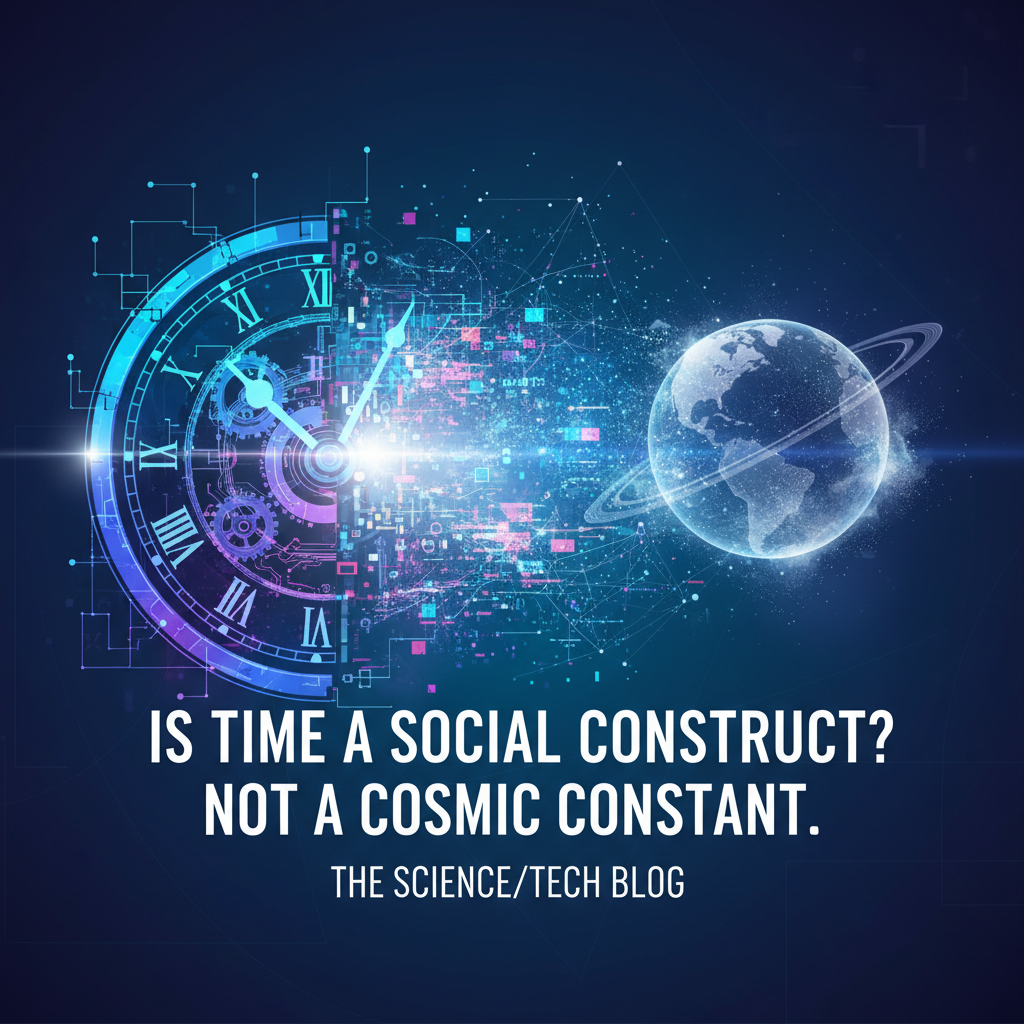
Is Time a Social Construct, Not a Cosmic Constant? Unraveling the Fabric of Our Chronological Experience
Tick-tock. Tick-tock. The ubiquitous rhythm of our lives. From the moment we wake to the gentle hum of our alarm to the last glance at the clock before sleep, time governs our existence. We measure it, schedule it, save it, waste it, and race against it. But what is time, really? Is it an unyielding, universal constant, a fundamental dimension woven into the very fabric of the cosmos, independent of human perception? Or is it something far more fluid, a conceptual framework, a sophisticated social construct we've meticulously built to order our chaotic world?
This question, seemingly academic, delves into the heart of philosophy, physics, psychology, and anthropology. It challenges our most deeply held assumptions about reality itself. Join us as we journey through the multifaceted perspectives on time, dissecting the arguments for its cosmic permanence and exploring the fascinating evidence that suggests its human-made nature.
The Clockwork Universe: Time as a Cosmic Constant
For centuries, our understanding of time was largely shaped by the Newtonian worldview. Isaac Newton, in his Principia Mathematica, described time as an absolute, true, and mathematical flow that "of itself, and from its own nature, flows equably without relation to anything external." In this view, time was a universal river, flowing uniformly everywhere in the cosmos, untouched by matter or motion. It was an independent backdrop against which all events unfolded.
Einstein's Revolution: Relativistic Time
Newton's absolute time held sway until the early 20th century, when Albert Einstein shattered this notion with his theories of special and general relativity. Einstein didn't negate time, but he profoundly redefined it.
- Special Relativity (1905): Introduced the concept of spacetime, a four-dimensional continuum where space and time are inextricably linked. Crucially, Einstein showed that time is not absolute but relative to the observer's motion.
- Time Dilation: Clocks moving relative to an observer run slower. The faster you move, the slower time passes for you relative to a stationary observer. This isn't a trick of perception; it's a verifiable physical phenomenon. GPS satellites, for instance, must account for time dilation to function accurately.
- Length Contraction: Objects moving at high speeds appear shorter in the direction of motion.
- Simultaneity is Relative: Events that appear simultaneous to one observer may not be simultaneous to another observer moving at a different speed.
- General Relativity (1915): Expanded on this by demonstrating that massive objects warp spacetime. Gravity isn't a force pulling things together; it's the curvature of spacetime caused by mass and energy, and this curvature affects the flow of time.
- Gravitational Time Dilation: Time passes more slowly closer to a massive object. A clock on Earth's surface runs slightly slower than a clock in orbit, which in turn runs slower than a clock further out in space. This, too, is accounted for in GPS technology.
Insight: While Einstein demonstrated that time is not absolute in the Newtonian sense, it remains a fundamental physical dimension. It's not a human invention but an intrinsic property of the universe, albeit a flexible and relative one, influenced by gravity and motion. It's a dimension we move through, just as we move through space.
The Arrow of Time
Despite its relativistic nature, time in physics exhibits a peculiar asymmetry: it always moves forward. This unidirectional flow is often referred to as the "arrow of time."
- Thermodynamic Arrow: The most common explanation for the arrow of time comes from the Second Law of Thermodynamics, which states that entropy (disorder) in a closed system always increases over time. A broken cup never spontaneously reassembles itself; an egg scrambles but never unscrambles. This irreversible increase in entropy gives time its forward direction.
- Cosmological Arrow: The expansion of the universe, starting from the Big Bang, also points to a forward direction. The universe is becoming larger and less dense, a process that defines a direction for time.
- Psychological Arrow: Our own subjective experience of time mirrors these physical arrows. We remember the past, experience the present, and anticipate the future. We don't remember the future or anticipate the past.
Interesting Fact: Some theoretical physicists, like Julian Barbour, propose "timeless physics," where time is not a fundamental entity but an emergent property of the universe's configurations. In this view, what we perceive as time is merely the change from one configuration to another. However, this remains a highly speculative area of research.
The Human Hand: Time as a Social Construct
While physics grapples with time as a dimension, a completely different perspective emerges when we consider how humans interact with, measure, and conceptualize it. Here, time begins to look less like a universal constant and more like a human-made framework.
The Invention of Measurement and Calendars
Imagine a world without clocks, calendars, or schedules. How would you coordinate a meeting? How would you track the seasons for agriculture? How would you define a birth or a death? Our ability to measure time isn't inherent; it's a sophisticated technological and intellectual achievement.
- Early Timekeeping: Ancient civilizations observed natural cycles: the rising and setting of the sun (days), the phases of the moon (months), and the changing seasons (years). These observations led to the earliest forms of calendars and astronomical measurements.
- Sundials, Water Clocks, and Mechanical Clocks: The invention of devices to subdivide these natural cycles – sundials, clepsydras (water clocks), hourglasses, and eventually mechanical clocks – marked a pivotal shift. They allowed for increasingly precise, standardized measurement, detaching time from natural phenomena and making it an independent entity.
- Standardization: The 19th and 20th centuries saw the global standardization of time.
- Greenwich Mean Time (GMT): Established in 1884 as the prime meridian for charting longitude, it became the world's time reference.
- Time Zones: A necessity for coordinating burgeoning global trade, communication (telegraph), and transportation (railways). Before time zones, every town set its clock by the local solar noon, leading to incredible logistical nightmares.
- Coordinated Universal Time (UTC): The modern international standard, based on atomic clocks, which defines the legal and scientific time of day.
Practical Takeaway: Without standardized time, modern society as we know it – global travel, telecommunications, financial markets, even synchronized sports events – would be utterly impossible. The precise division of hours, minutes, and seconds is a powerful, agreed-upon fiction that enables our complex global civilization.
Linguistic and Cultural Variations in Time Perception
The way different cultures conceptualize and speak about time offers compelling evidence for its constructed nature.
- "Linear" vs. "Cyclical" Time: Western cultures predominantly perceive time as linear, a continuous progression from past to present to future. This is reflected in our language ("time flies," "moving forward"). Many indigenous cultures, however, hold a more cyclical view, emphasizing seasons, generations, and repetitive natural rhythms. Time isn't a line but a recurring loop.
- Grammatical Tense: Not all languages treat tense the same way. Some languages, like those spoken by the Pirahã people of the Amazon, lack grammatical tenses or specific words for "time." Their focus is on immediate experience rather than abstract past or future. This doesn't mean they don't experience succession, but their linguistic framework doesn't force them into a linear, subdivided conceptualization.
- "Polychronic" vs. "Monochronic" Cultures: Anthropologist Edward T. Hall coined these terms to describe cultural attitudes toward time:
- Monochronic Cultures (e.g., Germany, Switzerland, USA): View time as a linear, tangible resource. It can be "saved," "spent," "wasted." Punctuality, schedules, and doing one thing at a time are highly valued.
- Polychronic Cultures (e.g., many Latin American, African, and Middle Eastern cultures): View time as more flexible and fluid. Relationships and social interactions often take precedence over strict schedules. Multi-tasking is common, and appointments are often seen as approximate rather than fixed.
Interesting Research: The Hopi language, an indigenous language spoken in northeastern Arizona, is often cited for its distinct approach to time. While early linguistic analysis suggested it lacked a concept of time altogether, later research clarified that it simply doesn't employ a linear, absolute framework like English. Instead, it uses grammatical structures that emphasize duration, validity, and the nature of an event's unfolding, rather than a fixed point in a continuous flow. This doesn't mean Hopi people don't experience past, present, and future, but their linguistic lens shapes a different cognitive understanding.
Time and Consciousness: The "Present Moment"
Our individual experience of time is profoundly subjective. The famous philosophical problem of the "specious present" highlights this: our perception of the "now" isn't an infinitesimal point but a small, fleeting duration, a window through which we integrate sensory input and build a coherent experience.
- Memory and Anticipation: Our consciousness constantly binds past and future. We carry memories of past events and anticipate future ones, creating a narrative flow that gives shape to our lives. Without memory and anticipation, our experience of time would dissolve into an endless, disjointed "now."
- Emotional Impact: Time appears to speed up when we're enjoying ourselves and drag when we're bored or in pain. This psychological elasticity demonstrates how our internal states can dramatically alter our subjective chronology.
Insight: While the physical universe might have a "time dimension," our experience of time – its divisions, its pace, its significance – is undeniably filtered through and shaped by our minds, our language, and our cultural norms. This makes it a deeply personal and intersubjective construct.
Bridging the Gap: A Synthesis
So, is time a cosmic constant or a social construct? The most accurate answer is perhaps both, depending on the level of analysis.
- Fundamental Reality: At the deepest physical level, time (as a dimension within spacetime) appears to be an intrinsic property of the universe. Einstein showed us it's not an absolute, immutable clock but a flexible, relative dimension influenced by gravity and motion. It's a fundamental aspect of reality without which the universe couldn't function as it does. Protons decay, stars evolve, and galaxies drift apart – these are processes that occur in time, regardless of human observation.
- Human Experience and Organization: However, our specific units of measurement (seconds, minutes, hours, days, years), our cultural norms around punctuality, our calendars, our linguistic expressions of tense, and even our subjective feelings about time's passage are undeniably human constructs. These constructs are essential for human communication, coordination, and the complex functioning of our societies. They allow us to impose order, predict events, and share a common chronological reference point.
Think of it like this: "Distance" is a fundamental physical concept. Objects in the universe are separated by measurable distances. But "miles" or "kilometers" are human constructs – arbitrary units we've agreed upon to measure that fundamental reality. Similarly, time as a dimension is real, but the way we slice, dice, and interpret it is very much our own creation.
Practical Takeaways and Insights
Understanding this dual nature of time offers several profound insights:
- Appreciate the Universality (and Relativity) of Physics: Recognize that the underlying physics of time dictates fundamental processes from stellar evolution to particle decay. We are all subject to its relativistic rules, even if we don't consciously perceive time dilation in our daily lives.
- Recognize the Power of Shared Constructs: Our system of standardized time is a monumental human achievement. It enables global cooperation and complex societal structures. Respecting these agreements is crucial for living in a connected world.
- Embrace Cultural Nuance: Different cultures perceive and value time differently. Being aware of monochronic and polychronic tendencies, for example, can significantly improve cross-cultural communication and understanding. What might be considered rude tardiness in one culture could be perfectly acceptable flexibility in another.
- Reclaim Your Subjective Time: Since our psychological experience of time is so flexible, we have some agency over it.
- Mindfulness: Practicing mindfulness can help us slow down our subjective experience of time, allowing us to savor moments and reduce feelings of being rushed.
- Novelty: Introducing new experiences and learning new things can make time feel richer and more expansive, as our brains process more information.
- Focus: Concentrating deeply on a task can lead to a sense of "flow," where time seems to disappear, yet the experience is deeply fulfilling.
Conclusion: Living in the Temporal Tapestry
The question of whether time is a cosmic constant or a social construct leads us not to a simple "either/or" answer but to a richer, more nuanced understanding. Time is both the relentless, relative dimension described by Einstein, governing the dance of celestial bodies and the decay of particles, and the intricate, adaptive framework humanity has woven to make sense of its existence.
We are temporal beings, inextricably bound to both the objective flow of the universe and the subjective narratives we create. Our clocks tick to the rhythm of atomic vibrations, but our lives unfold according to schedules, deadlines, and the unique pace of our individual and collective journeys. By recognizing this dual nature, we can better appreciate the profound mystery of time – a force that is both an immutable aspect of reality and a masterpiece of human invention, shaping our past, defining our present, and beckoning us toward the future. So, the next time you glance at a clock, remember the cosmic dance and the human ingenuity it represents.
Make Every Second Count
Inspired by this article? Take action now! Create a custom timer to help you manage your time better and reach your goals.
Create Your TimerAbout Dominic Mueller
Dominic Mueller is a German director for television and film with a deep fascination for time and time measurement. When he's not behind the camera crafting compelling visual stories, he explores the intricate world of temporal perception and timekeeping. Based in the beautiful city of Cologne, Germany, Dominic shares his life with his girlfriend and their beloved dog, Nala, finding inspiration in both the precise mechanics of time and the fleeting moments that make life meaningful.