Is Time a Fundamental Aspect of Reality, or an Emergent Property
 Dominic Mueller
The Unfolding Mystery: Is Time a Fundamental Aspect of Reality, or an Emergent Property?
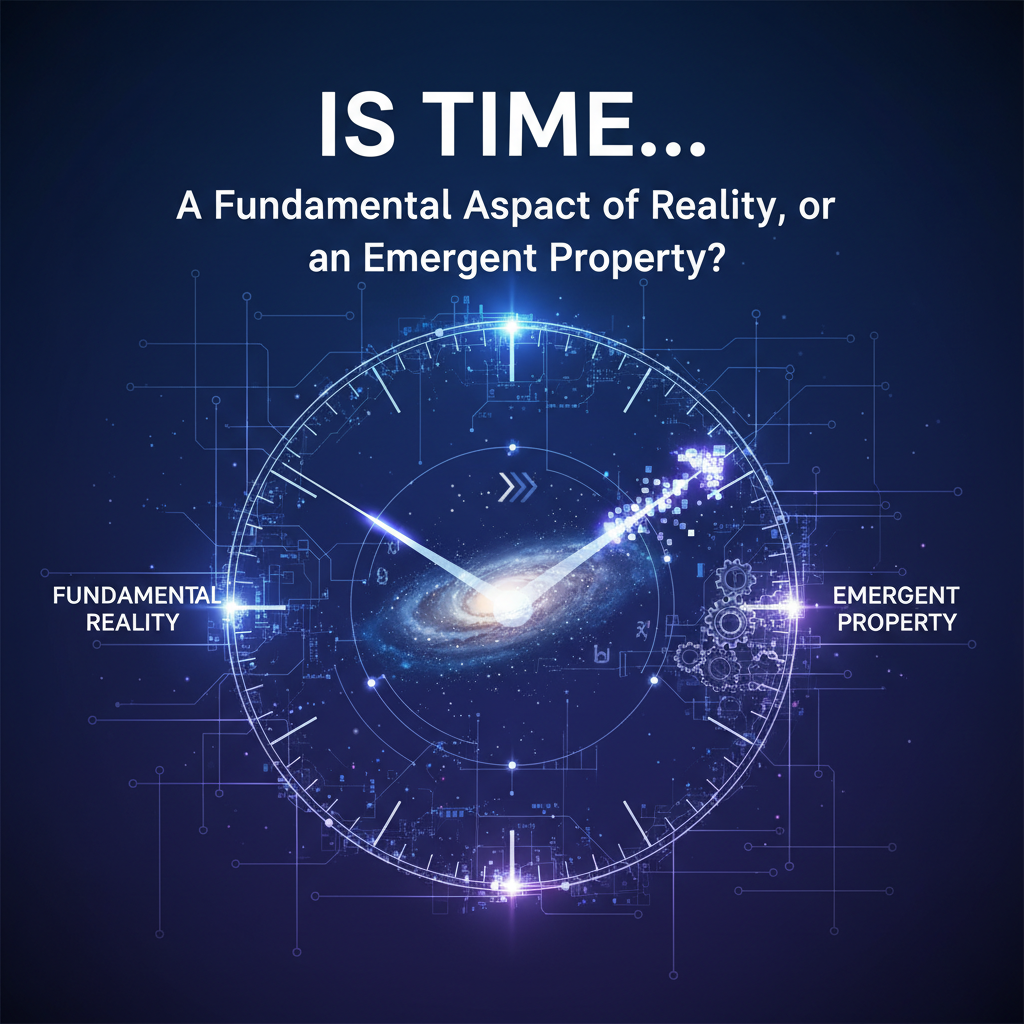
Time. It's the silent, relentless tick-tock of our existence, the invisible current that carries us from birth to death, from past to future. We feel its passage, measure its duration, and constantly lament its scarcity. But what is time, really? Is it a fundamental, irreducible part of the universe, like space or mass? Or is it something that arises from more basic interactions, an emergent property much like an ocean wave emerges from the movement of countless water molecules? This profound question lies at the heart of physics and philosophy, challenging our deepest intuitions and pushing the boundaries of human understanding.
For centuries, time was largely considered an absolute, unyielding backdrop against which all events unfolded. Newton famously championed this view, depicting time as a universal, immutable river flowing independently of the cosmos. Einstein, however, revolutionized our understanding, weaving time and space into the dynamic fabric of spacetime. Yet, even with this groundbreaking shift, the question of time's true nature remains fiercely debated. Join us as we delve into this captivating enigma, exploring the leading theories and mind-bending implications of whether time is truly fundamental or merely a clever illusion.
The Newtonian Paradigm: Time as an Absolute River
Before the 20th century, the dominant view of time was encapsulated by Isaac Newton's concept of absolute time. For Newton, time was a universal, omnipresent entity that flowed uniformly and independently of everything else. Imagine a grand cosmic clock, ticking away at the same rate for everyone and everything, everywhere in the universe.
- Key Characteristics of Newtonian Time:
- Absolute: It exists independently of observers and events.
- Universal: It flows uniformly for everyone.
- Immutable: Its rate cannot be altered or influenced.
- Linear: It progresses strictly from past to future.
This intuitive understanding mirrored our everyday experience. A second is a second, regardless of whether you're standing still or flying on a train. This framework was incredibly successful, forming the bedrock of classical mechanics and allowing us to predict the motions of planets and projectiles with astonishing accuracy. It felt right. Time was simply there, an unshakeable foundation upon which the drama of the universe played out.
Einstein's Revolution: Spacetime and the Relativity of Time
The serene river of Newtonian time was dramatically disrupted by Albert Einstein's theories of relativity. In a stroke of genius, Einstein demonstrated that time is not absolute but relative. It's not a separate entity but deeply intertwined with space, forming a unified four-dimensional continuum known as spacetime.
Special Relativity: Time Dilation
Einstein's 1905 theory of Special Relativity revealed two mind-bending phenomena:
- Time Dilation: Observers in relative motion will measure different durations for the same event. The faster you move, the slower time passes for you relative to a stationary observer. This isn't just a theoretical curiosity; it's a measurable effect. GPS satellites, for instance, experience time dilation due to their high speed, and their clocks must be adjusted to remain accurate. Without these adjustments, GPS systems would quickly become useless, accumulating errors of several miles per day!
- Length Contraction: Similarly, objects moving at high speeds appear shorter in their direction of motion.
These effects show that time is not a universal constant but a relative experience, dependent on the observer's frame of reference.
General Relativity: Gravity and the Curvature of Spacetime
A decade later, Einstein's General Relativity deepened this revolutionary understanding. He proposed that gravity isn't a force pulling objects together, but rather a manifestation of the curvature of spacetime caused by mass and energy. Massive objects, like planets and stars, warp the fabric of spacetime around them, and this curvature dictates the paths of objects (including light) and, crucially, the passage of time.
- Gravitational Time Dilation: Time passes more slowly in stronger gravitational fields. For example, a clock at sea level ticks slightly slower than a clock at the top of a mountain. Again, this is not just theoretical; it has been experimentally verified using atomic clocks. Astronauts on the International Space Station, experiencing both speed and reduced gravity, age fractionally slower than their counterparts on Earth.
Einstein's work fundamentally shifted our perspective. Time was no longer an independent, immutable background but an active participant in the universe's dynamics, intimately connected to space, motion, and gravity. For many, this interconnectedness suggests that time is fundamental to the very structure of reality. After all, if spacetime is the fabric of the cosmos, and time is an inseparable component of it, then time must be fundamental.
The Quantum Conundrum: Time at the Smallest Scales
While relativity beautifully describes time at cosmic scales, the picture gets far murkier when we venture into the bizarre realm of quantum mechanics. Here, the classical concept of time, with its continuous flow and definite measurements, seems to crumble.
The Problem of Time in Quantum Gravity
One of the greatest challenges in modern physics is reconciling general relativity with quantum mechanics to create a unified theory of quantum gravity. In attempting to quantize gravity, physicists encounter a perplexing issue known as the "problem of time."
- The Wheeler-DeWitt Equation: This foundational equation in quantum gravity, which attempts to describe the wave function of the entire universe, famously lacks a time variable. It describes a static, timeless universe. This doesn't necessarily mean time doesn't exist, but it strongly suggests that whatever "time" is, it might not be a fundamental, independent parameter at the quantum gravitational level.
- Background Independence: General relativity is "background independent," meaning spacetime itself is dynamic and not a fixed background. Quantum mechanics, on the other hand, typically assumes a fixed background time. Reconciling these two perspectives is a significant hurdle.
Some interpretations of quantum gravity suggest that time might not exist at the most fundamental level, but rather emerges from the entanglement of quantum states or from configurations of spacetime at a macro scale.
Emergent Time: An Illusion or a Feature?
The idea that time is not fundamental, but rather an emergent property, is gaining traction among many theoretical physicists. If time is emergent, it means it arises from more basic, timeless interactions, much like temperature emerges from the average kinetic energy of countless molecules.
Entropy and the Arrow of Time
One of the most compelling arguments for emergent time comes from thermodynamics, particularly the concept of entropy. Entropy is a measure of disorder or randomness in a system. The Second Law of Thermodynamics states that the total entropy of an isolated system can only increase over time, or remain constant (but never decrease).
- The Arrow of Time: This unidirectional increase in entropy provides a clear arrow of time. We distinctly remember the past, but not the future. Coffee cools, eggs scramble, and buildings decay – all processes that increase entropy. The universe is constantly moving from a state of lower entropy (the Big Bang) to higher entropy.
- From Timeless to Temporal: Perhaps time is simply the observable manifestation of increasing entropy. If the fundamental laws of physics are time-symmetric (meaning they work equally well forwards and backward), then the "flow" of time might simply be our perception of the universe moving toward greater disorder. In this view, time wouldn't be fundamental, but rather a macroscopic phenomenon, a consequence of the statistical behavior of countless particles. Imagine a perfectly ordered deck of cards. There's only one way it can be perfectly ordered, but countless ways it can be disordered. The "flow" of time might simply be the universe moving from that rare, highly ordered state to the overwhelmingly probable, disordered ones.
Loop Quantum Gravity and Causal Set Theory
Other approaches to quantum gravity also hint at emergent time:
- Loop Quantum Gravity (LQG): This theory proposes that spacetime itself is quantized, made of discrete "loops" or "atoms" of space. Within this framework, time might not be fundamental, but rather arises from the relationships between these fundamental spatial quanta. The universe could be viewed as a network of relationships, and time emerges from changes within this network.
- Causal Set Theory: This approach suggests that spacetime is made of discrete points, and the only fundamental aspect is the relationships of causality between these points. Events happen, and some events cause others. Time, then, is simply the chronological ordering that emerges from this web of fundamental causal connections. There is no continuous "time" flowing; there are only "before" and "after" relationships.
The "It From Bit" Perspective: Information and Time
A more radical view, gaining traction in some corners of theoretical physics, suggests that reality, including time, might ultimately be information-theoretic. This "It From Bit" philosophy, famously championed by John Archibald Wheeler, proposes that physical reality arises from processing information.
If reality itself is fundamentally information, then time could be seen as the sequence of computational steps or the processing of information that gives rise to our experienced reality. In this intricate dance, time emerges not as a pre-existing container but as a dynamic unfolding of information processing. Could our universe be a grand simulation? If so, time would be an emergent property of the simulation's algorithm.
Implications and Takeaways: How Does This Change Our Perspective?
Whether time is fundamental or emergent isn't just an abstract philosophical debate; it has profound implications for our understanding of reality, causality, and even free will.
- Reframing Causality: If time is emergent, then our intuitive understanding of cause preceding effect might need re-evaluation. Perhaps causality is more fundamental, and time a consequence of it, rather than the other way around.
- The Illusion of the Present: If the universe is timeless at its most fundamental level, our perception of a constantly moving "present moment" could be an illusion. All moments – past, present, and future – might "coexist" in a more fundamental, time-invariant reality. This echoes the "block universe" theory, where spacetime is a fixed, four-dimensional block, with all events already laid out.
- Redefining Free Will: If time is emergent from deterministic, timeless laws, does that leave room for genuine free will, or is everything predetermined? This question pushes the boundaries of philosophy and physics.
- A Deeper Understanding of Experience: Our subjective experience of time is incredibly rich and complex. Time can drag or fly. This subjective elasticity points to how deeply intertwined time is with consciousness and perception. If physical time is emergent, then our conscious experience of it might be an even higher-level emergent property.
- New Avenues for Physics: Pursuing the idea of emergent time can unlock new pathways in physics, potentially leading to a unified theory of quantum gravity and a more complete picture of the universe's origins and ultimate fate. It challenges us to think beyond our anthropocentric experience of time.
Conclusion: The Unending Quest
The question of whether time is a fundamental aspect of reality or an emergent property remains one of the most exciting and perplexing mysteries in science. From Newton's absolute flow to Einstein's relativistic spacetime, and finally to the quantum realm where time itself seems to dissolve, our understanding has undergone radical transformations.
While the current scientific consensus leans towards time being an intrinsic, fundamental component of spacetime within the framework of general relativity, the challenges posed by quantum mechanics and the allure of emergent time theories continue to push the boundaries of inquiry. The idea that time, the very rhythm of our existence, could be an illusion, a macroscopic phenomenon arising from something more basic and timeless, is both humbling and exhilarating.
Perhaps, as our instruments become more precise and our theories more refined, we will eventually unveil time's true nature. Until then, the clock keeps ticking, the universe continues to unfold, and the quest to understand the fabric of reality, including its most elusive dimension, continues. One thing is certain: our ongoing exploration of time is a journey that reshapes not only our understanding of the cosmos but also our place within it. The mystery of time remains, beckoning us forward into an ever-deepening understanding of the universe.
Make Every Second Count
Inspired by this article? Take action now! Create a custom timer to help you manage your time better and reach your goals.
Create Your TimerAbout Dominic Mueller
Dominic Mueller is a German director for television and film with a deep fascination for time and time measurement. When he's not behind the camera crafting compelling visual stories, he explores the intricate world of temporal perception and timekeeping. Based in the beautiful city of Cologne, Germany, Dominic shares his life with his girlfriend and their beloved dog, Nala, finding inspiration in both the precise mechanics of time and the fleeting moments that make life meaningful.