Is the Present an Illusion: The Enduring Debate
 Dominic Mueller
Is the Present an Illusion: The Enduring Debate
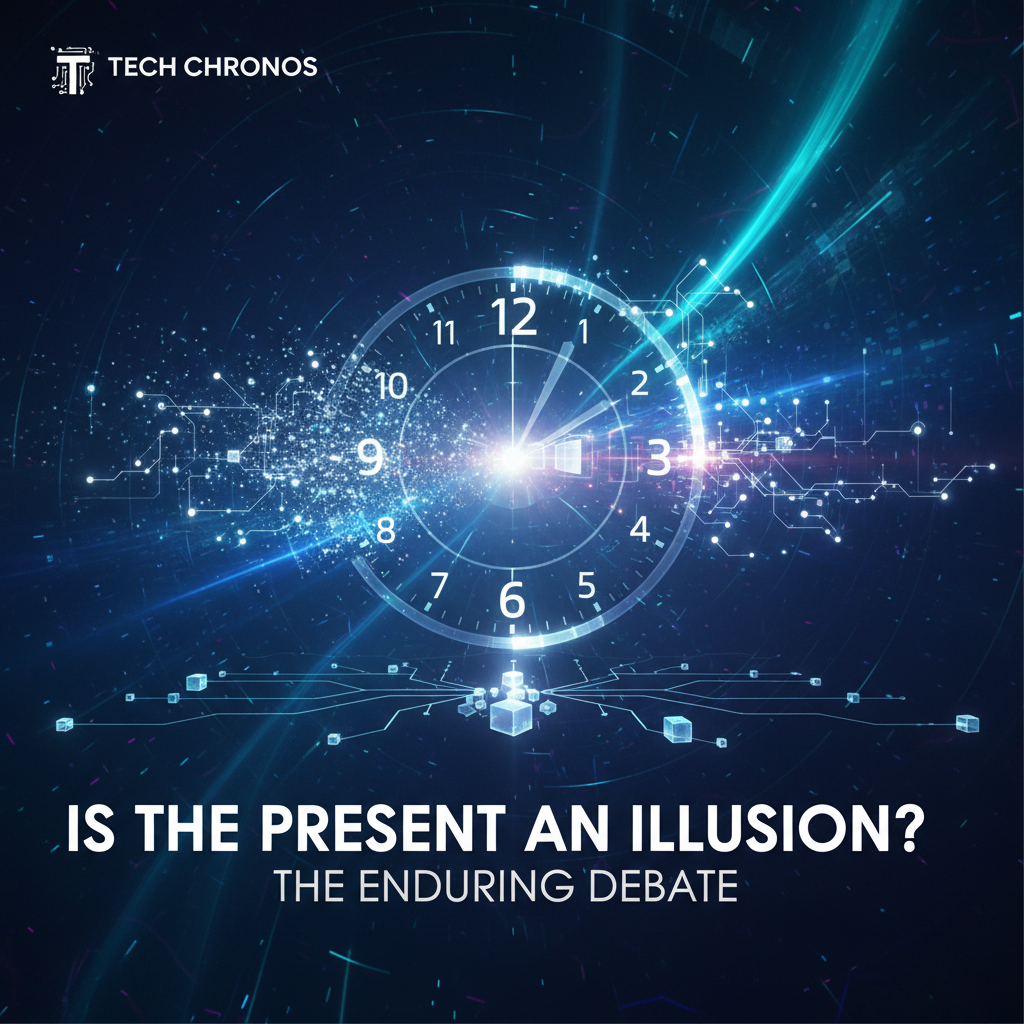
From the fleeting tick of a clock to the profound expanse of cosmic history, time is arguably the most mysterious and fundamental aspect of our existence. We experience it as a relentless, unidirectional flow – a succession of nows. But what exactly is this "now"? Is it a concrete, indivisible moment, a tangible slice of reality we inhabit, or is it merely a flicker, a conceptual construct, perhaps even an illusion? This question, seemingly esoteric, has puzzled philosophers, physicists, and mystics for millennia, leading to one of the most enduring and fascinating debates in human thought: Is the present an illusion?
The Ubiquitous "Now": Our Everyday Experience
Our intuitive understanding of time is deeply rooted in the concept of the present. We plan for the future, reflect on the past, but we actively live in the present. It's where consciousness resides, where decisions are made, and where reality manifests. When we say "I am here now," we feel an immediate, undeniable truth to that statement. We perceive a continuous stream of experiences, each anchored in that elusive "now."
Consider listening to a piece of music. Each note follows the last, creating a melody that unfolds only in the present moment. If the present were not real, how could we experience the coherence of a symphony, the fluidity of a conversation, or the immediate sensation of touch? This everyday experience makes the notion of the present as an illusion seem almost preposterous.
Philosophical Foundations: The Block Universe vs. Presentism
The debate over the reality of the present largely boils down to two opposing philosophical camps: Presentism and Eternalism (often associated with the "Block Universe" theory).
Presentism: Only the Now is Real
Presentism is the view that only the present exists. The past was, and the future will be, but neither possesses actual existence. Think of a spotlight moving across a dark stage: only the illuminated area (the present) is real. The areas the spotlight has passed over (the past) no longer exist, and the areas it has yet to reach (the future) do not yet exist.
Arguments for Presentism often lean on our strong intuitive experience of time and the seeming unreality of past and future events. If your childhood home still "exists" in some fundamental sense, where is it? If tomorrow's lottery numbers already "exist," why can't we access them? Presentists argue that the very distinctness of past, present, and future implies that only one of these states can truly be real at any given moment.
Key proponents: St. Augustine, who famously wrestled with the nature of time in his Confessions, finding the present to be the only truly tangible segment.
Eternalism (The Block Universe): All of Time Exists Simultaneously
In stark contrast, Eternalism, often depicted as the Block Universe theory, posits that all moments in time – past, present, and future – are equally real and co-exist in a four-dimensional spacetime block. In this view, time is not a flowing river but a static, immutable landscape. Our experience of "now" is merely analogous to an observer moving through this landscape, perceiving different points sequentially.
Imagine a loaf of bread. Each slice represents a moment in time. From an external perspective, all slices exist simultaneously as part of the loaf. Similarly, from an "outside" perspective of the universe, all moments from the Big Bang to the final heat death are already laid out. Our sense of a "moving present" is simply our particular way of experiencing this fixed reality.
Key implications:
- No genuine passage of time: Time doesn't "flow"; it merely is.
- Determinism: If the future already exists, then free will becomes a much more complicated concept, as events are already fixed.
- Symmetry of time: Past and future are fundamentally no different from each other.
Key proponents: Albert Einstein, Hermann Minkowski, and many contemporary physicists. Einstein's theory of Special Relativity, with its concept of spacetime and the relativity of simultaneity, provides strong theoretical support for Eternalism.
The Scientific Challenge: Relativity and the Disappearing Present
Modern physics, particularly Einstein's theories of relativity, has dealt a significant blow to the intuitive notion of an absolute, universally shared "present."
Special Relativity and the Relativity of Simultaneity
One of the most profound insights from Special Relativity is the relativity of simultaneity. This means that two events that appear simultaneous to one observer might not appear simultaneous to another observer who is in relative motion.
Consider this thought experiment: Imagine you are on a train moving at a very high speed. Two lightning bolts strike the front and back of the train simultaneously from your perspective. However, to an observer standing still on the ground, the lightning bolt striking the front of the train would appear before the one striking the back, because the light from the front has a shorter distance to travel to reach the observer, and the observer on the ground sees the train moving towards the front strike.
This seemingly simple idea has radical implications: there is no absolute "now" that all observers can agree upon. Your "present moment" is not necessarily the same as someone else's, particularly if they are moving at a different speed relative to you. If there is no universal "present," how can "the present" be a truly objective reality? This strongly favors the Block Universe theory, where all events simply exist at different points in spacetime, and observers slice through this block differently.
General Relativity and Curved Spacetime
General Relativity further complicates matters by showing that gravity itself can warp time. Clocks tick slower in stronger gravitational fields. This phenomenon, known as gravitational time dilation, means that your "now" is ticking at a different rate depending on how close you are to a massive object. An astronaut in orbit experiences time slightly faster than someone on Earth. If the rate of "now" is variable, does that make the "now" less real, or just more flexible?
These relativistic effects suggest that our shared experience of a universal, uniform "now" is more of a local agreement than a fundamental truth of the cosmos.
Quantum Mechanics: A Glimmer for the Present?
While relativity seems to push us towards a Block Universe, some interpretations of quantum mechanics offer a sliver of hope for the reality of the present.
Quantum mechanics deals with the probabilistic nature of reality at the subatomic level. famously, particles don't have definite states until they are observed or measured. This phenomenon, often described as the "collapse of the wave function," suggests that reality is not entirely predetermined. Until a measurement occurs, all possibilities exist in a superposition.
Some philosophers and physicists argue that this "collapse" happens in the present moment, with the act of observation bringing reality into being now. If reality is actively being created or chosen in the present through quantum interactions, then the present isn't just a point on a fixed timeline; it's a dynamic, active interface of existence. However, this interpretation is far from universally accepted and raises its own complex questions about the nature of consciousness and measurement.
The Psychological Present: Our Brain's Trick
Beyond physics, our experience of the present is deeply influenced by our biology and psychology. The "now" we perceive isn't an infinitely thin slice of time. Instead, our brains construct what's often called the "specious present" or "psychological present."
This refers to the short, finite duration of time that we subjectively experience as "now." It's not a single instant but a small window of time, perhaps a few seconds long, within which we integrate sensory information and perceive continuity. Think about listening to a sentence: you need to hold the beginning of the sentence in your working memory to understand the end. This "holding" is part of the specious present.
- Our brains are predictiion machines: Our perception of the present is heavily influenced by our expectations and predictions about the immediate future, based on past experiences. This predictive processing helps us react quickly to our environment.
- Memory and anticipation: Our brains are constantly weaving together snippets from the recent past with projections into the immediate future to create a coherent narrative of experience. Remove this integration, and the "present" would shatter into disconnected moments.
The very fact that our "now" has a duration, and that this duration can vary (e.g., in moments of high stress, time seems to slow down), suggests that the present is not a fundamental, objective unit, but rather a deeply subjective, neurologically constructed phenomenon.
Practical Takeaways and Insights
So, if the present might be an illusion, what does this mean for our daily lives?
- Embrace the Impermanence: If the present is fleeting, or even illusory, it underscores the impermanence of all things. This insight, central to many spiritual traditions like Buddhism, encourages us to appreciate moments for what they are, without clinging.
- Mindfulness and Presence: Paradoxically, while the present might be an illusion scientifically, experientially it is all we have. Practices like mindfulness thrive on bringing our attention fully to the "now," recognizing that our suffering often stems from dwelling on the past or worrying about the future. Even if it's a "specious present," it's the only one we directly inhabit.
- Rethink Free Will: If Eternalism is true, and the future already exists, does free will become an illusion? This is a huge philosophical question. Some argue that even if events are laid out, our experience of making choices and our internal deliberation are still real processes within that block. The debate shifts from whether we can choose, to what "choice" truly means within a deterministic framework.
- Perspective on Regret and Anxiety: Understanding that the past no longer exists (Presentism) or is merely a fixed point in spacetime (Eternalism) can help us release regret. Similarly, the future, whether yet to be created or already existing, is not something we can suffer in right now. This can be liberating for managing anxiety.
- The Mystery Endures: The biggest takeaway is the profound mystery of time. We stand at a crossroads where our intuitive experience clashes with the rigorous findings of modern physics. This humility before the unknown is a powerful driver of scientific and philosophical inquiry.
The Enduring Allure of the Question
"Is the present an illusion?" This question is not a mere academic exercise. It touches upon the very fabric of our being, our understanding of reality, free will, and consciousness. While physics leans heavily towards an Eternalist, Block Universe model, suggesting our "now" is a subjective path through a predetermined reality, our lived experience vehemently argues for its tangible existence.
Perhaps the resolution lies not in choosing one over the other, but in embracing the multifaceted nature of time. The objective reality of spacetime, as described by physics, might be a static block, while our subjective experience of time as a flowing "present" is a fundamental aspect of consciousness, a uniquely human way of navigating that block.
The "present" as we know it might indeed be an intricate illusion crafted by our brains, a necessary cognitive tool to organize a constant flow of information into a coherent narrative. Yet, within that illusion, we find meaning, make choices, and fully experience life. The debate continues, reminding us that even the most fundamental aspects of our reality are rich with mystery and ripe for ongoing exploration.
Make Every Second Count
Inspired by this article? Take action now! Create a custom timer to help you manage your time better and reach your goals.
Create Your TimerAbout Dominic Mueller
Dominic Mueller is a German director for television and film with a deep fascination for time and time measurement. When he's not behind the camera crafting compelling visual stories, he explores the intricate world of temporal perception and timekeeping. Based in the beautiful city of Cologne, Germany, Dominic shares his life with his girlfriend and their beloved dog, Nala, finding inspiration in both the precise mechanics of time and the fleeting moments that make life meaningful.