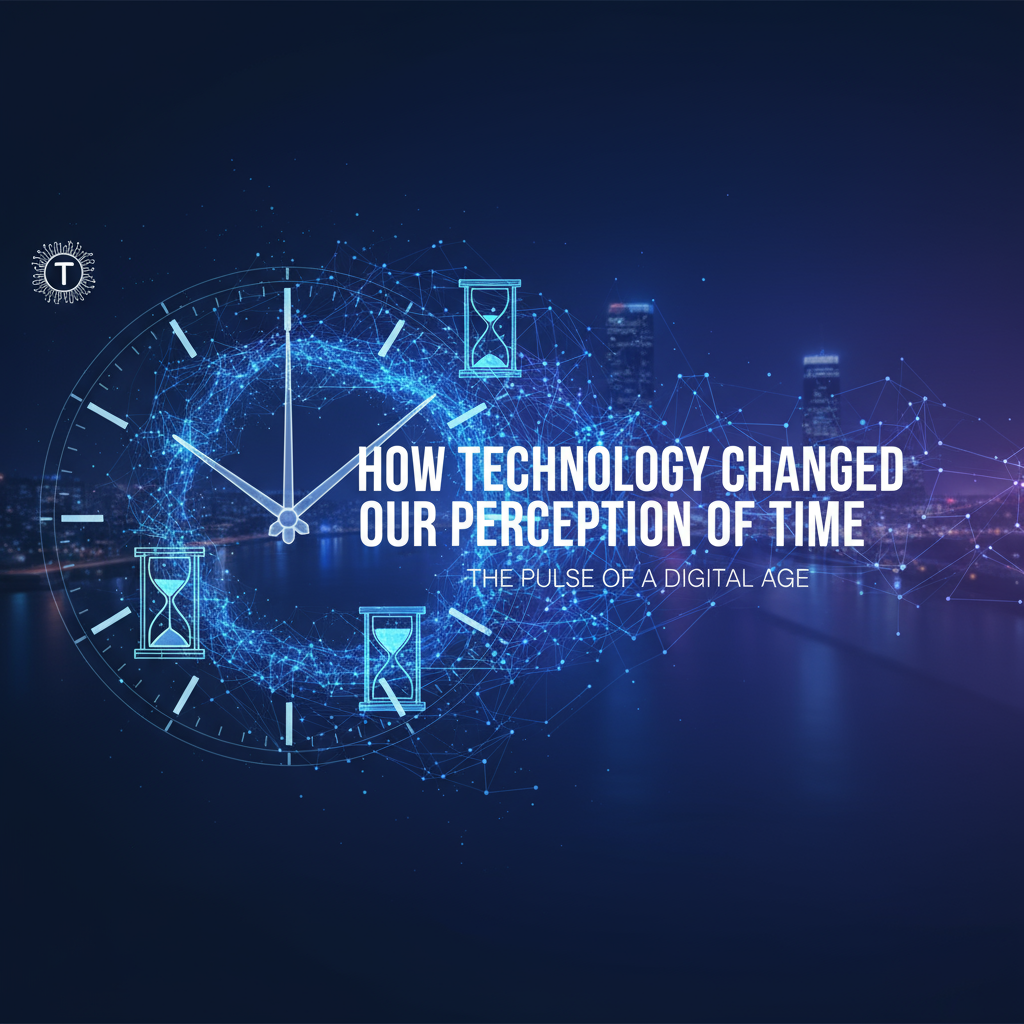
How Technology Changed Our Perception of Time
 Dominic Mueller
The Digital Stopwatch of Our Lives: How Technology Reshaped Our Perception of Time
Time. It's the ultimate constant, yet its perception is anything but. From the relentless ticking of geological epochs to the fleeting blink of a hummingbird's wing, time has always been a fundamental backdrop to human existence. But in the grand tapestry of human history, a relatively recent innovation – technology – has fundamentally altered not just how we manage time, but how we experience it. We've gone from living with the rhythms of the sun and the seasons to a hyper-connected, always-on existence, and this paradigm shift has profound implications for our internal chronometer.
This article delves into the fascinating and often disorienting ways technology has transformed our perception of time, exploring everything from the acceleration of daily life to the blurring lines between work and leisure, and how we might navigate this brave new temporal landscape.
The Dawn of Digital Time: From Sundials to Atomic Clocks
For millennia, humanity’s understanding of time was intertwined with natural cycles. Sundials tracked the sun’s journey, water clocks measured the steady drip, and lunar calendars dictated agricultural rhythms. The invention of mechanical clocks in the Middle Ages brought a new level of precision, albeit a localized one. Imagine a world where every town's clock told a slightly different time!
The industrial revolution, with its need for synchronized factory schedules and train timetables, propelled the standardization of time. But it was the advent of digital technology, particularly in the last few decades, that truly revolutionized our relationship with this elusive dimension.
- Atomic Clocks and the Quest for Ultimate Precision: Our modern world runs on atomic clocks, devices so precise they wouldn't lose a second in 30 million years. This unparalleled accuracy underpins GPS, global communication networks, and the very fabric of our interconnected world. We are, quite literally, living in the most precisely timed era in human history. Yet, paradoxically, our subjective experience of time often feels anything but precise. We constantly feel short on time, even as we measure it with incredible accuracy.
- The Global Clock: The internet and global communication have flattened time zones. A message sent from Tokyo instantaneously arrives in New York. This constant awareness of "global time" has both benefits and drawbacks. It enables seamless international collaboration but also creates a pressure to be "always on," blurring the lines of traditional working hours.
The Acceleration of Daily Life: A Perpetual Sprint
One of the most profound effects of technology is the perception that time is speeding up. Our lives feel more rushed, more demanding, and perpetually teetering on the edge of "not enough hours in the day."
- Instant Gratification and Diminished Waiting Times: Remember waiting patiently for a letter to arrive, or for photos to be developed? Those experiences are largely relegated to history. Email, instant messaging, and digital photography have drastically reduced waiting times, instilling an expectation of immediate results. This constant flow of instant gratification can make even short delays feel excruciating, contributing to a sense of impatience and time scarcity.
- The Multi-Tasking Myth and Cognitive Overload: Our smartphones, a microcosm of technological advancement, are designed to make us more efficient. Yet, they often plunge us into a maelstrom of notifications, emails, and social media updates. The constant urge to multi-task – checking emails during a meeting, browsing social media while watching TV – creates a fractured perception of time.
- Research Insight: Studies by organizations like the American Psychological Association have shown that chronic multi-tasking reduces efficiency and increases stress levels. Our brains are not designed for constant task-switching; it depletes cognitive resources and makes it harder to focus, making time feel more fragmented and less productive.
- The Tyranny of the Inbox: Email, once a revolutionary communication tool, has become a relentless taskmaster. The expectation of prompt replies creates a perpetual "on-call" mentality, extending the workday far beyond traditional hours. This blurring of work and personal time can lead to burnout and a feeling that we are constantly "working against the clock."
The Blurring Boundaries of Time: Work, Leisure, and the Eternal Present
Technology has dissolved many of the traditional boundaries that once defined how we experienced time.
- Work-Life Integration vs. Work-Life Balance: The ability to work from anywhere, at any time, has been touted as a liberation. However, the dark side is the erosion of distinct work and leisure periods. The "always-on" culture means that the work email arriving at 9 PM or the weekend Slack message has become commonplace. This permeable boundary makes it harder to truly switch off and recharge, contributing to chronic stress and a feeling of time scarcity.
- The "Eternal Present" of Social Media: Social media platforms are designed to keep us engaged in a perpetual present, constantly barraging us with real-time updates and ephemeral content. This can lead to a diminished sense of past and future. We are less likely to reflect on long-term goals or learn from past mistakes when our attention is constantly pulled to the immediate, fleeting moment.
- Practical Takeaway: Actively scheduling "digital detox" periods can help regain a sense of perspective and re-establish healthier boundaries with the digital world.
- Time Compression in Entertainment: Streaming services, binge-watching, and the ability to consume vast amounts of content on demand have altered our relationship with narratives and leisure time. We can now consume entire seasons of a show in a single weekend, leading to a compressed experience of storytelling. While enjoyable, this can sometimes lead to a feeling of passive consumption rather than active engagement, and a subsequent feeling of "where did the time go?"
Memory, Recall, and the Digital Footprint
Technology has also profoundly impacted our memory and how we remember the passage of time.
- The Externalization of Memory: Modern devices act as external hard drives for our memories. Photos, videos, messages, and even our daily activities are meticulously recorded. While this offers a rich archive of our lives, it raises questions about our internal memory capabilities. Are we outsourcing our memories to our devices, and what happens when we rely too heavily on external recall?
- Research Fact: Some cognitive scientists argue that the constant availability of external memory could potentially weaken our internal memory formation and retrieval processes, leading to a less robust personal narrative over time.
- Digital Nostalgia and Time Travel: Looking back at old social media posts or meticulously organized photo albums can create a unique form of digital nostalgia. We can "time travel" through our digital footprint with ease, reliving past moments with a fidelity impossible in previous generations. This can be fulfilling, but also sometimes overwhelming, presenting a curated, often idealized, version of the past.
The Algorithmic Manipulation of Our Time
Perhaps one of the most insidious ways technology has altered our perception of time is through the algorithmic design of our digital environments.
- Keeping Us Scrolled and Engaged: Social media feeds, news aggregators, and video platforms are expertly crafted to maximize engagement – to keep our eyes on the screen for as long as possible. Infinite scroll, autoplay videos, and personalized recommendations are all designed to make us lose track of time. This can lead to unproductive time spirals, where minutes turn into hours without conscious intent.
- The "Fear of Missing Out" (FOMO) and Urgency: Notifications, limited-time offers, and trending topics all contribute to FOMO, a feeling that if we disengage, we are missing out on something important. This creates a perpetual sense of urgency, driving us to constantly check our devices and reinforcing the idea that time is a finite resource we must manage with constant vigilance.
Reclaiming Our Time: Practical Takeaways
Understanding how technology has reshaped our perception of time is the first step towards reclaiming control.
- Practice Mindful Technology Use: Instead of passively consuming, be intentional about when and how you use technology. Set specific times for checking emails or social media.
- Schedule Digital Detoxes: Designate periods – an hour, an evening, a whole weekend – where you disconnect from all non-essential technology. Re-engage with the physical world and real-time interactions.
- Cultivate Deep Work: In a world of constant distractions, finding uninterrupted blocks of time for focused, deep work is crucial. Turn off notifications, close unnecessary tabs, and create an environment conducive to concentration.
- Embrace Boredom: Paradoxically, technology has almost eliminated boredom. Yet, boredom is a fertile ground for creativity, reflection, and problem-solving. Allow yourself to be bored occasionally; you might be surprised by what emerges.
- Re-evaluate Your Relationship with Instant Gratification: Consciously delay gratification in small ways. Instead of immediately checking a notification, set a time limit for yourself. This can help retrain your brain to be less dependent on immediate rewards.
- Set Clear Boundaries: Communicate your "off-hours" to colleagues and friends. Learn to say no to requests that encroach on your personal time. Protecting your boundaries is essential for maintaining a healthy work-life integration.
- Journal and Reflect: Despite the digital archives, make time for personal reflection. Journaling about your day, your feelings, and your long-term goals can help build a stronger internal narrative and a more conscious relationship with the passage of time.
Conclusion: The Future of Time Perception in a Hyper-Connected World
Technology is not inherently good or bad; it is a tool. Like any powerful tool, its impact depends on how we wield it. The digital age has undeniably rewired our brains, accelerating our perception of time, blurring boundaries, and fragmenting our attention. We live in a world where speed is often prioritized over depth, and constant connectivity over genuine presence.
However, recognizing these effects empowers us to be more conscious participants in our own temporal experience. By understanding the forces at play, we can learn to wield technology in a way that serves us, rather than enslaving us. Reclaiming our time in the digital age isn't about rejecting technology, but about integrating it mindfully, ensuring that while it connects us to the world, it doesn't disconnect us from ourselves and our intrinsic rhythms. The ultimate challenge of our era may well be to slow down the digital stopwatch and rediscover the richness and depth of time, one mindful moment at a time.
Make Every Second Count
Inspired by this article? Take action now! Create a custom timer to help you manage your time better and reach your goals.
Create Your TimerAbout Dominic Mueller
Dominic Mueller is a German director for television and film with a deep fascination for time and time measurement. When he's not behind the camera crafting compelling visual stories, he explores the intricate world of temporal perception and timekeeping. Based in the beautiful city of Cologne, Germany, Dominic shares his life with his girlfriend and their beloved dog, Nala, finding inspiration in both the precise mechanics of time and the fleeting moments that make life meaningful.