The Social Time Warp: How Group Dynamics Distort Our Clocks
 Dominic Mueller
The Social Time Warp: How Group Dynamics Distort Our Clocks
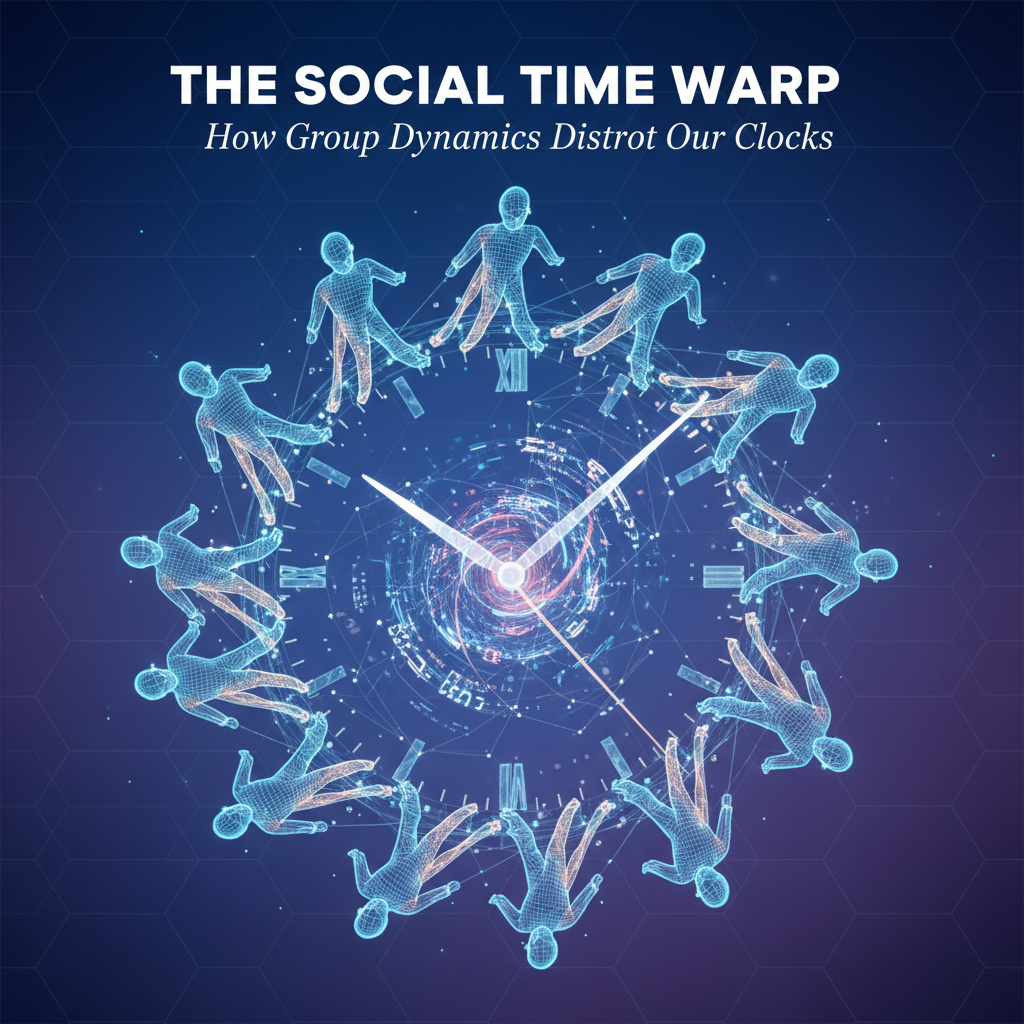
Have you ever been engrossed in a conversation with friends, only to glance at your watch and realize hours have flown by unnoticed? Or perhaps you've endured an agonizingly slow meeting, where every minute felt like an eternity, despite the clock insisting otherwise. These common experiences aren't mere coincidences; they are fascinating manifestations of the Social Time Warp, a phenomenon where our perception of time is profoundly influenced, and often distorted, by the groups we inhabit.
From the fleeting joy of shared laughter to the grinding tedium of collective boredom, our social interactions profoundly sculpt our internal chronometers. This isn't just about how we "spend" time; it's about how we experience it – how quickly or slowly it seems to pass, how clearly we remember events, and how we collectively synchronize (or fail to synchronize) our temporal rhythms. In this deep dive, we'll journey into the intricate interplay between group dynamics and our perception of time, uncovering the psychological mechanisms at play and offering practical insights into navigating these fascinating temporal distortions.
The Subjectivity of Time: A Human Constant
Before we delve into the social dimension, it's crucial to acknowledge the inherent subjectivity of time perception. Unlike the objective, measurable ticks of an atomic clock, our internal experience of time is fluid, malleable, and deeply intertwined with our emotional and cognitive states. This has been a long-standing observation in psychology. William James, in The Principles of Psychology (1890), noted that "the only time of which we have any direct experience is the present." The past is memory, the future anticipation, and both are reinterpreted and reshaped by our present state.
This subjectivity is the canvas upon which group dynamics paint their temporal distortions. While individual factors like arousal, attention, and task engagement can speed up or slow down our internal clock, the presence of others adds a new, complex layer of influence.
Collective Flow: When Time Disappears
One of the most profound ways groups warp our perception of time is through the phenomenon of "collective flow" or "group flow." This is an extension of Mihaly Csikszentmihalyi's concept of individual flow state, where one is completely immersed in an activity, experiencing energized focus, full involvement, and enjoyment. When this state is achieved collectively, time seems to vanish.
Imagine: A band improvising perfectly, each member anticipating the next note. A sports team executing a complex play flawlessly. A creative team brainstorming ideas, each suggestion building seamlessly on the last. In these moments:
- Loss of Self-Consciousness: Individuals become less aware of their separate selves and more attuned to the collective "we."
- Blurred Time Perspective: The past and future recede, and the present moment becomes all-consuming. Hours can feel like minutes.
- Effortless Action: Tasks that might seem difficult individually become almost automatic within the shared rhythm.
Research Insight: Studies on collective improvisation, whether in music, dance, or theatrical performance, often highlight the sensation of time distortion. Participants report feeling "timelessness" or "being outside of time" when the group is highly synchronized and performing at its peak. This isn't just about enjoyment; it's about the brain dedicating all its resources to the shared task, leaving little capacity for monitoring the passage of objective time. The neural correlates suggest a reduction in activity in brain regions associated with self-reflection and temporal awareness during peak flow states.
Social Monitoring and the Slowing of Time: The Meeting Effect
On the flip side of collective flow lies the dreaded "meeting effect"—the phenomenon where time drags interminably in group settings, particularly those perceived as unproductive or disengaging. This is where social monitoring plays a significant role.
When we are part of a group, especially in formal settings like meetings or lectures, we often engage in a subtle, often unconscious process of social monitoring:
- Observing Others: Are they paying attention? What are their expressions? Are they agreeing or disagreeing?
- Self-Presentation: How am I perceived? Am I contributing enough? Am I looking engaged?
- Anticipation and Waiting: Am I waiting for my turn to speak? Am I waiting for the meeting to end?
This constant background processing, coupled with a lack of meaningful engagement, diverts cognitive resources towards external and internal social cues rather than the task at hand. When a task requires minimal mental effort or is deeply uninteresting, our attention often drifts, seeking stimulation. In a group setting, this stimulation often comes from observing others or feeling the palpable energy (or lack thereof) in the room.
Why does this slow time down?
- Attention Division: Our attention is split between the (often dull) primary activity and the engaging (or anxiety-inducing) social cues. When attention is divided, events appear to unfold more slowly because our cognitive system is constantly checking in with various inputs.
- Lack of Novelty: Repetitive or uneventful social interactions, common in long, unfocused meetings, offer little novel information for our brains to process. When there's less information to encode, our perception often stretches the duration.
- Emotional Disengagement: Disinterest, boredom, or frustration act like psychological anchors, making each minute feel heavier and longer.
Social Synchrony and Rhythmic Entrainment
Human beings are inherently social and rhythmic creatures. From the swaying of a concert crowd to the synchronized movements of a dance troupe, we naturally tend to align our bodily rhythms with those around us. This "rhythmic entrainment" has profound implications for our perception of time.
When individuals in a group move, breathe, or even think in sync, there's a powerful sense of cohesion and shared experience. This can:
- Enhance Feelings of Connection: Shared rhythm fosters empathy and belonging.
- Improve Task Performance: Coordinated action, like rowing a boat or marching in step, is more efficient.
- Alter Time Perception: Research shows that engaging in synchronized activities can lead to a compressed sense of time, similar to the effects of flow. Our brains are efficient at processing predictable, rhythmic information, and this efficiency can make time seem to pass more quickly.
Example: Think about dancing at a club. When the music is good, and everyone is moving together, hours can vanish. The shared rhythm of the music and the collective movement create a powerful temporal distortion. Conversely, imagine waiting in a queue where everyone is restless and out of sync; the collective impatience amplifies the perceived slowness of time.
Shared Memory and Temporal Reconstruction
Our personal timeline is largely constructed from our memories. When we share experiences with a group, these collective memories can significantly reconstruct and even distort our perception of when events happened and how long they lasted.
- Consensus-Based Timing: If a group collectively remembers an event as having happened "just yesterday" or "ages ago," individual members might adjust their own memory to fit the group's narrative, even if it contradicts their initial personal recollection.
- Anchoring and Adjustment: A strong, shared memory of a significant group event (e.g., a challenging project deadline, a memorable trip) can serve as a temporal anchor, influencing how participants remember the duration of related events. If the project felt incredibly long to the group, an individual might also perceive it that way in retrospect, even if their personal experience wasn't as intense.
- Reminiscence Bump: While not strictly about group dynamics, this phenomenon where individuals tend to recall more events from specific periods (like adolescence and early adulthood) can be amplified in social contexts, as shared stories and communal nostalgia reinforce these temporal anchors.
The Role of Emotion and Collective Arousal
Emotions are powerful time-distorters. High arousal, whether positive (excitement, joy) or negative (fear, anxiety), can significantly impact how we perceive duration. When experienced collectively, these emotions can create a potent unified distortion.
- Collective Excitement (Time Speeds Up): At a thrilling concert, a captivating sports match, or a shared moment of triumph, the collective surge of adrenaline and positive emotion can make time fly by. The group's heightened physiological state acts as a shared accelerator for their internal clocks.
- Collective Anxiety/Threat (Time Slows or Accelerates): During moments of shared panic or crisis, time perception can be highly erratic. For some, extreme fear can slow time down to an agonizing crawl (often called "bullet time"), allowing for an intense scrutiny of details. For others, the overwhelming nature of the event might lead to memory gaps and a sense of accelerated, blurry time, as the brain tries to cope. The group's processing of the threat, whether through collective analysis or shared distress, will influence each individual's temporal experience.
Practical Takeaways: Mastering the Social Time Warp
Understanding these social time distortions isn't just an academic exercise; it offers valuable insights for improving our personal and collective temporal experiences.
- For Engaging Meetings & Events:
- Foster Flow: Design agendas that encourage active participation, relevant discussions, and clear objectives. Break tasks into smaller, manageable chunks to maintain momentum.
- Minimize Social Monitoring: Create an environment of psychological safety where individuals feel free to contribute without excessive self-consciousness. Clear roles and agendas can reduce uncertainty.
- Incorporate Rhythm: Even subtle rhythms, like consistent turn-taking or a structured Q&A, can aid in establishing a positive group cadence.
- For Enhancing Collaborative Work:
- Encourage Shared Goals: A clear, collectively understood objective is foundational for group flow. When everyone is pulling in the same direction, time distortions become more positive (i.e., time flies).
- Promote Synchronized Action: For tasks that benefit from coordination, actively seek ways to align efforts. This could be regular check-ins, joint brainstorming sessions, or shared working documents.
- Celebrate Small Wins: Positive emotional arousal, when shared, can make challenging projects feel less arduous and perceived duration shorter.
- For Navigating Waiting Times:
- Provide Distraction (Collectively): If a group is waiting, providing a shared point of interest (e.g., a screen playing relevant content, a simple game, background music) can divert attention from the clock and the collective impatience.
- Manage Expectations: Clearly communicating how long a wait might be can reduce anxiety and the feeling of time dragging, even if the wait is still long.
- Facilitate Interaction: Allowing for positive social interaction within a waiting group can transform a tedious wait into a more bearable, or even enjoyable, experience.
- For Personal Awareness:
- Mindfulness of Group Influence: When you feel time speeding up or slowing down drastically in a group, pause and consider why. Is it collective flow, collective boredom, or shared anxiety? This metacognition can help you gain a more balanced temporal perspective.
- Individual Time Management: While group dynamics are powerful, maintaining some personal time management strategies (e.g., setting internal deadlines, checking clocks periodically in long meetings) can help you stay grounded amidst the social time warp.
Conclusion: The Dance of Social Chronometry
Our internal clocks are not solitary mechanisms; they are intricately woven into the fabric of our social lives. From the exhilarating rush of collective flow, where hours dissolve into moments of shared brilliance, to the tedious crawl of an unproductive meeting, where minutes stretch into eternity, group dynamics wield immense power over our temporal perception.
Understanding the Social Time Warp allows us to appreciate the profound influence our shared human experiences have on something as fundamental as time itself. It highlights the importance of fostering positive, engaging group environments that encourage collective flow and minimize the conditions that lead to temporal drag. By consciously shaping our social interactions, we can, in a very real sense, become master conductors of our collective chronometers, ensuring that our shared time is not just spent, but truly experienced—richly, meaningfully, and sometimes, even timelessly. The next time you find yourself caught in a temporal distortion, lean in; the social clock is ticking, and its rhythm is complex, captivating, and deeply human.
Make Every Second Count
Inspired by this article? Take action now! Create a custom timer to help you manage your time better and reach your goals.
Create Your TimerAbout Dominic Mueller
Dominic Mueller is a German director for television and film with a deep fascination for time and time measurement. When he's not behind the camera crafting compelling visual stories, he explores the intricate world of temporal perception and timekeeping. Based in the beautiful city of Cologne, Germany, Dominic shares his life with his girlfriend and their beloved dog, Nala, finding inspiration in both the precise mechanics of time and the fleeting moments that make life meaningful.