The Paradox of Retrospective Timelines: Why Memories Deceive Our Past
 Dominic Mueller
The Paradox of Retrospective Timelines: Why Memories Deceive Our Past
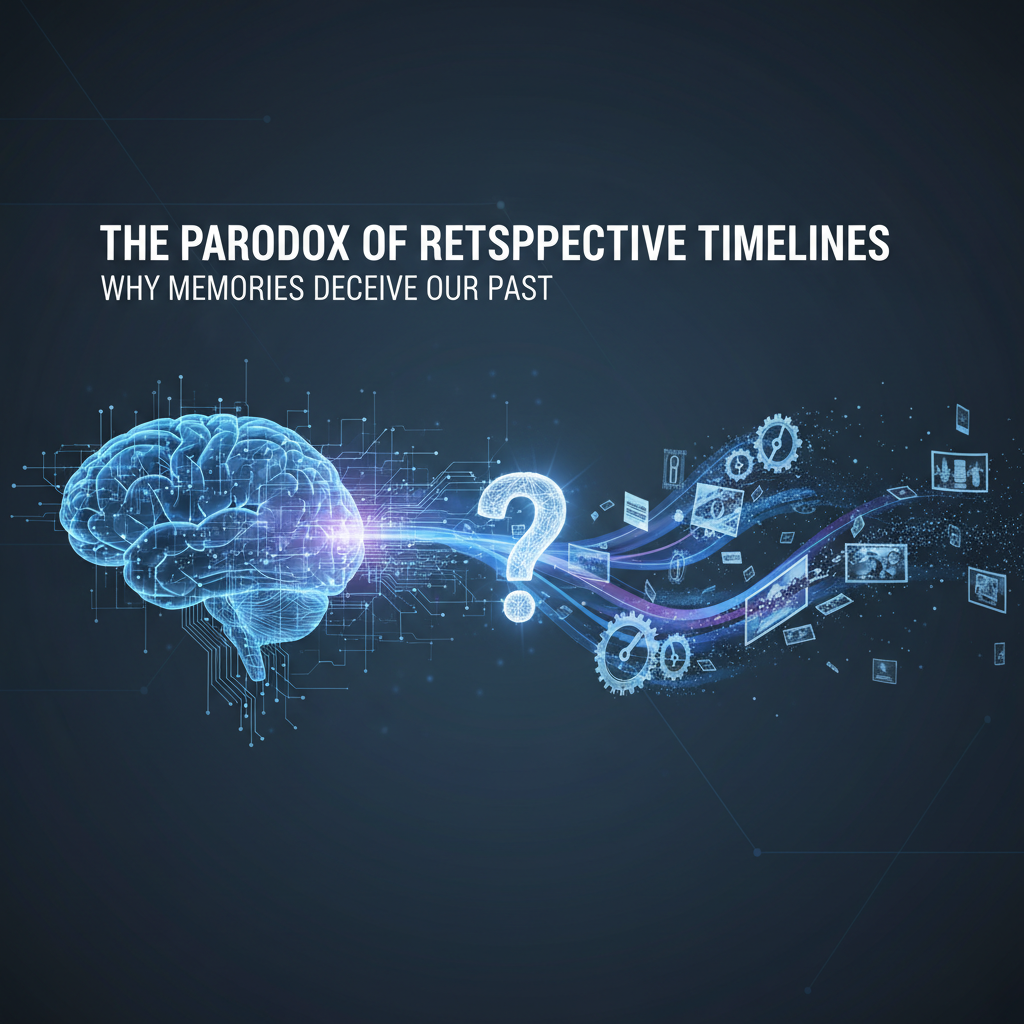
Tick-tock, tick-tock goes the clock of our lives, relentlessly pushing us forward. Yet, when we cast our gaze backward, our minds don't always rewind with perfect fidelity. We remember, we recall, we reconstruct, but the timeline we build in our heads often bears little resemblance to the objective sequence of events. This is the fascinating and often unsettling paradox of retrospective timelines: the curious way our memories manipulate, distort, and even invent our past.
As a species, our ability to remember is both a blessing and a curse. It allows us to learn, to grow, to build narratives of who we are. But beneath the surface of this seemingly reliable faculty lies a complex and dynamic system, one that's far more susceptible to influence and deception than we often realize. In this article, we'll delve into the intricate mechanisms that contribute to these temporal distortions, explore the psychological research behind them, and offer insights into understanding – and perhaps even navigating – the often-unreliable landscape of our personal histories.
The Architect of Our Past: Memory as Reconstruction, Not Playback
Forget the idea of memory as a dusty old video recorder, faithfully preserving every moment. Modern neuroscience and psychology have unequivocally demonstrated that memory is a reconstructive process. Every time we access a memory, we don't simply "play it back." Instead, we actively rebuild it, drawing on fragmented pieces of information, current knowledge, beliefs, and even our emotional state at the moment of recall.
Think of it like this: your past is a sprawling, chaotic library. When you want to "remember" an event, your brain doesn't pull out a pristine, pre-recorded book. Instead, it sends out a librarian (your current cognitive state) to gather various fragments – a dog-eared photograph, a snippet of an old conversation, a feeling of warmth, a smell – and then weaves them into a coherent narrative. The librarian might fill in gaps, reorder chapters, or even invent details to make the story flow better. This active reconstruction is the foundational principle behind why our retrospective timelines are so malleable.
The Power of Schema and Expectation
One of the most significant forces shaping our retrospective timelines is the influence of schemas. These are mental frameworks or blueprints that help us organize and interpret information. We have schemas for almost everything: what a typical birthday party looks like, how a job interview should proceed, the sequence of events in a commute.
When we recall an event, our brains often use these schemas as a template. If a particular event deviates from our expected schema, our memory might unconsciously normalize it, aligning it more closely with what we anticipate. For example, if you remember a particularly chaotic flight, your memory might subconsciously smooth out the timeline, omitting small, unremarkable delays because your schema for "a flight" typically involves a more predictable sequence of boarding, take-off, and landing.
Research by cognitive psychologists like Frederic Bartlett in the early 20th century highlighted this phenomenon. In his famous "War of the Ghosts" experiment, participants recalled a Native American folk tale, but their retellings consistently omitted or altered elements that didn't fit their Western cultural schemas, streamlining the narrative and making it more conventional.
The Slippery Slope of Source Monitoring Errors
One of the most insidious ways our memories deceive us regarding timelines is through source monitoring errors. This refers to our difficulty in remembering where or how we acquired a particular piece of information. Did I experience that event myself, or did someone tell me about it? Did I see it on TV, or did it happen in real life? The confusion can be profound and have significant implications for our personal timelines.
Consider the classic example of childhood memories. How many "memories" do we truly possess from our early years, and how many are vivid narratives constructed from family stories, old photographs, or even dreams? We might recount a detailed story of a playground incident, complete with dialogue and emotional nuances, only to later discover it was a tale told by an older sibling. Our brains, eager to fill in the gaps and create a coherent personal history, often attribute these external sources to our own direct experience.
The Misinformation Effect and False Memories
The vulnerability of source monitoring is powerfully demonstrated by the misinformation effect. Pioneered by Elizabeth Loftus, this research shows how exposure to misleading information after an event can subtly, yet significantly, alter our memories of that event. If you witness a car accident and are later asked about the "speed of the cars when they smashed into each other" versus when they "contacted" each other, your recollection of the speed will likely be higher in the former case.
While not strictly a timeline distortion, the misinformation effect can subtly shift the temporal framing of an event, altering the perceived duration or intensity, thereby impacting its position within our broader personal timeline. In more extreme cases, the brain can even construct entirely false memories, convincing individuals they experienced events that never actually happened. This is particularly relevant when external cues, suggestive questioning, or vivid imagination coalesce to create a compelling, yet entirely fabricated, past.
The Emotional Tide: How Feelings Reshape Our Past
Our emotions are not just a reaction to events; they are active participants in shaping our memories and, consequently, our retrospective timelines. The emotional valence of an event – whether it was positive, negative, or neutral – can profoundly influence how we remember its sequence and duration.
Peak-End Rule and Duration Distortion
Nobel laureate Daniel Kahneman's work on the peak-end rule demonstrates how our overall evaluation of an experience is often determined by the intensity of its peak emotional moment and how it ends, rather than the sum of all moments. This also impacts our perception of time. A painful medical procedure that has a less painful ending might be remembered as shorter or less unpleasant than one with a lingering, uncomfortable conclusion, even if the objective duration was the same.
Similarly, emotionally charged events, particularly traumatic ones, can lead to significant duration distortion. Time can feel like it slows down during moments of intense fear or danger, a phenomenon often described as temporal expansion. Conversely, deeply enjoyable or absorbing experiences can make time seem to fly by, leading to temporal compression. When we look back, these subjective distortions in perceived duration contribute to a timeline that doesn't accurately reflect objective clock time.
Rosy Retrospection and The Good Old Days
Have you ever looked back on a challenging period of your life, like a particularly tough university semester or a demanding job, and remembered it with a surprising fondness? This is often due to rosy retrospection, the psychological phenomenon where we tend to remember past events more positively than they were experienced at the time. The negative aspects fade, while the positive ones are amplified.
This emotional filtering naturally impacts our retrospective timelines. Difficult periods, once fraught with stress and anxiety, might be remembered as "character-building" or "simpler times," with their temporal intensity diluted. This mental reframing can smooth out the bumps and rough edges of our personal history, creating a more palatable, albeit less accurate, narrative. It's why "the good old days" often seem so good – our memories have, quite literally, airbrushed the less pleasant details.
The Narrative Imperative: Crafting Coherent Stories
Humans are innate storytellers. We crave coherence, meaning, and a sense of progression. Our brains are constantly working to weave the disparate threads of our lives into a unified and understandable narrative. This narrative imperative is a powerful driver behind the distortions in our retrospective timelines.
To create a compelling story of ourselves, our memories often engage in a process of selection and omission. Events that don't fit the chosen narrative might be downplayed, forgotten, or even subtly altered to align with the overarching plot. For example, if you view your career as a steady upward trajectory, you might emphasize successes and downplay setbacks, making them seem like minor detours rather than significant obstacles.
Hindsight Bias: The "I Knew It All Along" Phenomenon
One of the most common narrative-driven distortions is hindsight bias, often called the "I-knew-it-all-along" effect. After an event has occurred, we tend to overestimate our ability to have predicted it. This isn't just about believing we should have known; it's about genuinely feeling that we did know, even if there was no evidence beforehand.
In terms of timelines, hindsight bias can subtly alter the perceived sequence and inevitability of events. Decisions that were once fraught with uncertainty might be recalled as obvious and straightforward. Moments of confusion or indecision might be forgotten, creating a retrospective timeline where our actions appear more logical and our foresight more acute than they truly were.
Practical Takeaways: Navigating the Deceptive Past
Understanding the paradox of retrospective timelines isn't about despairing over the unreliability of our minds. Instead, it's about gaining a deeper appreciation for the complex, dynamic nature of human memory and developing strategies to better understand our own pasts.
- Embrace the Imperfection of Memory: Recognize that your memories are not objective recordings but rather subjective reconstructions. This awareness can foster greater empathy for others' differing recollections of shared events.
- Triangulate Your Past: Whenever possible, verify significant memories with external sources. Look at old photographs, diaries, letters, or talk to others who were present. This "triangulation" can help anchor your memories closer to objective reality.
- Be Wary of Suggestion: Whether from others or self-generated, be mindful of how new information or interpretations can subtly alter your existing memories. The more you revisit a memory, the more susceptible it becomes to reconstruction.
- Journaling as a Time Anchor: Keeping a diary or journal is an excellent way to create a more objective record of events, thoughts, and feelings as they happen. This real-time documentation serves as a valuable counterpoint to the reconstructive nature of memory when you look back.
- Focus on the Lessons, Not Just the Details: While factual accuracy is important, sometimes the "truth" of a memory lies in the lessons learned or the emotional impact it had. Instead of agonizing over every detail, consider what the memory means to you now.
- Understand Your Biases: Reflect on your personal narrative. Do you tend to romanticize the past? Do you minimize failures? Recognizing your own cognitive biases can help you approach your memories with a more critical and informed perspective.
Conclusion: The Unfolding Story of Self
The paradox of retrospective timelines reveals a profound truth about human existence: our past is not a fixed, immutable entity, but an ever-evolving narrative shaped by our present self. Our memories, while imperfect, serve a vital function. They don't just record what happened; they help us make sense of who we are, build our identity, and chart a course for the future.
While the brain's tendency to deceive our past can sometimes be frustrating, it also highlights the incredible adaptability and creativity of the human mind. Each time we remember, we're not just recalling; we're actively participating in the ongoing construction of our personal story. By understanding the mechanisms behind these temporal distortions, we can approach our own histories with a blend of curiosity, skepticism, and ultimately, a deeper appreciation for the unfolding and subjective masterpiece that is our life story. So, the next time you reflect on your past, remember: the clock might tick steadily forward, but your memory dances to a rhythm all its own.
Make Every Second Count
Inspired by this article? Take action now! Create a custom timer to help you manage your time better and reach your goals.
Create Your TimerAbout Dominic Mueller
Dominic Mueller is a German director for television and film with a deep fascination for time and time measurement. When he's not behind the camera crafting compelling visual stories, he explores the intricate world of temporal perception and timekeeping. Based in the beautiful city of Cologne, Germany, Dominic shares his life with his girlfriend and their beloved dog, Nala, finding inspiration in both the precise mechanics of time and the fleeting moments that make life meaningful.