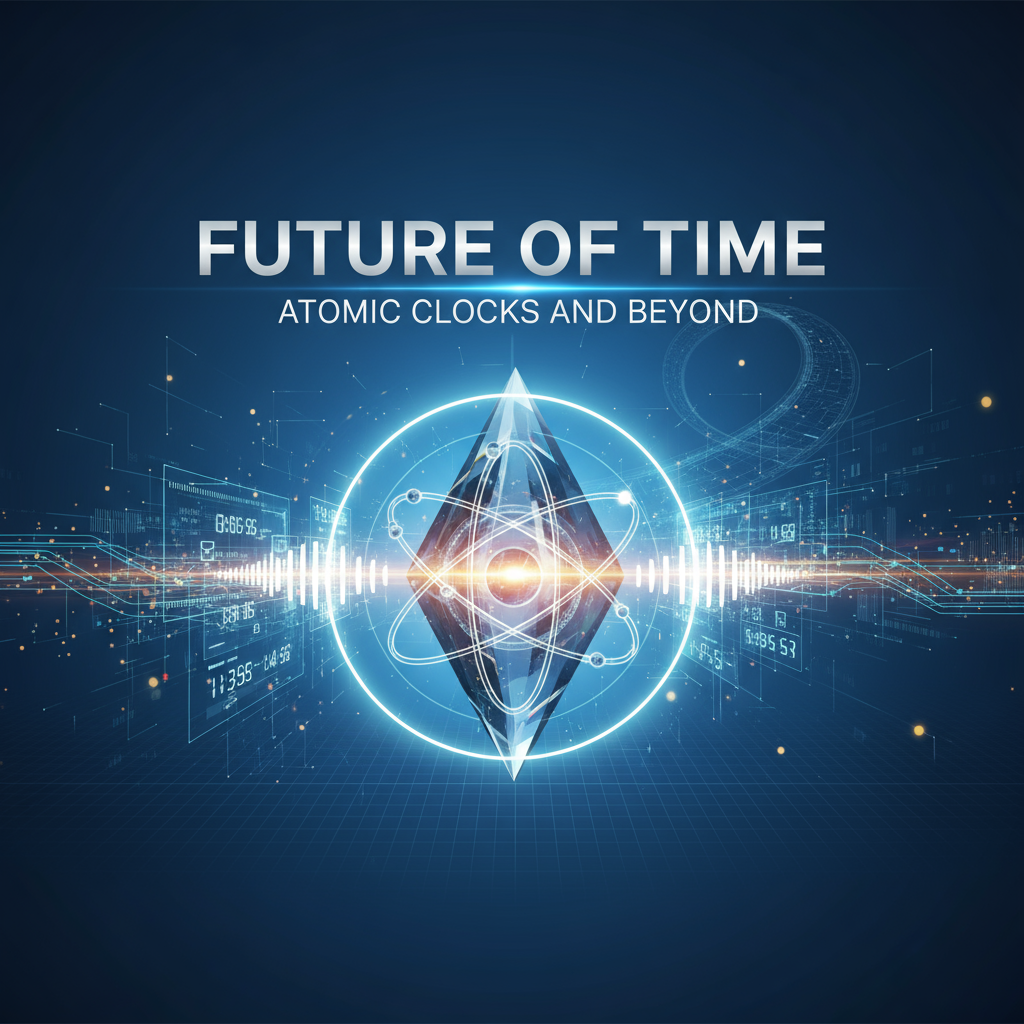
Future of Time: Atomic Clocks and Beyond
 Dominic Mueller
The Future of Time: Atomic Clocks and Beyond
Time, an enigmatic force that governs our existence, has always fascinated humanity. From the rhythmic dance of celestial bodies to the ticking precision of atomic clocks, our understanding and measurement of time have evolved dramatically. But what does the future hold for this fundamental dimension? As we hurtle into an era of unprecedented technological advancement, the very fabric of time itself is being scrutinized, refined, and even reimagined. This article delves into the cutting-edge world of atomic clocks and explores how these remarkably precise instruments are not just measuring time, but actively shaping its future, impacting everything from global navigation to our understanding of the universe.
The Unseen Architect of Modern Life: How Atomic Clocks Became Indispensable
Before we peer into the future, let's appreciate the profound impact of atomic clocks on our present. For millennia, humanity relied on sundials, water clocks, and ultimately pendulum clocks. While groundbreaking for their eras, their accuracy paled in comparison to the demands of the nascent information age. The advent of the atomic clock in the mid-20th century marked a paradigm shift.
- What is an Atomic Clock? At its core, an atomic clock doesn't "tick" in the traditional sense. Instead, it measures time by observing the precise resonant frequency of electromagnetic radiation absorbed or emitted by atoms. Imagine an atom as a miniature, perfectly calibrated pendulum, vibrating at an incredibly stable frequency. The world's first atomic clock, built by Louis Essen and Jack Parry in 1955 at the National Physical Laboratory in the UK, used caesium-133 atoms.
- Cesium: The Gold Standard (for now). Caesium-133 atoms are particularly well-suited for this task because their outermost electron can transition between two specific energy levels when exposed to microwave radiation of a very precise frequency (9,192,631,770 Hz, to be exact). This transition acts as the "tick" of the atomic clock, defining the SI second with astonishing accuracy.
The implications of this newfound precision were immediate and far-reaching:
- Global Positioning Systems (GPS): Without atomic clocks, GPS would be impossible. Each satellite in the GPS constellation carries several atomic clocks. Their synchronized time signals are crucial for triangulating your precise location on Earth. A drift of even a nanosecond can mean an error of 30 centimeters in your position.
- Internet and Communication Networks: The seamless flow of data across vast networks relies on perfectly synchronized timing. Atomic clocks ensure that packets of information arrive in the correct order and at the right time, preventing chaos and ensuring reliable communication.
- Financial Transactions: High-frequency trading and other financial operations demand extremely precise timestamps to ensure fairness and prevent fraud.
- Scientific Research: From radio astronomy to fundamental physics experiments, atomic clocks provide the bedrock for many scientific endeavors requiring exquisite temporal resolution.
While remarkable, even the best cesium fountain atomic clocks, the current international standard, have a natural error rate. They can drift by about one second in 100 million years. Impressive, but the quest for even greater precision continues relentlessly.
The Next Frontier: Optical Atomic Clocks – Redefining Precision
Enter the next generation: optical atomic clocks. These revolutionary devices exploit an even higher frequency transition in atoms, typically in the visible or infrared spectrum.
- Why Optical is Better: The higher the frequency of the "tick," the more individual "ticks" can be counted within a given time interval. This translates directly into greater precision. Imagine trying to measure a sprint race with a clock that ticks once per second versus one that ticks a million times per second. The latter will give you a far more accurate result. Optical clocks operate at frequencies thousands of times higher than microwave clocks.
- Trapped Ions and Strontium Atoms: Current leading optical clock designs often utilize single trapped ions (like Ytterbium or Aluminum) or arrays of neutral atoms (like Strontium) electromagnetically suspended in a vacuum. Lasers are then used to manipulate and interrogate these atoms, observing their quantum transitions.
- Mind-Blowing Accuracy: The most advanced optical atomic clocks can achieve an accuracy such that they would lose or gain only one second in billions of years, surpassing even the age of the universe! This incredible precision opens up a whole new realm of possibilities.
Beyond Telling Time: Unlocking New Scientific Avenues
The improved precision of optical atomic clocks isn't just about showing the "right" time; it's about using time as an ultra-sensitive sensor for fundamental physics and practical applications.
1. Relativistic Geodesy: Measuring the Earth's Shape with Time
Einstein's theory of general relativity famously predicts that gravity affects time. Clocks tick slower in stronger gravitational fields. This effect, though incredibly subtle on Earth, can now be measured by optical atomic clocks.
- Gravitational Redshift in Action: If you place an optical clock at sea level and another atop a mountain, the mountain clock, being in a slightly weaker gravitational field, will tick infinitesimally faster. This difference, though incredibly small (a few parts in $10^{18}$ for a meter of height difference), is now detectable.
- Mapping the Geoid: This allows for "relativistic geodesy," a new way to measure differences in gravitational potential, effectively mapping the Earth's geoid (the irregular shape of the Earth based on gravity) with unprecedented accuracy. This has implications for understanding sea level rise, atmospheric pressure systems, and even tectonic plate movements.
2. Dark Matter Detection: Listening for the Universe's Whisper
One of the most profound mysteries in cosmology is dark matter, the invisible substance that makes up about 27% of the universe. While we can't see it, its gravitational effects are undeniable. Optical atomic clocks might provide a novel way to detect it.
- Searching for "Wobbles": Some theoretical models suggest that dark matter particles might interact very weakly with ordinary matter, causing subtle, transient fluctuations in the fundamental constants of nature (like the fine-structure constant or the proton-to-electron mass ratio). These fluctuations would cause atoms in an atomic clock to "wobble" in their ticking frequency.
- The Global Clock Network: By networking multiple ultra-precise optical clocks across vast distances, scientists could look for synchronized "wobbles" that would be indicative of a dark matter wave passing through. This distributed network acts like a giant dark matter detector.
3. Redefining the Second: A Quantum Leap
Currently, the international standard for the second is defined by the microwave transition of cesium-133. However, with optical clocks vastly outperforming cesium clocks, there's a strong push to redefine the second based on an optical transition.
- Benefits of a New Standard: A redefinition would mean an even more stable and accurate time standard, propagating the benefits of optical precision through all aspects of science and technology. It would also lead to even more accurate measurements of fundamental constants and tests of physical laws.
- The Road Ahead: The international scientific community is carefully evaluating candidates for this new definition, likely involving an internationally coordinated ensemble of optical clocks, perhaps within the next decade.
4. Quantum Computing and Communication: The Intimate Link with Time
The emerging fields of quantum computing and quantum communication are inherently entwined with precise timing.
- Coherence and Entanglement: Quantum bits (qubits) rely on maintaining their "quantum state" (coherence) for as long as possible. The delicate processes of entangling qubits and performing quantum operations require exquisite timing to control laser pulses and microwave signals.
- Secure Communication: Quantum key distribution (QKD), which leverages quantum mechanics for ultra-secure communication, often involves time-stamping individual photons with nanosecond precision to ensure their authenticity and detect eavesdropping.
Practical Takeaways and Insights for a Time-Conscious World
While the science behind atomic clocks might seem abstract, their future implications resonate deeply with our daily lives and productivity.
- Enhanced Navigation and Automation: Imagine self-driving cars navigating with centimeter-level precision even without continuous network connectivity, or drones conducting intricate autonomous inspections with unparalleled accuracy. Better timekeeping fuels better automation.
- More Robust and Secure Networks: As our digital lives become ever more central, the underlying infrastructure needs to be more resilient. Ultra-precise timing makes networks faster, more reliable, and more secure, reducing latency and vulnerability.
- New Medical Technologies: Precision timing can impact areas like medical imaging (e.g., fMRI) and radiation therapy, allowing for more precise targeting and clearer diagnostic images.
- Fundamental Discoveries Leading to Unforeseen Applications: History teaches us that pushing the boundaries of fundamental science often leads to practical applications we couldn't have imagined at the outset. The quest for ultra-precise time might unveil new physics that revolutionizes energy production, materials science, or even our understanding of consciousness.
- The Value of Precision in Details: The journey of atomic clocks highlights the importance of precision in all endeavors. Even seemingly insignificant improvements in measurement can unlock profound insights and transform entire fields. For personal productivity, this translates to the value of meticulous planning, accurate tracking, and focused execution – every "nanosecond" of effort can add up.
The Horizon: Even Crazier Ideas
The relentless pursuit of temporal precision doesn't stop with current optical clocks. Researchers are already exploring:
- Nuclear Clocks: These clocks would use transitions within the nucleus of an atom (specifically Thorium-229m) rather than electron transitions. Nuclear transitions are orders of magnitude higher in frequency, potentially offering even greater stability and resilience to external perturbations. However, they are incredibly difficult to manipulate and observe.
- Clock Networks in Space: Placing atomic clocks in orbit or on other celestial bodies could enable new forms of navigation, scientific measurements, and even tests of general relativity on larger scales. Imagine a cosmic GPS!
- Relativity on a Chip: Miniaturizing optical atomic clocks to chip-scale devices would revolutionize their accessibility and integration into everyday technology, making ultra-precise timing ubiquitous.
Conclusion: Time's Unfolding Story
From the ancient sun dials to the sophisticated optical atomic clocks of today, humanity's quest to understand and measure time has been a continuous journey of innovation. The future of time is not just about counting seconds more accurately; it's about harnessing that accuracy to perceive the universe anew, to push the boundaries of technology, and to unlock secrets previously hidden in the subtle dance of quantum mechanics and general relativity.
As we move forward, the "tick-tock" of these extraordinary instruments will continue to orchestrate our technological progress, enhance our scientific understanding, and perhaps even offer us glimpses into the very nature of existence. The future of time is not a fixed destination, but an ever-expanding horizon of possibilities, meticulously measured and brilliantly illuminated by the unwavering precision of atomic clocks and the ingenious minds that craft them.
Make Every Second Count
Inspired by this article? Take action now! Create a custom timer to help you manage your time better and reach your goals.
Create Your TimerAbout Dominic Mueller
Dominic Mueller is a German director for television and film with a deep fascination for time and time measurement. When he's not behind the camera crafting compelling visual stories, he explores the intricate world of temporal perception and timekeeping. Based in the beautiful city of Cologne, Germany, Dominic shares his life with his girlfriend and their beloved dog, Nala, finding inspiration in both the precise mechanics of time and the fleeting moments that make life meaningful.